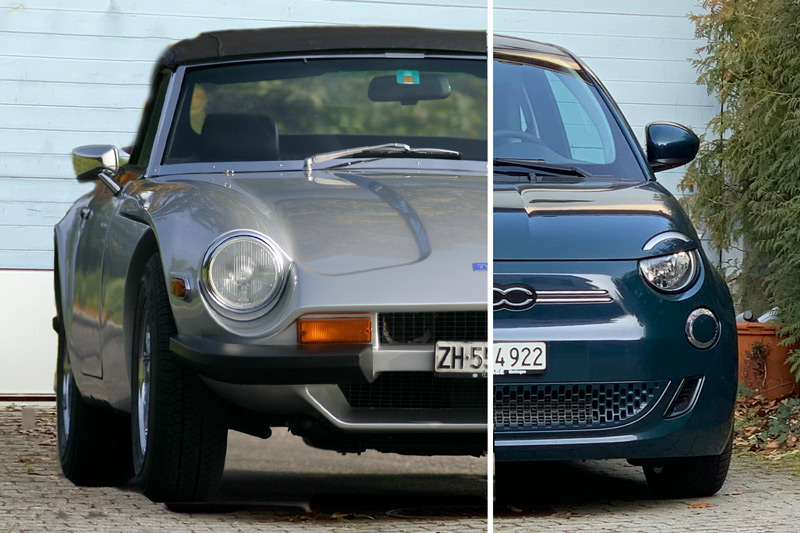
A little older or younger? A comparison of two Jaguar convertibles...

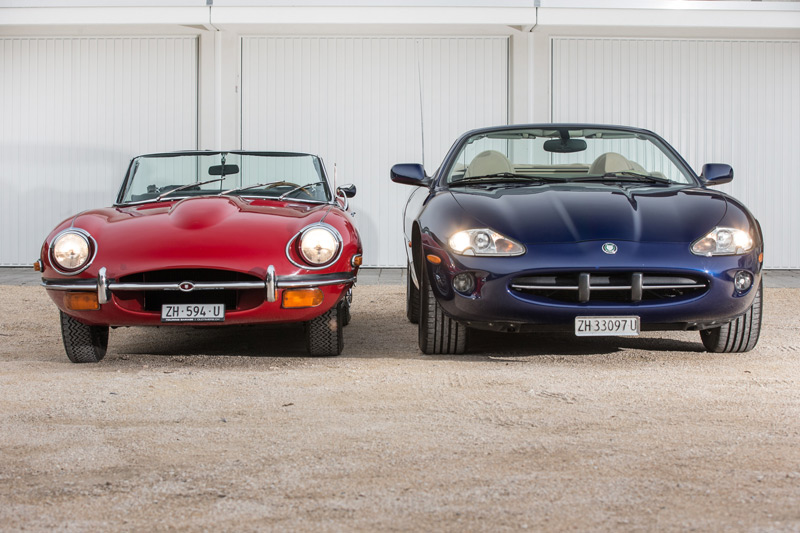
The Jaguar E-Type is one of the automotive icons of the 20th century and there is almost no way around it. Whether at rally events, meetings, in museums or at the Concours d'Elégance, sooner or later a Jaguar E-Type will make an appearance. The models from the first series, built until 1968, are particularly popular, and the twelve-cylinder models from the third generation from 1971 onwards also have a large fan base. Somehow, the convertibles and coupés of the second series were caught between the fronts, as they already had to adapt to American tastes and safety requirements, but had to live with the exhaust-optimized in-line six-cylinder and dwindling horsepower under the hood. According to the technical data, however, there were still 269 SAE horsepower available, enough power for a vehicle weighing just over 1.2 tons, one would think.
And so it is when you sit behind the wheel of a well-maintained second-series Jaguar. There is no lack of temperament, the propulsion is definitely sporty and more than sufficient for country road speeds. And you can also hear a lot of the beautiful straight-six sound when you drive along open-top.
Unfortunately, even series 2 convertibles are not really cheap; you can hardly get a good one for less than EUR 50,000 or CHF 70,000, and the prices are usually at least 20 grand higher. And then you're buying a car that is around 50 years old and can keep up in modern traffic, but only likes traffic jams and heat waves to a limited extent. The roof over your head doesn't seem like a good solution for the next winter either.
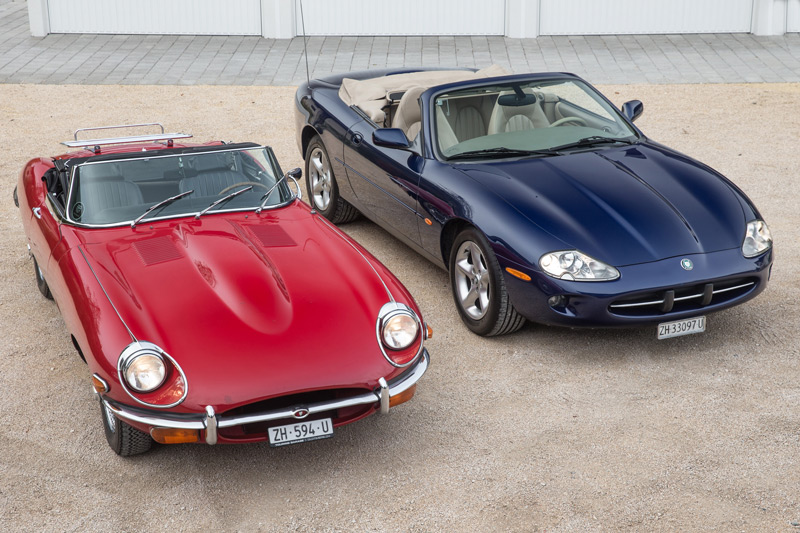
You might even think about buying a newer Jaguar model, especially as they are much cheaper.
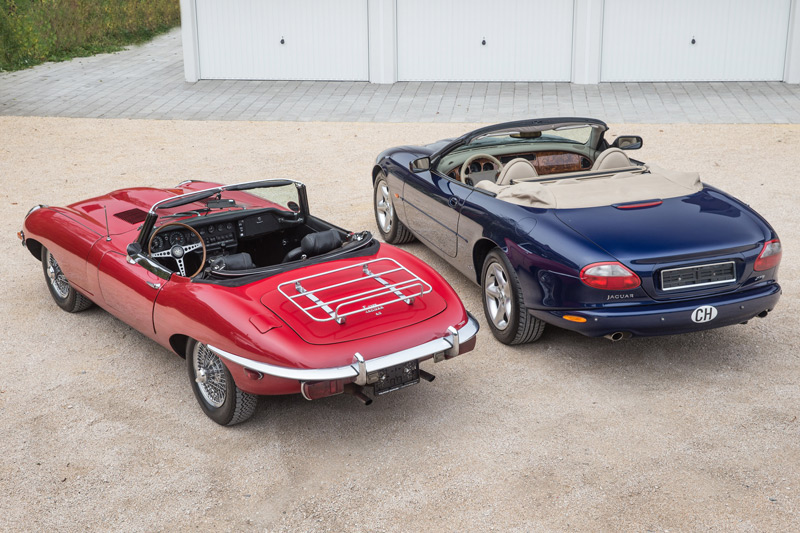
An alternative to the E-Type is the youngtimer XK8, which is much closer in design language to the 1960s cat than the XJS, which existed in between and was born as a coupé and only opened up later.
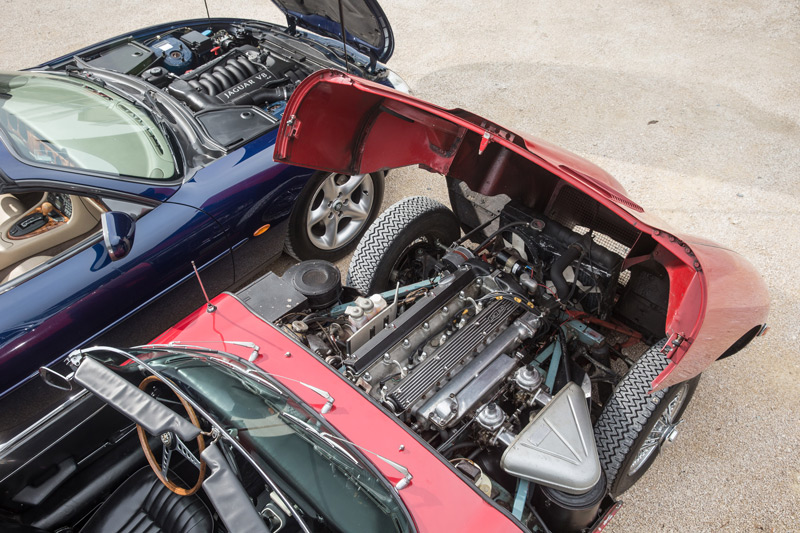
The XK8 was unveiled in Geneva in 1996, with the last examples going to their first owners around ten years later. The designation "XK8" correctly indicates an eight-cylinder engine. The V8 light-alloy engine produces 284 DIN horsepower and weighs just 200 kg. However, it is around 20 centimeters longer and 15 centimeters wider than the straight-six in the E-Type. And at over 1.7 tons, the weight has also increased significantly. Nevertheless, the XK8 still outruns the E-Type in (almost) every situation and even the most inept driver can manage fast lane changes thanks to the five-speed automatic transmission.
The Jaguar XK8 is a genuine luxury convertible, as evidenced by the new price at the time, which was around five times that of the E-Type. Lots of wood, beautifully finished leather, a lined roof with heated rear window and, of course, an air conditioning system as well as many comfort electric motors make traveling in the XK8 an effortless affair. No wonder, after all, the Jaguar was designed to compete with the SL versions from Mercedes-Benz.
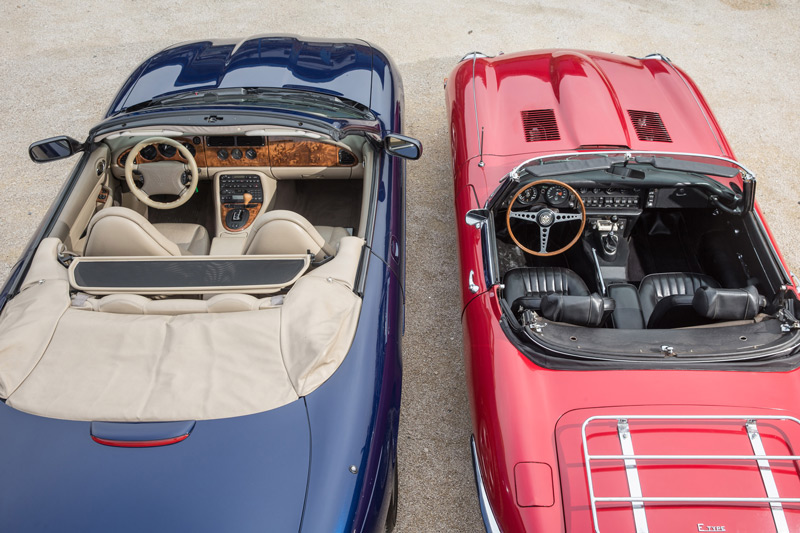
There is not much to do while driving, the automatic takes care of the gear changes, the rest is routine. You hear almost too little of the engine, it is so restrained in its vocalizations. On the other hand, you can purr almost silently through the neighborhood early in the morning without making a fuss. Children can also be taken along, but the rear seats are probably more suitable as additional luggage capacity. The tarpaulin, which is stretched by hand over the fully electrically opened roof in the old-fashioned way, is probably a reminiscence of the past.
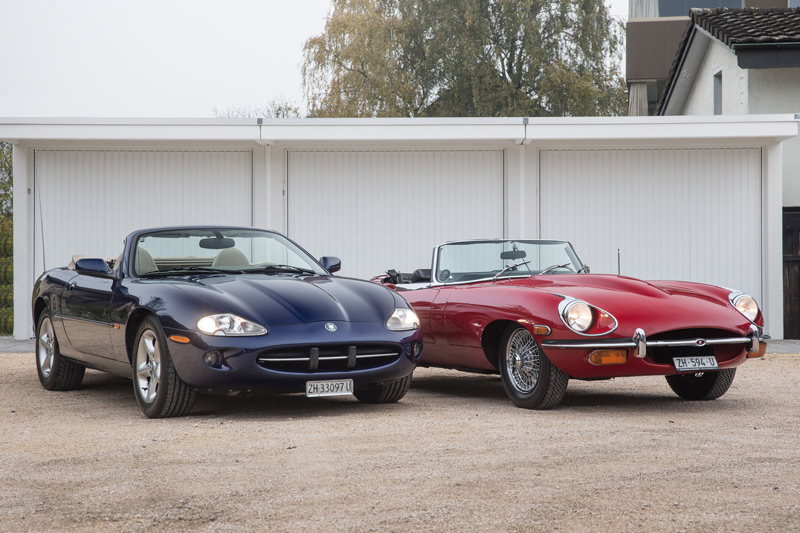
The differences between the E-Type and the XK8 are enormous, and you can immediately feel the progress of 30 years of further development. You drive an E-Type, force it where you want to go with muscle power, feel the technology with every movement. In the XK8, you drive more, let the electronics and electrics do their work, enjoy the almost unlimited comfort.
Despite their shared tradition, the two cannot really be compared. That leaves the price as an argument. Even a very good XK8 costs barely a fifth of the Series 2 Jaguar, which is actually inexpensive by E-Type standards. Bargains are already available for four-figure sums and do not necessarily have to develop into a financial maintenance mess (although this is not impossible). You might be tempted, especially as you could entrust your XK8 to your mother-in-law, which you might not do with the E-Type.
So let's take another look at the technical data in comparison:
| Make/Model | Jaguar E-Type S2 Conv. | Jaguar XK8 Convertible |
|---|---|---|
| Engine type | Inline-6 | V8 |
| Displacement (cm3) | 4235 | 3996 |
| Power (PS) | 269 | 284 |
| at rpm | 5400 | 6100 |
| Gearbox | 4-speed (manual) | 5-speed automatic (ZF) |
| Weight (kg) | 1265 | 1784 |
| Length (cm) | 445 | 476 |
| Width (cm) | 166 | 182.9 |
| Height (cm) | 122 | 130.6 |
| Tire dimension | 185/(80)/15 | 245/50/17 |
| Vmax (km/h) | 240 | 248 |
| 0-100 km/h (s) | 7.2 | 7.6 |
| Price (CHF) | 26'200 | 128'800 |
| Price (DM) | 27'195 | 142'600 |
| Value today (CHF) | 60'000 to 120'000 | 9000 to 28'000 |
| Value today (EUR) | 55,000 to 110,000 | 8000 to 25'000 |
There are plus points to be reported for both Jaguar generations, but hardly anyone will have to choose between an e-Type and an XK8, they are so different. Maybe you should buy both?
P.S. We will soon be publishing comprehensive and detailed reports on both models. Until then, however, there are already many articles to read on the Jaguar brand pages.