Depreciation of new cars then and now - a paradox?


They say that cars have improved significantly over the last 40 years. This should actually be reflected in better value retention. But it doesn't. On the contrary!
Eurotax ( via the NZZ) recently published lists of the most stable passenger cars in 2019. In the "City" category, the Dacia Sandero has a resale value of around 65.3% after three years, the Ford Fiesta still has around 51.1% and the VW Up 49.9%.
Among company cars, the Skoda Octavia performed best with 54.2%, while the BMW 3-series came in 10th place with 42.5%.
And the ever-popular SUVs actually performed slightly better. After three years, a Dacia Duster is available for around 66.7% of its new value, while a Mercedes-Benz GLE comes in at around 56.6%.
Let's look back almost 40 years, as ADAC Motorwelt published a similar analysis back then.
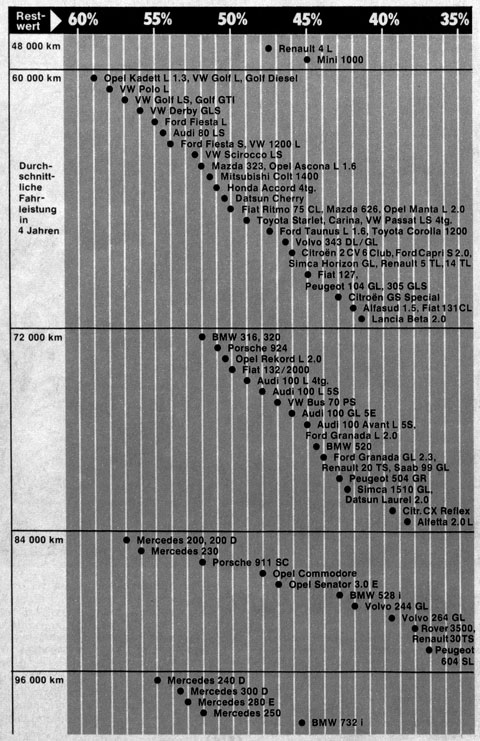
Back then, the most valuable cars also scored in the region of 50 to 60%. However, the ADAC used a time horizon of four rather than three years. In 1980, an Opel Kadett L or VW Golf Diesel was still worth 59% of the new price after four years of use and 60,000 km of mileage! A Mercedes-Benz 230 still brought 57% after four years and 84,000 km, and a BMW 320 still 52% after four years and 72,000 km. Even the Alfasud 1.5 from 1976, known for its rust-friendliness, was still worth 42% of the new price in 1980 with 60,000 km on the clock.
The higher production quality, better materials and more sophisticated engineering of the modern era therefore do not lead to the expected higher value retention. This is astonishing, as modern cars certainly last much longer in everyday use. Rust is much less of an issue than in 1976 or 1980 and the technology also lasts longer. What has become significantly more expensive, however, are the repairs. Once the warranty has expired, even simple mishaps can quickly result in bills that exceed the residual value of the car. This in turn is likely to have a direct impact on used car prices. Ever stricter emissions standards and their impact on the freedom to drive in cities and municipalities are also likely to have an influence.
But perhaps our readers know of other reasons for this apparent paradox?