One goal, two paths, one name - Fiat Multipla

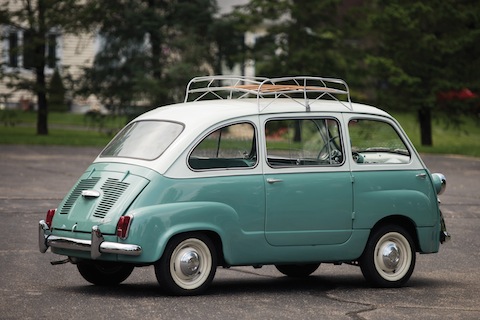
60 years ago, when the Fiat 600 was presented, cars were much smaller than they are today. However, this does not mean that there were not people with a desire for more space and size.
For example, Fiat offered the four- to five-seater Fiat 600 alongside the Fiat 600 Multipla with six seats in three rows (or two rows of seats and more luggage space). The small space giant could be used in a variety of ways, hence the name "Multipla".
Larger inside than outside
For maximum use of space, the front-wheel drive design was used and the majority of the five square meters of floor space (a modern Mini has 6.23 square meters, by the way) was allocated to the six passengers.

The entire vehicle weighed only 700 kg and a further 400 kg could be loaded.

Independent wheel suspension was fitted all round and the water-cooled four-cylinder engine with 633 cm3 produced just over 20 hp. This was enough for a top speed of 101 km/h and a fuel consumption of around six liters per 100 km.
Heating at extra cost
The Fiat 600 Multipla cost 6300 francs in Switzerland and 4990 DM in Germany, although the heating cost 180 DM extra. But with six people on board, it was probably warm even without this accessory.
The car was loved and 129,994 units were produced between 1956 and 1965. Cab drivers, DIY enthusiasts and large families enjoyed using the little big car a lot. And if the car was too slow for you, you could buy tuning kits from Carlo Abarth, which took the minibus to 38 hp and well over 120 km/h top speed.
Multipla for the second time
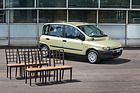
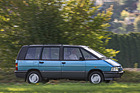
Then there was a break ... until another Fiat Mulitipla made the world happy in 1999, now with a front engine and powered front wheels. The name had been retained, as had the idea of offering plenty of space in a small footprint.

The Mulitpla for the new millennium also had six seats, but this time they were arranged in two rows instead of three. And this made the new Multipla a children's favorite, because now there was this additional attractive middle seat at the front, directly between mom and dad.

The new Multipla, built between 1999 and 2010, focused entirely on the "woman" card. Huge glass surfaces created a clear view and made parking easier. At 4.1 meters, the car was short enough to master most parking spaces. Only the width of the six seats required compromises, because at 1.9 meters, the car was very full. But on the other hand, it was brimming with ideas with practical benefits.
Unusual appearance
However, it was the design that polarized most, because the almost vertical side walls, the huge glass surfaces, the wheels positioned far to the outside and, above all, the front, which had an additional sheet metal bulge below the windscreen and built-in lights for an unusual look, made the car unmistakable, but not necessarily beautiful.

In 2004, the appearance was brought into line with the rest of the Fiat range, which made the car a little less quirky, but also much more ordinary.
Art?
The original version from 1999 made it into the New York Museum of Modern Art, if that wasn't an honor.
Technically, the Multipla was in line with the trends of the time, but it was available with three different drive concepts, namely with front-mounted petrol, diesel and natural gas engines and 90 to 120 hp. The British loved it because of its agile handling, but the special Italian was less well received in other markets, despite the flexibility offered by the seating system.
Increase in value
At auctions today (the next opportunity will be in Hershey on October 9, 2015 , when RM will bring the Multipla pictured here under the hammer), Fiat 600 Multipla cars are already fetching prices five to ten times higher than their original purchase value. It remains to be seen whether the successor to the new millennium will be able to do the same.