Is this still a classic? Jaguar 300 SL or Mercedes C-Type ...
Hawker Racing, an English specialist in car and aircraft restoration, has recently started offering a Jaguar C-Type Coupé with gullwing doors:
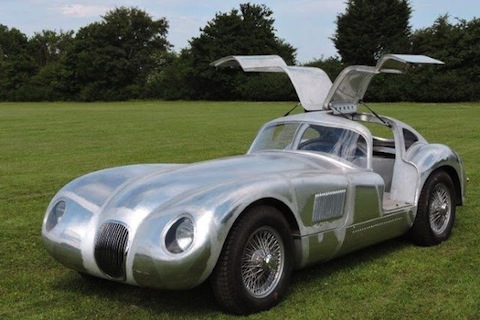
A maximum of three of these are to be produced.
Hawker praises the car as "the best of 1950s sports car design whilst enabling the driver to enjoy an iconic supercar without the complexity and expense of a period machine" (the best of 1950s sports car design, offering the driver the pleasure of an icon without the hassle of a historic vehicle). The technology comes from Jaguar or from its own development: "Designed around Jaguar components including a 3.8-litre straight-six engine, the C-Type Coupe will boast a five-speed gearbox with overdrive for long-legged touring, improved suspension and braking plus a useful boot. The leather-trimmed interior will maintain the period feel, with specially designed instruments" (Developed around Jaguar components including a 3.8-liter straight-six engine, the C-Type Coupe will boast a five-speed gearbox with overdrive for long-legged touring, improved suspension and braking plus a useful boot. The leather interior, together with the specially designed instruments, will provide that 50s feel).
It's not a question of whether Hawker is trying to deceive potential buyers. Effectively, they are saying exactly what their offering is: a modern super sports car that cites innovative concepts from 50s sports car engineering.
And there is also no question that cars with gullwing doors have exerted a particular fascination since their introduction in the Mercedes-Benz 300 SL. One example of this is the Marcos GT 1000 with gullwing doors from 1961:
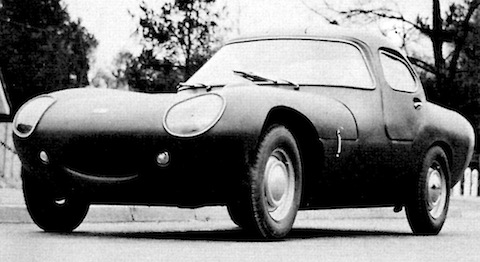
With its role models, the Jaguar C-Type Coupe has the long hood with the characteristic snout of the C-Type ...

... and the gullwing doors of the 300 SL (W 198).
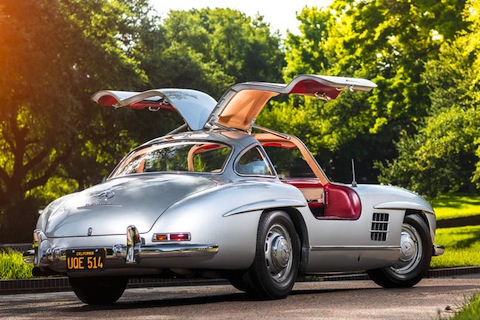
However, a comparison with its ancestors clearly shows that the differences outweigh the differences:
| Make/Type | Jaguar C-Type | Mercedes-Benz 300SL |
|---|---|---|
| Internal designation | XK 120 C | W 194 |
| Years of construction | 1951-1953 | 1952 |
| Layout | open 2-seater | 2-seater coupé with gullwing doors |
| Body | Aluminum | Aluminum |
| Chassis | Tubular steel frame | Steel lattice tube frame |
| Length / width / height in mm | 3'960 / 1'640 / 980 | 4'212 / 1'780 / 1'270 |
| Wheelbase | 2'440 | 2'200 |
| Track front / rear in mm | 1'295 / 1'265 | 1'345 / 1'445 |
| Engine | 6-cylinder in-line | 6-cylinder in-line |
| Displacement (bore x stroke) | 3,442 cm3 (83 x 106) | 2'995 cm3 (85 x 88) |
| Compression ratio | 8:1 |
8,2:1 |
| Carburetor | 2 SU HB 2 in | 3 Solex downdraft carburetors (the series version W 198 then had mechanical injection) |
| Valves | 2 valves / cylinder | 2 valves / cylinder |
| Valve timing | 2 overhead camshafts | 1 overhead camshaft |
| Unladen weight | 950 kg | 1,100 kg |
| Drag coefficient (cw) | 0,45 | 0,38 |
| Power (PS) | 210 @ 5'300 rpm | 170 @ 5'200 rpm |
| Torque (Nm) | 298 @ 3'900 rpm | 255 @ 4'200 rpm |
| Transmission | Moss 4-speed manual | 4-speed manual |
| Brakes | 4 drum brakes, later: 4 Dunlop disc brakes | 4 drum brakes |
The allusion refers solely to the shape of the bodywork. Neither the engine capacity nor the advertised large trunk have anything to do with the originals. This also sets the Hawker apart from vehicles from Lynx, for example, which offer faithful replicas of the C- and D-Type.
The car collector scene is intensely debating the difference between original and authentic cars. The Hawker breaks down these categories by simply playing with history and promising driving pleasure combined with a breathtaking shape.
But how should we rate this car? Here are three suggestions:
- Hawker is right: this is a car that has style and is still contemporary.
- A real alternative to the Ferrari F12berlinetta or California, which also play with the shapes from the 1950s.
- Past and present are two different things that should not be mixed up. If you want to drive a car from the 50s, you should drive an original.
Or do you see it completely differently? We are curious. Just comment on this blog post ...