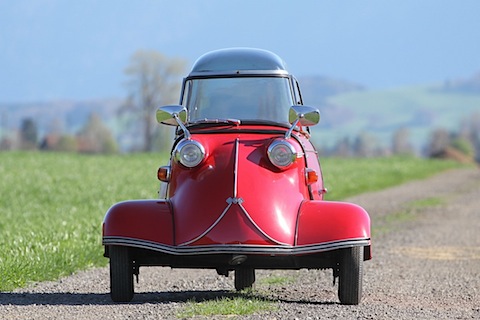
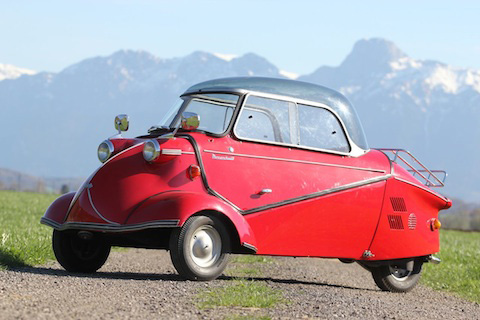
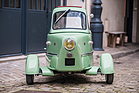
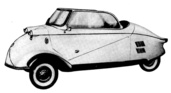
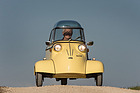
This is how it was 60 years ago - chasing world records with the Messerschmitt
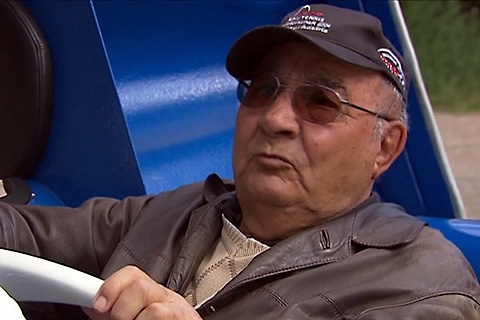
My name is Karl Eisele. I am the last surviving driver who took part in the world record runs with Messerschmitt in 1955. To commemorate the event, the SWR broadcast a television program filmed in Hockenheim and the surrounding area.
How did my participation in the world record runs come about? Let me tell you:
During my apprenticeship at the then NSU in Neckarsulm, due to a lack of small change, I rode the daily 20 kilometers on a scraped-together bike instead of the train, so after just four weeks I entered my first bike race (first step) and managed a surprising second place behind a 22-year-old regional amateur. And this was "only" because I slipped off the pedals in the final sprint, as I didn't have racing hacks, handlebars or gears.
Later, at my first track race with my road bike and the first flyer race with special permission from the BDR, because we didn't have any youth riders yet, I made it to the final heat together with the riders Spiegel and Sonntag (later 6-day race pairing) and the reigning German flyer champion Schertle from Stuttgart.
The experts were chatting casually behind me and of course didn't take me seriously at all. After the first lap, my anger got the better of me and I drove for all I was worth. By the time my rivals had realized this, I was already half a lap ahead. Suddenly, at the start of the finishing bend, I realized that my opponents were trying to pass me on the outside. So I simply accelerated on the firmer inside track
until the three opponents on the outside were knocked off their bikes and so I won my first flyer race at the age of just 16. Just to start with.
Unfortunately, my health was suffering at the time. I got pneumonia, which put me out of action for six months. Then my father got me a DKW 175 sports contract bike from DKW, with whom he had a dealership contract, which I was allowed to ride on 12 major cross-country rides. For every gold medal I won, I got one change, and after 12 class wins, the 175 was paid off.
The next stage was an Adler 250 M, where my bonsai size allowed me to get the best grip on the ground with my short legs. After eight finishes in the top five, I should have become a licensed rider, but the Adler works bike was too expensive at DM 12,000. So my father took over the Messerschmitt agency and I first rode the KR 175 in reliability races, including the Wintersternfahrt Oberstdorf with a class win and then Garmisch with a class win.
In between, I won the Württemberg championship for scooters of all classes and my friend Fritz Fend, the man behind Messerschmitt, invited me to the record races at the Hockenheimring in 1955.
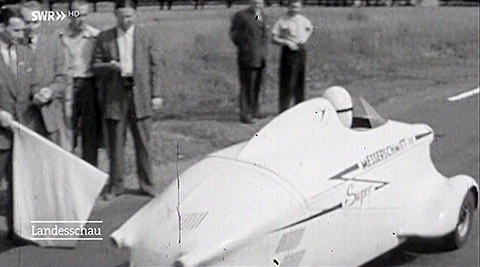
Among other things, I had to start at 3:00 a.m. and after an hour I suddenly saw a white blanket of fog descending. As I had no orientation other than the rev counter, I started counting to 125 from the Stadtkurve to the Ostkurve and 120 to the Krabbenspitze. But when the fog reduced visibility to barely 10 meters, I started to drive as fast as I could along the white record line and count, but at the Krabbenspitze I was suddenly in the meadow.
After my shouts at the start and finish, fires were lit before the bends, but at some point I only saw big white ghosts coming towards me. Finally, I stopped just before our transition area where they practically blindly pulled me out of the scooter. Despite the fog, I was able to keep my average speed above 106 km/h.
After another hour, we had to end the record runs because the flywheel magnet rivets had sheared off. Yes, that's how it was.
Later, I also drove Fiat and Steyr-Puch on the mountain, on the circuit and in endurance races on the Nordschleife and on the Hockenheimring, but that's another story.
But you shouldn't miss the SWR report on the 60th anniversary of the world record drives ...

Editor's note. The world record runs took place on August 29/30, 1955 at the then Hockenheimring in largely standard Messerschmitt KR 200 models with aerodynamically modified bodies. Six drivers took turns during the planned 24 hours and set several records over 1000 miles, 2000 kilometers etc.. An average speed of well over 100 km/h was achieved over 24 hours.