How the three Auto-Union racing cars found their way to Ingolstadt - fiction or truth?

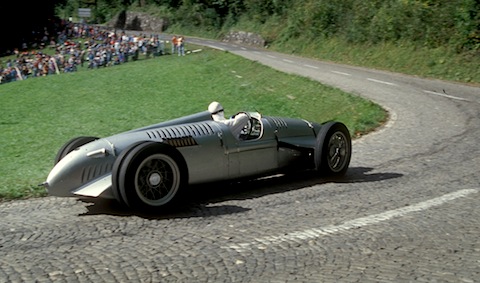
After the end of the Second World War in 1945, Germany was divided into two parts: the Soviet occupation zone in the east of the country and the areas occupied by the Western Allies. Thanks to Stuttgart's western location, Mercedes was able to get its Silver Arrows through the turmoil of war almost unscathed. Some were even brought to Switzerland to survive walled up in the underground garage at the Mercedes-Benz branch in Schlieren, Zurich.
The Auto Union company in Zwickau, located in the east, had a much harder time. The company was dissolved and the production facilities shut down. The Silver Arrows were housed in the halls of a mine and disappeared into what was then the USSR. Traces of the rare racing cars quickly disappeared in the largest country in the world.

In 1949, Auto Union GmbH (today: Audi AG) was newly founded in Ingolstadt, Bavaria. The old Silver Arrows were considered lost forever. In addition, the Iron Curtain had closed and the East was at war with the West.
A single Auto Union Type-C had survived the turmoil of war reasonably intact and was still in West Germany. It was donated to the German Museum in Munich before the war. However, the museum was not spared during the bombing raids and the racing car was also badly damaged. However, it was rebuilt by Audi in 1979/80.
At the end of the 1970s, rumors began to spread again that Silver Arrows had been spotted in the USSR. Paul Karassik, an American from a Belorussian family who grew up in Belgrade, then traveled across the Urals with his German wife in search of the missing racing cars. Thanks to his perfect knowledge of Russian and good negotiating skills, he finally found two disassembled and incomplete examples in the Ukraine after 10 years and countless trips. He was able to acquire both cars and brought the vehicle remains in individual parts, partly by van, to the safe West himself. From here, the valuable stock of spare parts was brought to the USA, to Florida to be precise. In the fall of 1990, Paul Karassik contacted Ingolstadt and received advice on the restoration, which was carried out by specialists Crosthwaite & Gardiner from Buxted, East Sussex, England.
A 38 Type-D supercharger and a 39 Type-D with twin superchargers were created from the Russian spare parts store. As all the body parts had been lost and could not be found, the entire body shell had to be rebuilt by Rod Jolley Coachbuilding from Lymington in Hampshire, England. 55 years after the end of the Silver Arrow era on the race track, the two vehicles were presented on October 1, 1994 on the occasion of the Eifel Classic at the Nürburgring.
In 1998, the 38 Type-D changed hands and returned to its true parents. Later, Paul Karassik also sold the 39 twin-compressor, but to a private individual. Karassik's great dream of having the impressive racing car driven once again in Belgrade was prevented by the raging Balkan war in the 1990s. As a young boy, Paul Karassik saw the last big race of the Silver Arrows in Belgrade shortly before the war began.
Years later, Audi was also able to buy back the twin supercharger. The price must have been so astronomically high that no sane person would have been able to resist.
The third surviving car, Hans Stuck's Bergrennwagen - a Type C/D - stood in a sad state in the Riga Car Museum in Latvia until shortly after reunification. Audi was finally able to acquire the car in exchange for a faithful copy of the original.
We will probably never know whether all this actually happened. From Audi's point of view, these three cars, which were rebuilt according to the original plans, are originals. But how much original substance is really in them? Did the valuable cars really find their way back to Germany this way? How many individual parts of the original cars were actually found by Karassik in the Ukraine and why did the stories only become public 20 years later? Why are there no photos of the found spare parts store? And no picture of the finder? Questions upon questions that will probably remain unanswered forever and ever.
Either way, we must be glad that these cars have been revived, because there are hardly any more attractive racing cars for our collective senses: hearing, sight, smell and touch.
These three ex-USSR cars will be on display at the Goodwood Revival in England from September 14-16, 2012. A feast for the senses for the visitors on site!