How car tests have changed over time

With the birth of the car, media coverage of the automobile also developed. Resourceful journalists began to check manufacturers' performance figures and make customer-oriented comparisons. At some point, the vehicle test was invented. These vehicle tests soon became an important magazine or newspaper feature and various publishers almost went into overdrive in terms of the level of detail and measurement accuracy. Tools were developed (e.g. the Peiseler wheel), special trunk measurement methods were devised and test courses were set up to achieve even better comparability. With the development and increasing maturity of the automobile, however, the tests also changed, as the following comparison of an AR test from 1956 (Citroën DS 19) with a contemporary test from the same magazine shows:
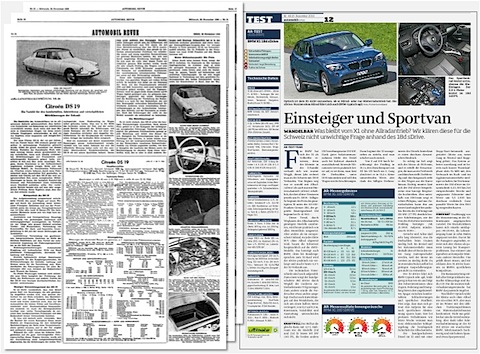
The AR testers described the Citroën DS 19 in 1956 in around 6,250 words or 45,000 letters, respectively on 13 A4 pages in 12-point font. They took detailed measurements to determine the weight distribution under different load conditions, to calibrate the on-board instruments, to determine acceleration times and to document the elasticity values in different gears. They measured the continuous climbing ability, the maximum speeds in the individual gears, the maximum speed, the turning circle, the braking deceleration and the fuel consumption in different load and stress scenarios. They explained the technology and handling in detail. Pictures - black and white - were purely illustrative and documentary, not even the vehicles were cleaned before the photos were taken. Maintenance instructions were explained in detail (including lubrication schedule, types of oil to be used, electrode distances to be observed, etc.).
In order to gain this test experience, the testers at the time drove 12,000 km in one vehicle, sometimes even further. With such meticulousness, it is no wonder that only 1 test per issue was possible, sometimes even only per 2-3 issues.
In modern times, things are different, as a tester has to limit himself to 1.5 A4 pages, space for around 900 words or 5,500 letters (including spaces). Measurements have been reduced to values for acceleration, braking distance, test consumption and meter calibration. The available driving distance is a few hundred to a few thousand kilometers. More would not be possible, as a small team has to complete 2-4 tests every week, plus a number of driving reports. The design focuses on the pictures - large, colorful.
In an age in which vehicle operation is largely standardized and vehicle maintenance is professionalized and delegated, readers are of course no longer prepared to work through pages and pages of recommendations for precisely these topics. In modern tests, experiences with navigation and audio systems are of more interest than comparisons of driving dynamics, as vehicles today have become so similar to one another that the differences are often no longer even measurable. Driving performance measurements have also lost much of their appeal, most cars are more than fast enough and the top speed will soon only have academic significance, as traffic situations and regulations hardly allow it to be used. Things were different in the past, so it was important to know whether a car was going 140 or 160 km/h and whether an overtaking maneuver could be completed in 5 or 25 seconds. And lubricating the axles and checking the water, oil and brake fluid levels were also still part of the driver's duties back then.