How do you drive a Citroën DS 19?

When the Citroën DS 19 appeared in the mid-1950s, it was so different from all other cars that the AR test editors included recommendations on how to drive the DS 19 in their test report in AR 51/1956.
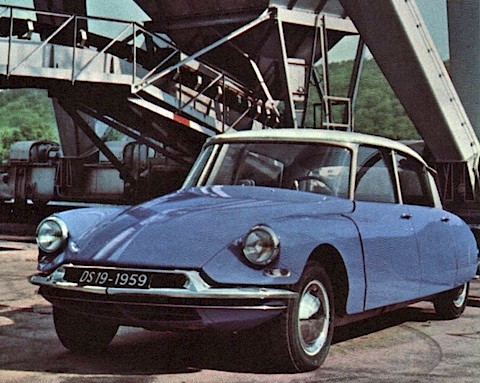
A short excerpt from the detailed long-distance test report of around 13 A4 pages shows why they felt this was necessary:
"The design innovations are also noticeable in an unusual, simplified arrangement of the controls. For example, the engine is started by moving the gearshift protruding from the dashboard under the steering wheel, so that it is not possible to accidentally operate the starter with a gear engaged. The neutral position is located between the first and second gear positions; there is no neutral position between the top three gears. Furthermore, the clutch pedal is no longer required due to the automatic clutch actuation. The brake pedal also has the unusual shape of a small button, which does not act directly on the brake but opens the valves of the servo brake. The foot pressure required is very low, and the foot travels a barely perceptible distance even when braking hard. A third pedal, mounted on the outside left, takes over the function of the handbrake as well as a starting and emergency brake. It acts on the front disc brakes without a servo effect and can be locked and secured in the applied position by a button on the left under the dashboard. ...
... When switching from a conventional and especially a sporty car to the new Citroën, you have to get used to the completely different response of the steering, the absence of the clutch, the "remote control" of the gearbox and the small, effortless brake foot pedal. The new design is not completely foolproof in that it also makes new driving errors possible. Only after some driving experience will the driver who is used to the other cars lose his reflexes that are no longer suited to the DS 19, and only then will he and his passengers be able to fully enjoy the sensational qualities of this vehicle. Anyone who does not drive the DS 19 the way it wants to be driven will therefore make the wrong judgment. After all, you wouldn't accuse a normal power transmission of scratching if you didn't operate the clutch. It is exactly the same with the DS 19, whose new design also requires a certain driving style.
Apart from getting used to the new, simpler operation, there are only a few things to consider. Above all, all movements must be carried out smoothly and without haste and must be started early. When starting off, accelerate the clutch engagement with a little throttle and then accelerate gently and slowly. The steering wheel must not be moved abruptly; instead, you should start turning the steering wheel at an early stage towards the apex of a bend and then turn it back again just as smoothly. When shifting up, take your foot off the accelerator pedal and adjust the engine speed to the new gear shortly before engaging it, while when shifting down, apply an increasing dose of throttle before engaging the new gear. Due to its powerful effect, the brake also needs to be operated with foresight and in a smoothly graduated manner."
Nowadays, hardly any large-scale manufacturer would dare to sell a vehicle that differs from the existing standard in this way. A pity, but also understandable, because modern car testers would hardly have so much patience and understanding for these "peculiarities".
But at least we can now read the AR test report from back thenand marvel at it. And look at the next passing DS with even more admiration ...