Do you want to build a car yourself?

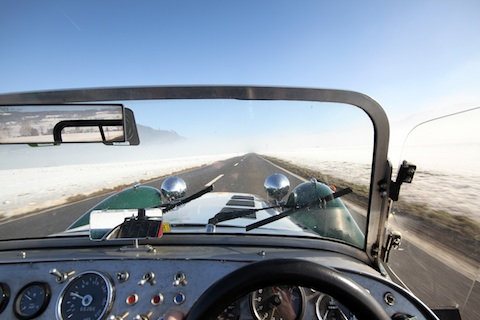
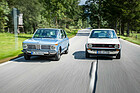
An article in AR 2 from 1961 began with the title"Do you want to build a car yourself?" and immediately listed a few of the vehicles that could be assembled by hand: GSM Delta, Rochdale Olympic, Falcon 1000 or Cheetah (pictured, not to be confused with the American racing sports car of the same name, or the Swiss racing car from the 1970s).

Other brands such as TVR, Lotus, Marcos, Ginetta and Gilbern are also mentioned, brands that are still familiar today.
Self-assembly cars were very "en vogue" in the early 1960s because they promised a much lower purchase price, as taxes on kit-built cars were much lower in England. But kits were also successfully offered in other countries, especially in the USA, where suppliers of bodies, mostly made of polyester, made a name for themselves, for example Devin or Victress.
There were basically three types of kits: the complete kits, the almost-complete kits (typically lacking the engine and gearbox) and the conversion kits (these usually consisted of a new (polyester) body that could be fitted to an existing (self-supporting) chassis). Lotus typically supplied complete kits, while Devin (from the USA) and JWF (from Australia) tended to supply the conversion kits.
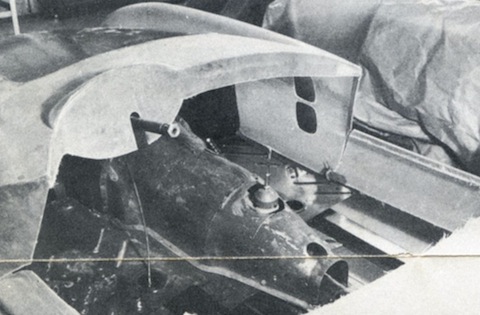
(in the picture a Devin kit, still waiting to be completed)
Vehicles were also offered in France for do-it-yourself construction, such as the Fournier Marcadier. It was modeled on the Lotus 23 and could be completed with Renault mechanics and drive parts. The finished vehicle could be driven on the road and on the racetrack and often appeared on the rankings of national racing events.

The AR 6 of 1966 reported on one of these cars, which was assembled in Burgdorf, and also quantified the "material costs" at 10,000 to 12,000 Swiss francs. Today, Marcadiers are sought after and fetch quite respectable prices.
The following (unfortunately pixelated) picture from a contemporary field report shows what such a kit could look like.
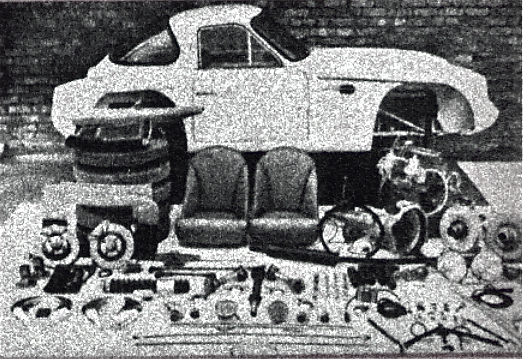
And it all started with checking the individual parts received, of which there were quite a few
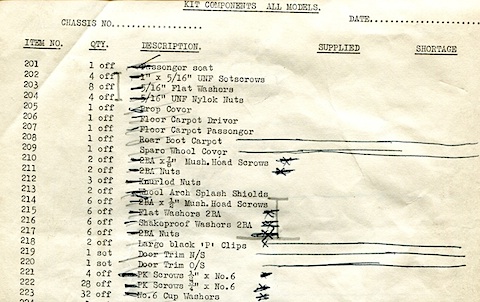
Depending on the manufacturer and kit, different levels of craftsmanship and time were required, ranging from "one weekend is enough" to "welding skills recommended/required".
With the buggy, which became fashionable at the end of the 1960s and turned the VW Beetle into an open-top fun car, the kit business experienced an unexpected renaissance, but even today kits (usually called kit cars) can still be purchased, e.g. if you want to build a Porsche Carrera 6, a Ford GT/40 or other exotic racing cars. However, it is becoming increasingly difficult to get such cars approved for road use and they are also viewed rather critically at classic car events.