They have secretly disappeared, the Schuco sheet metal cars

Once upon a time, the Schuco car was a household name! I was always surfing around on the websites of various toy (car) manufacturers, but I recently discovered that not a single one of their classic models can be found in Schuco's current catalog. So where have they gone? I couldn't find any press releases or anything like that, just a note from an online retailer that no more tinplate cars with the famous name would be released since 2022. Nostalgic as I am, this is a bitter loss for me and tears a gap in the toy universe, which is increasingly dominated by the Far East anyway. Yes, I have to admit that I was a sucker for Schuco cars, even if I always concentrated on the replicas and replica models - certainly from the manufacturer itself, but not from the original time of their creation. This was also for cost reasons.
The toy manufacturer Schuco was founded in 1912 by Heinrich Müller and Heinrich Schreyer, the name stands for Schreyer und Co. Heinrich Schreyer was the businessman of the two, Müller the inventor and creative mind behind Schuco.
The brand from Germany's toy stronghold of Nuremberg became particularly well-known for technically interesting and functionally superior toy cars from the 1930s onwards - in addition to figures, airplanes and boats.
Not only did the Schuco Studio debut in 1936 with a credible, if not accurate, depiction of the Mercedes W25 Grand Prix racing car, the miniature also featured removable wheels, rack-and-pinion steering and, as a special highlight, a visible, genuine differential gear on the rear axle.
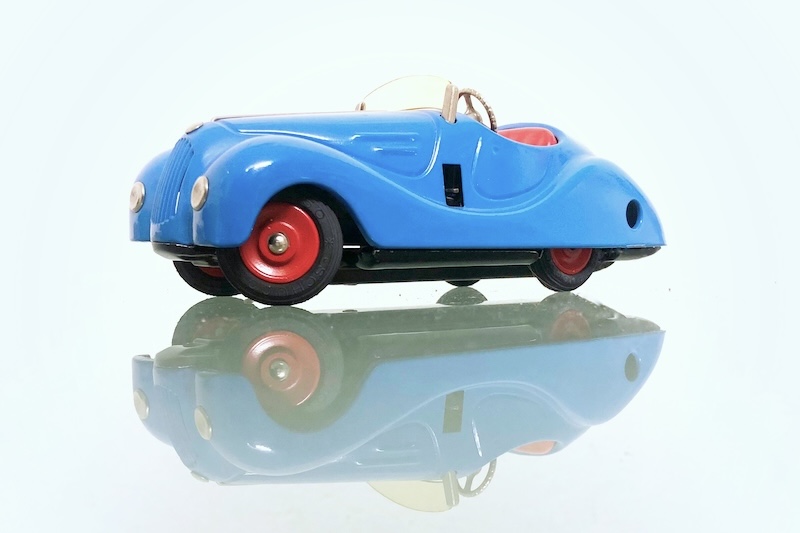
The Examico, which appeared somewhat later, was a car modeled on the BMW 328 in approximately 1/24 scale, but had four speeds that could be switched on the dashboard, including reverse gear, a clutch, steering and handbrake - a small mechanical wonder.
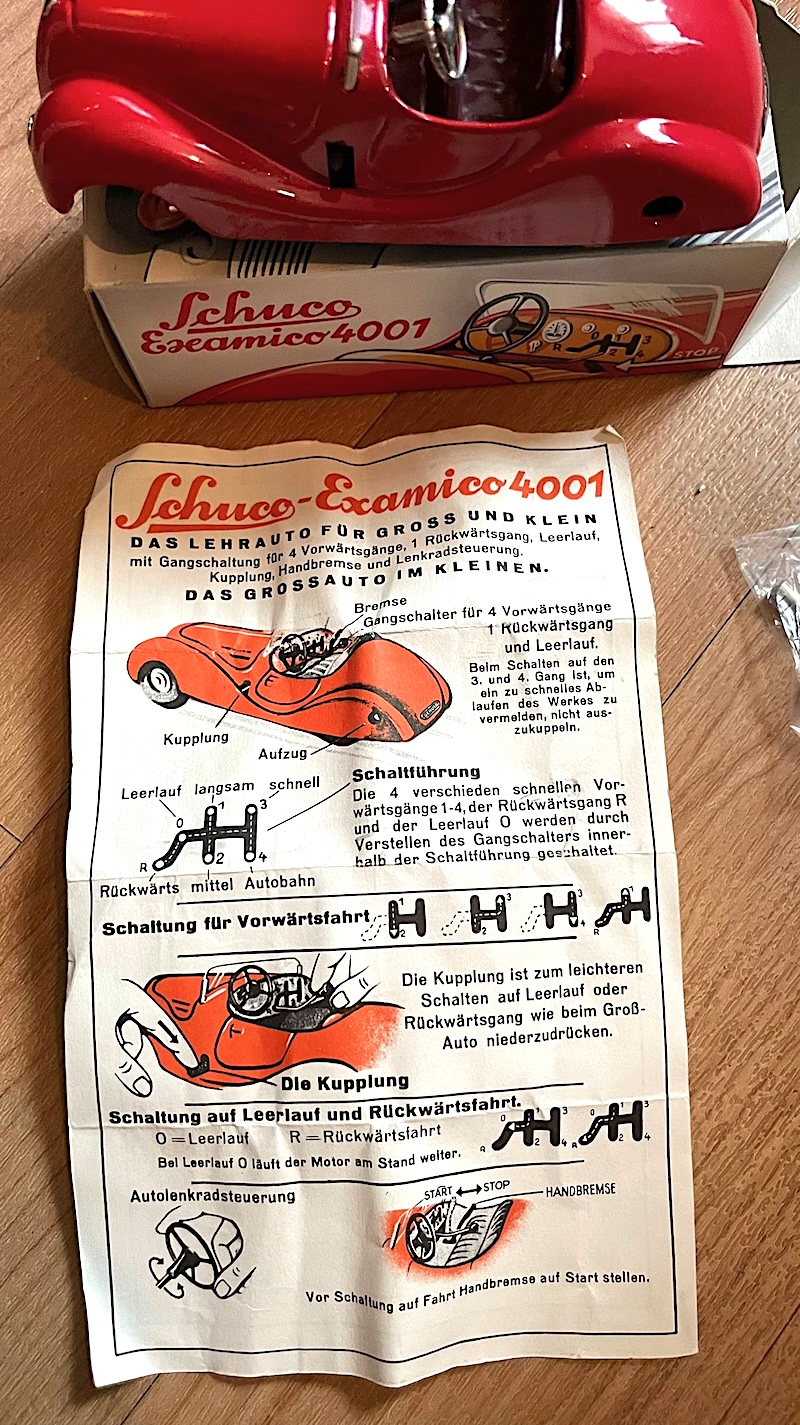
A lot of technology packed into the smallest of spaces - the Schuco Examico 4001 is a small, mechanical wonder and was built in numerous variants from the 1930s until 2022. Now it's over
The reversible car, on the other hand, did not fall off the tabletop; the direction of travel of the command car could be changed with a magic wand or a command given with a lot of air.
After the Second World War, further sensations were added: the Packard with an 8-speed synchromatic gearbox or the Mercedes Electro-Hydro with a fluid clutch. Schuco cars were leaders in the development of new functions.
Heinrich Müller died in 1956, and although the playfulness was somewhat lost, the technical sophistication remained. In addition, there were now more and more plastic parts to complement the sheet metal construction. Another highlight were the monoposti of the late 1960s with steering, wind-up motor or, as a variant, with electric remote steering. Like the prototype, the rear axle was equipped with double longitudinal and transverse control arms and supported by small spring struts. Wire hangers between the open differential and the wheels, installed with plenty of play, acted as half shafts - brilliant!
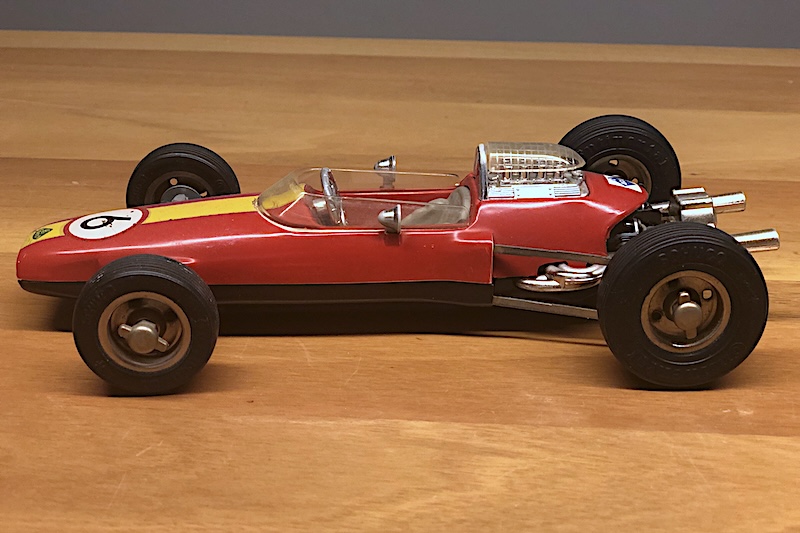
Schuco Lotus Type 33, item number 1071 from the late 1960s. With spring-loaded suspension, removable wheels, steering, differential and properly functioning rear suspension
However, Schuco went bankrupt in 1976, the toys from the Far East were significantly cheaper and the trend had long since moved from sheet metal to plastic. Although Schuco followed this trend, the high demands that the manufacturer placed on itself were not adequately met by the market. At the end of the 1960s, quality toys were becoming increasingly difficult to find. Schuco survived for a while, but had to give up in 1976, as mentioned above. As a result, numerous molds were scattered all over the world. The molds for the classic car series, the "Rüttler" for example, were bought by GAMA in 1980. Some old models reappeared in the 1980s, such as the Schuco Studio.
With the takeover of the brand by Dickie Simba in 1996 at the latest, the small Piccolos, the Microracer and the classic sheet metal models found their way back into the Schuco range. What's more, an entire family of vehicles emerged from the Schuco studio towards the end of the 1990s. The W25 Silver Arrow, the original Studio, was joined by the Auto-Union P racing car as Studio II, the Mercedes W196 streamliner as Studio III, a Bugatti 35 as Studio IV, the Mercedes SSKL as Studio V, the Auto-Union as a streamlined vehicle as Studio VI and the Mercedes W196 Monoposto as Studio VII, all with the same mechanics. There were also corresponding assembly sets with rain tires, tools and even figures
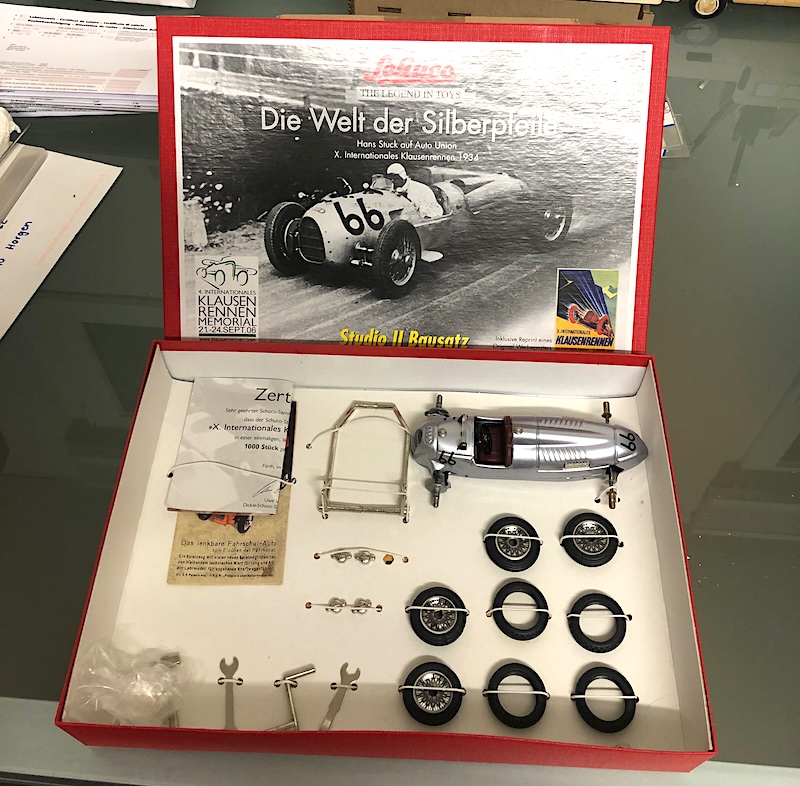
Studio II kit of the Auto-Union racing car, issued for the Klausen Memorial 2006 with driver figure of Hans Stuck (unfortunately he is hidden in the bottom left of the plastic bag). There is no historical toy model of the Studio II, it was a new Schuco model in the old style
Other tinplate classics followed, such as the Jaguar XK 120 as an Examico version, as well as the Porsche 550 Spyder with the same 4-speed mechanics. This continued until Schuco secretly discontinued production of the Classic series, the tinplate and wind-up cars such as the die-cast micro racers, in 2022. There seems to be no more room for nostalgic toys in the Schuco range. Given the abundance of antique Schuco cars from the last 25 years, this is hardly surprising: the die-hard collectors were probably never seriously interested in these replicas and everyone else is probably well stocked up on them. As these objects are hardly used as toys anymore, many of them can be found on the relevant sales platforms in perfect condition, with original packaging and all accessories. Never really cheap in price, most models are unlikely to appreciate in value.
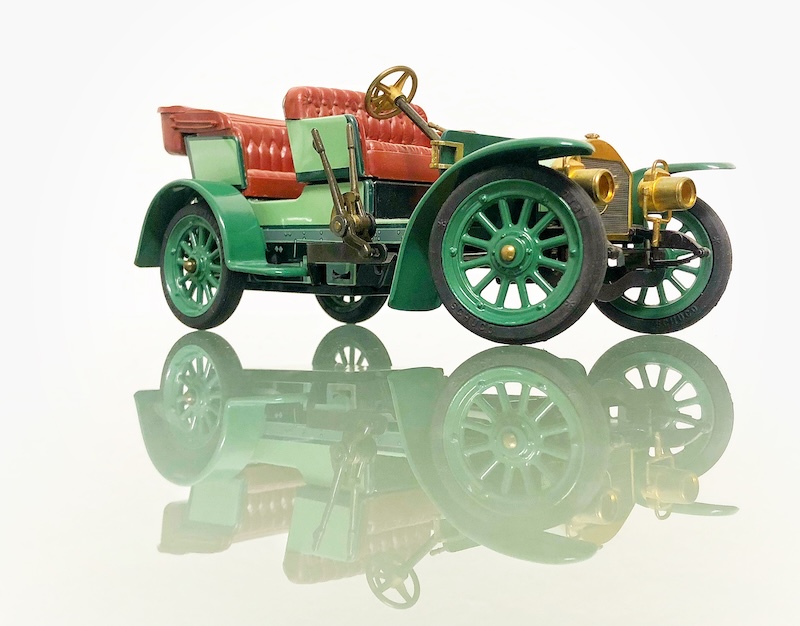
Schuco vintage car number 1229 Mercedes Simplex "Rüttler" as an edition from the late 1990s, the model first appeared in 1957 and was reissued in 1980 after GAMA took over the tools.
From then on, Schuco "only" produced die-cast models and these - excellently made, admittedly - now largely came from the Far East. Some of the sheet metal models, on the other hand, were hand-built in Europe, for example at Kovap in the Czech Republic.
But it is the shakers, the classic car series, which was first launched in 1957, that I am currently particularly fond of. Two patients, Ford T number 1227 and an Opel Doktorwagen, number 1228, are currently on my workbench. The diagnosis is: a broken spring on the Ford T and a worn drive gear - the gearboxes are made of die-cast - on the Opel Doktorwagen. I found both for little money at a jumble sale. Luckily, there are cheap salvage vehicles available as spare parts donors. When it starts to get too cold for me in the workshop in winter, I just move to the basement and carry on working on small parts.
Incidentally, the motor press has also repeatedly reported on the subject of Schuco; there is an interesting article on this in our magazine archive.