Spanish van with Porsche engine - Do you know the Emelba 7?

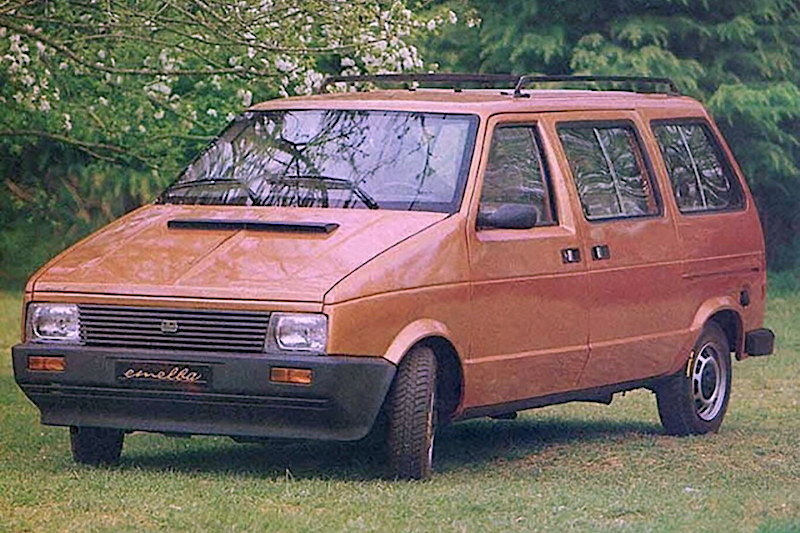
In May 1985, what at first glance looked like a shrunken Chrysler Voyager was presented at the "Salón Internacional del Automóvil" in Barcelona. However, the "monovolume" from Spanish coachbuilder Emelba had nothing to do with the American family truck. In fact, it was based - how could it be otherwise? - on Seat components.
More precisely, on the chassis of the Fiat Ritmo licensed Seat Ronda, whose wheelbase had been extended by 25 centimetres to 269.8 centimetres. The only other modification was a reinforcement of the rear axle to withstand the additional load of two more passengers and their luggage. The petrol engines were taken from the Seat Ibiza, as were the headlights and radiator grille.
However, a much larger name was emblazoned on the valve covers, as Porsche had developed the 64 or 85 hp four-cylinder engine with either 1.2 or 1.5 liters of displacement for the Spaniards. The 1.7-liter diesel engine with 55 hp was sourced from Fiat. When the Emelba 7 - quite pragmatically named after the number of seats - was announced as ready for series production by Automobil-Revue in February 1987, the export version for Europe was to be equipped with Fiat engines.
In terms of space, the Emelba was in no way inferior to the American model. The rear two rows of seats could be removed, creating a 2.40 meter long loading area. The front seats could be turned around and the middle seat in row two could be folded into a table for sociable coffee mornings or family game evenings in the car.
In addition to the variable space concept, the Emelba 7 also offered an extremely advanced shell. Like the Renault Espace, the small open-plan Spaniard had a plastic body - and unlike the French car, it even had rear sliding doors, which made it much easier to handle with children and in tight parking spaces.
Emelba planned to produce 5000 units per year. The city of Barcelona even wanted to order 12,000 units in order to have a uniform cab fleet based on the London model by the 1992 Olympic Games. But nothing came of it. The project died when VW took over Seat in 1990. Only six prototypes were built. One of them is said to still exist.