2000 km through Germany

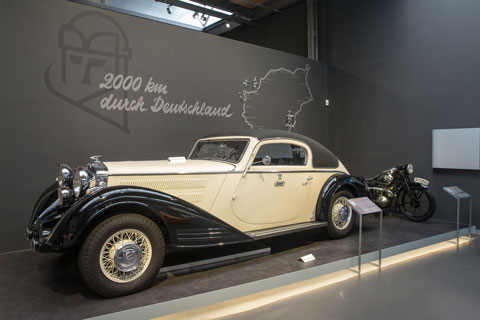
In 1933, a long-distance marathon similar to the famous Mille Miglia took place north of Switzerland for the first time as the "2000 km through Germany". On hermetically sealed roads, 454 participants took part in Germany's most important long-distance race. In wind and weather and at high speed, the riders raced across Germany in different classes without stopping.
The route led from Baden-Baden non-stop via Munich, Saxony, Berlin, the Ruhr area, Cologne and the Palatinate back to Baden-Baden. The participants drove around 1200 kilometers over winding and steep roads in various low mountain ranges. Depending on the vehicle class, the cars averaged between 56 and 88 km/h over the entire route.
In 1933, twelve Opel cars took part in the race. The first to cross the finish line after 26 hours and 23 minutes and an average speed of 78.8 km/h was the Opel sports two-seater Erich Sander, equipped with a 1.8-liter six-cylinder engine.
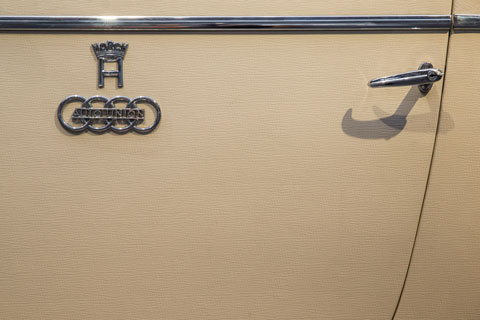
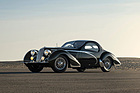
Auto Union also developed ten special cars together with the coachbuilder Hornig in Merane. Four Horch, three Wanderer and three Audi vehicles with streamlined bodies were built in just two and a half months. The Horch with the special body shown here was based on the 830 model and had to reach an average speed of 82 km/h in the race in its displacement class up to 4 liters.
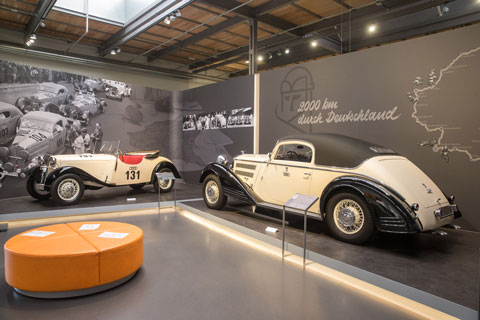
At the second and final event in 1934, 650 cars and 1088 motorcycles took part.
Although planning for a third edition in 1935 was already in full swing, it was stopped by the National Socialist rulers in Berlin. The reasons for this were, on the one hand, the Italian success of the Fiat Balilla and the poor performance of the German brands in the previous year, which of course could not be marketed profitably. On the other hand, off-road sports with automobiles became increasingly important.
In 1989, the "2000 km through Germany" was revived as a normal classic car rally over several days.