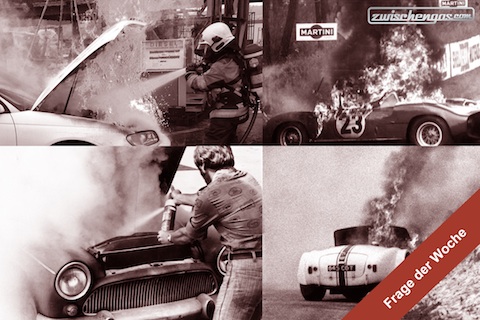
When a classic car starts to burn ....

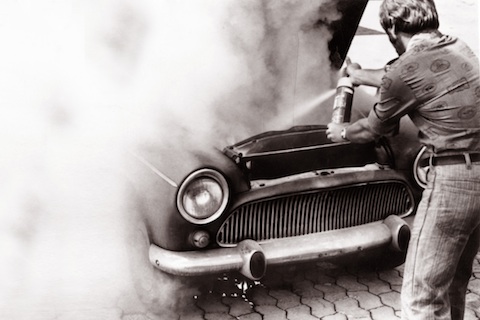
... then every rescue attempt often comes too late. This is because there are many flammable substances in the car, the fire spreads and there is usually a lack of suitable means (and skills) to extinguish the fire quickly on the road (but also outside your own home).
For a vehicle fire to start, it needs a flammable material (e.g. plastic, rubber, gasoline, etc.), energy (e.g. heat or a spark) and oxygen. A fire-friendly situation quickly develops in the engine compartment in particular, as the heat development is high and gasoline is continuously fed from the tank to the engine while the engine is running. According to statistics from 1974, most fires are caused by technical failure; accidents are much less common causes of fire. Arson is a separate problem that will not be discussed here.
According to the study at the time, engine/carburetor were the cause in 27% of all cases, heating and ignition system in 26%, cable/radio in 18% and exhaust/other in the remaining cases. In the majority of cases, the fire first starts in the engine compartment.
In order to extinguish the fire, it is necessary to counteract the above-mentioned causes of fire. The energy is reduced with foam, water or water vapor, the oxygen is kept from connecting with the source of the fire by using fire blankets, foam, CO2 or powder and, of course, the supply of fuel, e.g. gasoline, should be stopped.

Accordingly, if you notice an incipient fire in the engine compartment, always turn off the engine and, if possible, switch off the power completely (emergency switch). According to experts, an incipient vehicle fire can still be extinguished in the first few seconds/minutes, but this is more difficult than you might think. A powder extinguisher, for example, needs to be operated correctly and even if the fire can be extinguished, there is a risk of consequential damage due to the corrosive effect of the powder. To extinguish the fire, however, you first have to get close to it and even professional firefighters do not always manage to open the hood quickly enough. An agitated car owner has even less chance here.
Extinguishing an engine fire is often much more about preventing the fire from spreading than extinguishing the actual source of the fire. It is virtually impossible to stop the petrol from burning, so it is important to ensure that the fire does not spread to other flammable materials in the engine compartment. And even if the fire is stopped, it can start up again of its own accord due to the heat and the fuels still present. By then at the latest, the portable fire extinguisher is usually empty ...
Engine fires are more common than you might think. In Germany, for example, it is estimated that there is one vehicle fire for every 800 to 2500 vehicles (depending on the statistics). The number has fallen since the 1970s, but seems to be rising again nowadays.
So are there no recipes for preventing the worst? Yes, there are, provided you can act quickly enough.
The company alsave GmbH gave an impressive demonstration of how this works yesterday in Zofingen. The fire automatically triggers the extinguishing process via a pressurized line, in which the installed extinguishing system sprays "extinguishing water", i.e. a water-based liquid that does not run off, under pressure onto the sensitive areas in the engine compartment. A few seconds after the fire started, a plopping sound was heard, the system distributed the extinguishing liquid in the engine compartment and the fire was extinguished. And the car could actually be started again afterwards and ran as before.
Alternatively, if you have enough presence of mind, you can of course use a hand-held fire extinguisher to put out the incipient fire in good time. If you do this with the right extinguishing fluid and professional extinguishing technique, with a bit of luck you can prevent a total loss.
Incidentally, the explosions often seen in films are "pure Hollywood", real vehicle fires occur continuously and without major explosions, apart from when the tires burst.