The greatest success

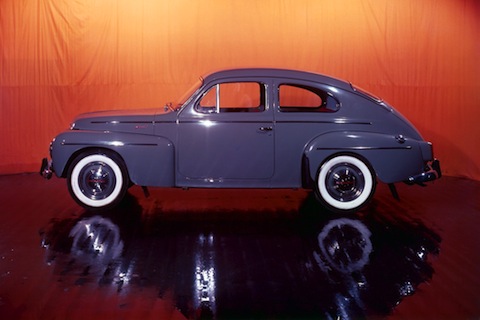
In the mid-sixties, almost 50 years ago, the Swedish car manufacturer Volvo published a commemorative publication, which naturally also described the most important milestones in the company's development.
The development of the Volvo PV 444/544 was documented under the title "The greatest success".
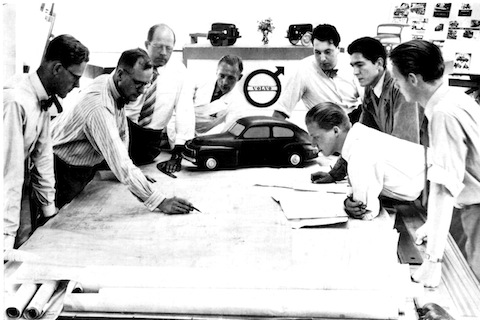
Instead of retelling what the Volvo press people said at the time, we will simply reproduce the original text here:
"The PV 444 was shown for the first time at a special exhibition in Stockholm in 1944. The car was a sensation. The streamlined shape, the technical solution, performance, size - yes, they were all innovations. This car also became the biggest Volvo success among the models that are no longer produced. A total of 440,000 cars of this model were produced. Of these, 160,000 were exported. Exports alone earned Sweden more than a billion skr!
The modest goal that was set in 1944 was achieved in every respect. The aim was that the PV 444 should benefit the Swedish public after the end of the war and also to a certain extent benefit foreign countries.
Even before the Second World War, developments in Europe had moved away from the larger American automobile model towards smaller, economical passenger cars. Volvo calculated early on that this development would become even more pronounced after the war. Among other things, fuel was to become more expensive and demand therefore had to be concentrated on cars that were economical in consumption.
With these facts in mind, engineers Helmer Pettersson and Erik Jern began work on the new model in May 1943. A year earlier, the Volvo board, in particular Assar Gabrielsson and Gustaf Larson, had already drawn up new guidelines for the project. The new car was to have a modern streamlined shape, a self-supporting body and a four-cylinder engine.
However, production of the larger engine type was not discontinued. The PV 60 - which was introduced at the same time as the PV 444 - had a six-cylinder engine.
The designers were in no hurry. The war was still raging in Europe and nobody knew when the car would go into production. Discussions were held to arrive at the best solutions.
The self-supporting body saved weight and space. Nevertheless, the PV 444 was not a light car. As Volvo made use of American subcontractors, the car was built around components that were designed for larger and heavier cars manufactured in the USA. The PV 444 was an exceptionally robust car for its size. Interested parties were able to order the car as soon as it was presented in 1944. The price was relatively high for the time - 4,800 skr - but many had no objections to the price and ordered anyway. Demand increased rapidly. Delivery times became longer and longer.
However, it took 3 years before the car went into production. The shortage of
raw materials was enormous in Sweden in the post-war period. Sheet metal was only available in very limited quantities. However, with great difficulty, Volvo managed to produce a few thousand cars a year. All the cars were immediately absorbed by the automotive-poor market.
The situation improved over the next few years. Access to raw materials improved and more and more PV 444s left the assembly line in Gothenburg. Demand increased at the same pace as the inflow. The peak was reached in the 2-year period 1958-1960, when 100,000 cars were produced. In 1965 - 21 years after its introduction - production of the PV 444/544 was discontinued.
There was great sadness among the many people who had perhaps never had or even driven another car. But the end of production was necessary. There was a great demand for increased production of the 120 model and the entire production capacity at the Torslanda factory was needed for this model. The factory in Gothenburg also had no room for the PV 544, which was needed for truck production. However, the owners of the PV 544 could continue to drive the vehicles with confidence. Volvo guaranteed spare parts for another 12 years all over the world thanks to a generous stockholding policy."