The first plastic passenger car

As early as the 1930s, as part of research in the armaments industry, the Americans had begun to find a suitable reinforcing material that would make synthetic resin usable for the construction of aircraft or ship parts. Initial tests with cotton threads and palm branches were not satisfactory. In 1929, German researchers Rosengorth and Hagen centrifuged glass fibers for the first time, but this production method proved to be too expensive.
The Americans succeeded in developing a process with which glass fibers could be produced cost-effectively. The new material was soon used not only in the defense industry, but also in the civilian sector, e.g. in boat building.
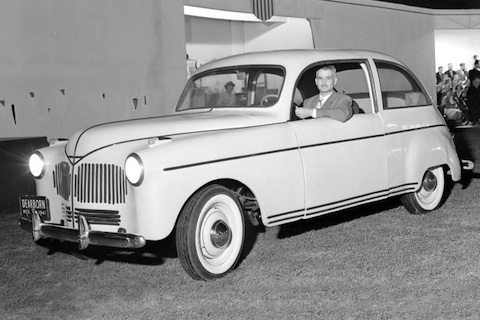
Among the first to discover the new material for the construction of automobiles was Henry Ford, who had a prototype built between 1939 and 1941 that was around 450 kg lighter than the standard Ford, which was clad in sheet steel at the time. Ford used soybeans as the raw material! With this car, Ford not only wanted to become independent of expensive steel, but also to do something good for agriculture.
To show the strength of the new car, Ford produced a promotional film in which Henry Ford hit the rear of the plastic car with a hammer. However, it is said that this was not the original car, but Henry Ford's private car, which was fitted with a plastic rear panel. Nonetheless, the pictures were impressive at the time.