Bertrand Piccard: "This is the pic-pic of my grandfather's uncle!"

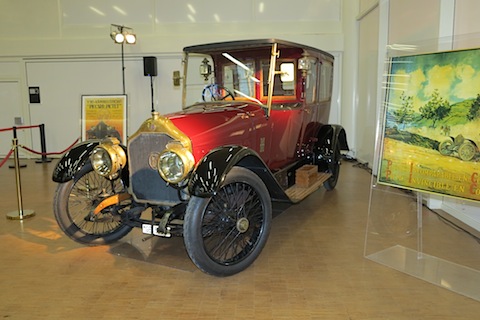
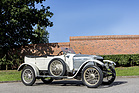
The oldest car at this year's Motor Show was the famous Pic-Pic MIV from 1914. This Geneva-built car from the Pic-Pic company (short for Piccard-Pictet) celebrated its 100th birthday in the presence of descendants of the families of Paul Piccard (1844-1929) and Lucien Pictet (1864-1928), who founded the Pic-Pic brand in 1906: Gisèle Pictet and Charles Pictet, as well as Bertrand Piccard (1958), who plans to travel around the world in his solar airplane next year.

Born on March 1, 1958, Bertrand Piccard comes from a family of adventurers and explorers.

His grandfather Auguste Piccard ascended in a balloon to a height of 16,940 meters into the stratosphere on 18 August 1932, higher than anyone had ever been before. His father Jacques Piccard was drawn in exactly the opposite direction: on 23 January 1960, he dived with the bathyscaph "Trieste" to a depth of 10,916 meters in the Mariana Trench - a record that has never been equalled since.

Bertrand, on the other hand, emulated his grandfather and was a well-known delta pilot and microlight pilot from a young age. As a passionate Formula 1 fan, Bertrand Piccard even had himself chauffeured in a McLaren-Mercedes Formula 1 two-seater in 2000.

Paul Piccard, who founded the Pic-Pic brand together with Lucien Pictet, was the uncle of Bertrand's grandfather Auguste Piccard (1884-1962), who is not only known for his balloon records, but also because he was the inspiration for the character Professor Bienlein in the comic strip Tintin. In the sixth Tintin volume, "The Arumbaya Fetish", you can see a vintage car that bears an obvious resemblance to the Pic-Pic MIV from 1914.

"With Paul Piccard, my grandfather Auguste's uncle, our family has not three generations of pioneers, but four," Bertrand Piccard said very proudly in front of the 1914 Pic-Pic MIV. "And what fascinates me is that even back then there were skeptics who didn't believe in the future of the car and the new technology. And even today, similar skeptics don't believe in the future of new environmentally friendly technologies. This beautiful pic-pic from 1914 replaced horses back then and hybrid, electric and hydrogen cars will also replace our current cars in the future. I am convinced of that."
It is interesting to note that the company "Piccard, Pictet & Cie", which produced turbines and machines, was already manufacturing engines and mechanical parts for the successful Dufaux racing cars in 1904. One of these Dufaux cars will be on display at the vintage car and parts market in Fribourg on March 22 and 23.
No less interesting is the fact that this Pic-Pic MIV exhibited at the Motor Show became famous in 1999. On March 22, 1999, it welcomed Bertrand Piccard at Geneva Airport after his first non-stop round-the-world flight in a Breitling hot-air balloon. This non-stop round-the-world balloon flight with Brian Jones was considered the "last adventure of the 20th century".

Alexis Couturier, who rode the Pic-Pic on March 22, 1999, remembers it very well: "The people at Breitling told me that it was forbidden to go to the airport for safety reasons. I was about to go home when I bumped into Bertrand's father Jacques Piccard at the airport. I asked him: Aren't you going to your son's press conference? "The Breitling people forgot to take me there and I'm afraid I'll have to wait here," Jacques Piccard replied. I immediately decided to take him to the press conference. When I explained that I had to drive Professor Jacques Piccard to his son, all security checks were immediately lifted!" The 1914 Pic-Pic MIV was thus able to pick up Bertrand Piccard in good time as he disembarked from his plane in Cairo.
After a journey of 46,759 kilometers, Bertrand Piccard and Brian Jones landed in the Egyptian desert on 21 March 1999 (19 days, 21 hours and 55 minutes after taking off from Château-d'Oex in Vaud). Not only had they achieved their goal, they had also completed the longest flight in aviation history, both in terms of duration and distance, and set a total of seven world records.
After a champagne shower on his return to Geneva, Bertrand Piccard and Brian Jones boarded the Pic-Pic, which could be admired for the entire duration of the Motor Show in the basement of the Palexpo halls. Various posters, information and videos explained the history of the Pic-Pic company right next to the car.

In 1909, three years after the company was founded, 220 chassis had already been produced. The majority of these were built by Gangloff in Geneva and Geissberger in Zurich. Smaller and larger four-cylinder touring cars were then produced and, from 1912, Pic-Pic excelled in numerous races with specially designed and spectacular racing cars. Pic-Pic was the second largest Swiss car brand after Martini.

Pic-Pic automobiles were exported worldwide thanks to their recognized quality. The Red Cross used Pic-Pic vehicles as ambulances and the Swiss Army used the Pic-Pic 22 model as a staff vehicle. During the World War, grenade fuses were manufactured for the Allies. Instead of the annual output of 1000 cars planned for 1920, the company went bankrupt.
Only seven Pic-Pics, which were regarded as the "Rolls-Royce of Switzerland" thanks to their outstanding technical quality, have survived to this day. After the Geneva Motor Show, the Pic-Pic MIV from 1914 will once again be on display in the entrance hall of Geneva's Pictet & Cie bank.
An extensive reportwith many photos on the historic cars at this year's Geneva Motor Show was published on Zwischengas.