The anti-lock braking system and its development over many decades

Like so many developments that make our modern driving lives safer and more pleasant, the anti-lock braking system dates back many years.
As early as 1928, inventor Karl Wessel was granted a patent for a brake force regulator, and just eight years later the Bosch company patented a device to prevent wheels from seizing.
However, there was still a long way to go before the first anti-lock braking system was fitted as standard, and it was the British who mechanically prevented the wheels from locking in the Jensen FF with the Dunlop Maxeret system.
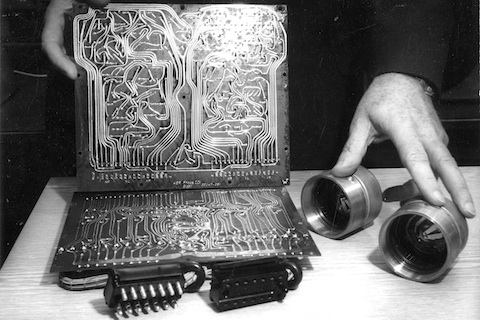
In 1970, the manufacturer was probably Bendix (see picture from 1970 above: Teldix control electronics and two of the four sensors) was probably a step ahead in the development of electronically controlled braking behavior, but the components were still expensive and also quite heavy and large. Mercedes presented the system in impressive performance demonstrations, but the system was not yet considered ready for series production. A planned introduction at Citroën at the beginning of the seventies was postponed.
It was then, once again, the Americans who led the way with various variants, such as the Lincoln Continental Mark III, the Imperial (Sure Brake, Bendix system) and others, until finally Bosch, together with Mercedes Benz, offered the now name-protected electronically controlled ABS in the S-Class W 116 for the first time in 1978, at a massive surcharge of DM 2217.60. In 1986, the safety system was offered as standard for the first time at Mercedes.
Since then, the systems have become ever lighter, mechanically simpler and, above all, more efficient and it is hard to imagine everyday driving without them, even if you rarely really notice them.


.jpg)