Designer Ercole Spada misses his first Aston Martin DB4 Zagato in Lucerne


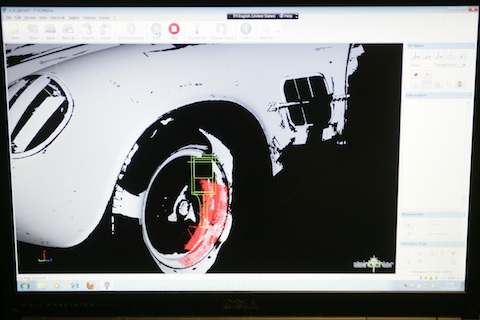
Ercole Spada is one of the most important designers of the sixties to nineties and yet is hardly known to many. In addition to vehicles such as the Alfa Romeo Junior Zagato, Alfa Romeo 2600 SZ, Ford GT 70 or several series of the BMW 5 and 7 series, he also created the Aston Martin DB4 Zagato, his first work! Yesterday, Spada, now 74 years old, was in Lucerne at the Swiss Museum of Transport to digitally measure the Aston Martin, of which only 19 were built.

"I still remember exactly how John Wyer turned up at Zagato in 1960 and asked for a car that was capable of beating the Ferrari in the 24 Hours of Le Mans. The base car was an Aston Martin DB4 and my job was to make the car lighter and design a more aerodynamic body," said Spada. He created not just any faster Aston Martin but - at least from today's perspective - an icon of sports car construction.
Aluminum was used instead of sheet steel, and further important kilograms were saved by using Plexiglas instead of glass for the windows. The car, driven at Le Mans in 1961 by Frenchmen Jean Kerguen and Jacques Dewes, retired after 286 laps, but in the following year they only managed half the number of laps of the previous year and both times the reason was a defective cylinder head gasket.
John Wyer's bold dreams of beating the Ferraris came to nothing, not even top drivers like Jim Clark or Roy Salvadori managed it. In 1961, Salvadori drove the Zagato to second place behind Mike Parkes' victorious Ferrari 250 GT SWB in the RAC Goodwood Tourist Trophy. And that was it. The Aston Martin DB4 Zagato always had a higher starting weight than the Ferrari SWB and later the GTO, and the engines of the Italian derivatives are also likely to have had a higher output.

Ercole Spada said, looking at his work today. "The design is still convincing. The lines of the car reflect the crouched, dynamic and aggressive tension of a big cat before the jump."
He had good reason to be proud, because at the age of 23 he had created a true masterpiece. No wonder the Milan native went on to make a career as head designer at Zagato.
When asked about the way he used to work, Ercole Spada grinned: "The first sketches were made by hand, then we went to the drawing board. Back then, nobody thought about computers and three-dimensional drawings, as they are standard today".
And in 1960, the Zagato men would never have dared to dream that cars could now be scanned with a large-format laser scanner and converted into a digital model.
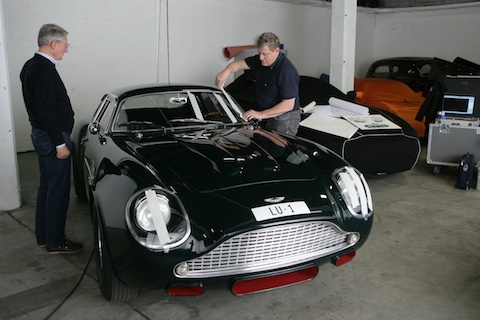
The Museum of Transport Lucerne was also delighted to welcome the famous guest: "We are of course delighted that Ercole Spada, one of the most important car designers, is visiting us. At the same time, we are also a little proud to have such an icon as the Aston Martin DB4 Zagato in our collection, and we were happy to make this model available for the "digital scan".