From initial design concepts to the finished Talbot Tagora

The Talbot Tagora is an almost forgotten car model, yet less than 50 years have passed since its creation and launch. At the time, Chrysler had high hopes for the new sedan and proudly documented its history, printing a 40-page brochure in several languages.
Among other things, it detailed the sequence of the development process:
"In May 1976, it was decided - at that time still under Chrysler's direction - to replace the Chrysler 2L with a completely new model that would have its place in the upper class of notchback models on the European market. The C9 project was launched.
In June 1976, the requirements for this new vehicle to be developed were specified: it was to be a saloon with an overall length of 4.60 with a generously dimensioned interior and large windows. The technology of the C9 was to be significantly improved compared to the 2L. In addition to a new independent suspension, further chassis improvements were planned, which would have an effect on road holding and comfort. The engine was to be roughly equivalent to the 2L, have a high torque at low revs and thus great elasticity, yet deliver high performance with low fuel consumption. It seemed absolutely essential to be able to offer the C9 with a choice of 4- or 5-speed gearboxes and an automatic transmission.
Just as important as optimized technology was the outstanding interior equipment to improve comfort and the increased use of electronic aids to inform the driver about the vehicle's condition, etc...
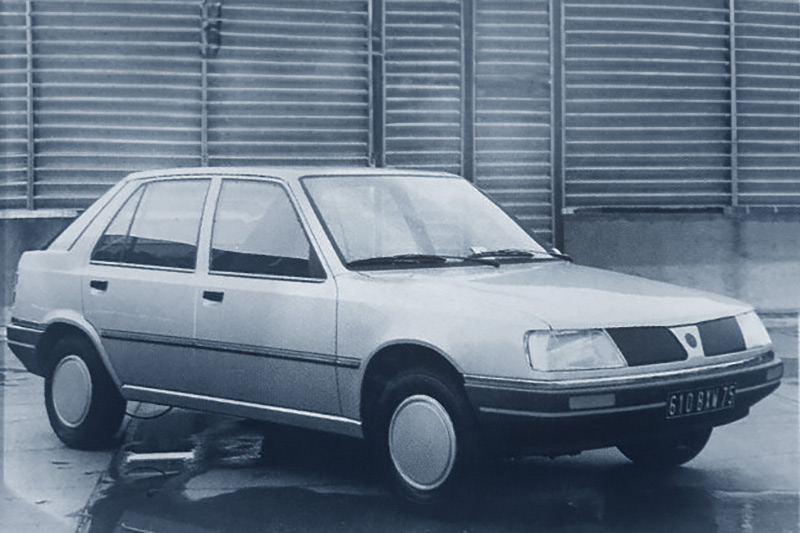
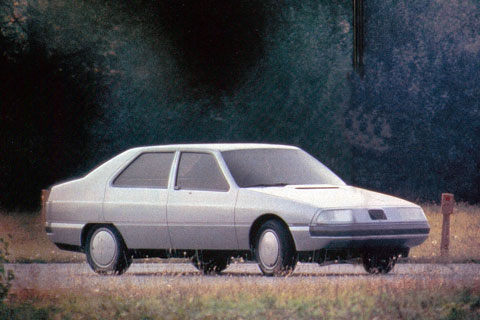
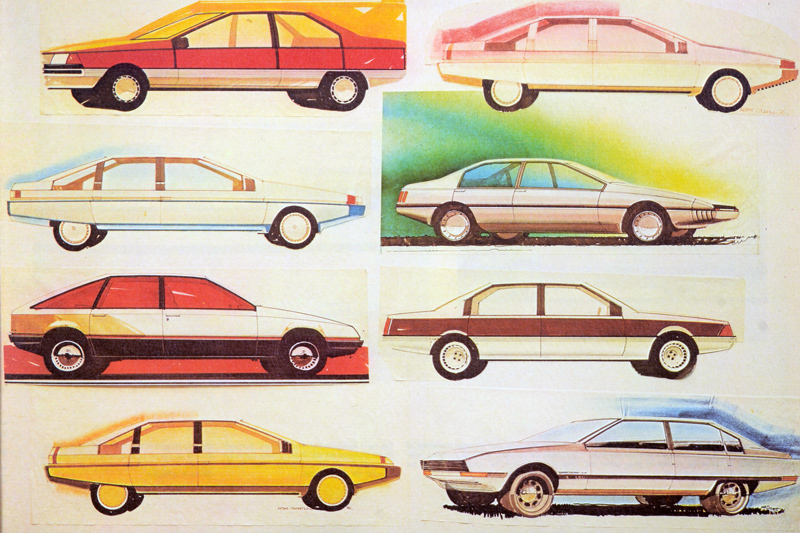
Based on these requirements, four model designs were created, two of which were notchback versions and two hatchback versions.
With these designs, market studies were carried out in the most important European countries in 1976, in which one notchback and one hatchback design were eliminated from the race. Further market studies revealed that the association between hatchback and front-wheel drive was undesirable for the developers and marketing experts, so that ultimately only the notchback design was pursued further.
This design was the subject of a study on the basis of which four plaster models were created.

The models differed slightly from each other externally and were built on four different wheelbases: 2,642 mm, 2718 mm, 2769 mm and 2819 mm.
Another model was created for aerodynamic tests. This allowed technical, aerodynamic and styling studies to be carried out in parallel.
At the end of these studies, the final model was determined and in April 1977, after further detailed work, the external appearance of the new C9 was finalized.
It was now possible to start computer calculations to draw up plans for the production of the press tools and the first prototypes for a wide variety of tests were produced. In the meantime, the styling department continued to work on the exterior of the C9 (headlights, radiator grille, rear-view mirrors, door handles, wheels, etc...).
At the same time, designs were created for the interior, which were carefully coordinated with the overall appearance of the new model. The seats were designed according to the latest ergonomic principles, and the dashboard was designed to be functional and clear, without neglecting the features of passive vehicle safety.
The final design of the interior was preceded by styling studies in which owners (men and women) of competitor models in the same vehicle class were surveyed. The aim of the interior design of the C9 was to achieve optimum comfort and convenience for both driver and passengers. In June 1977, the studies for the interior and exterior design were practically completed, so that the final touches could also be made to the detailed drawings of the body sections.
At the beginning of 1978, a test was finally carried out in France and Germany to see how the C9 fared against its direct competitors. The test with vehicle owners from these two countries was surprisingly positive, after which only a few details were improved.
On August 10, 1978, Chrysler Europe was taken over by the PSA Group. This made it possible to equip the C9 with technical organs from this group. New studies brought detail corrections, the most important of which were:
- an increase in the wheelbase to 2,808 mm,
- a new radiator grille for improved engine cooling,
- new wheels and,
- a wider range of engines (2.2-liter based on the Simca 2L, turbo diesel and 2.6-liter V6).
The final model, the Talbot Tagora, was thus finalized."
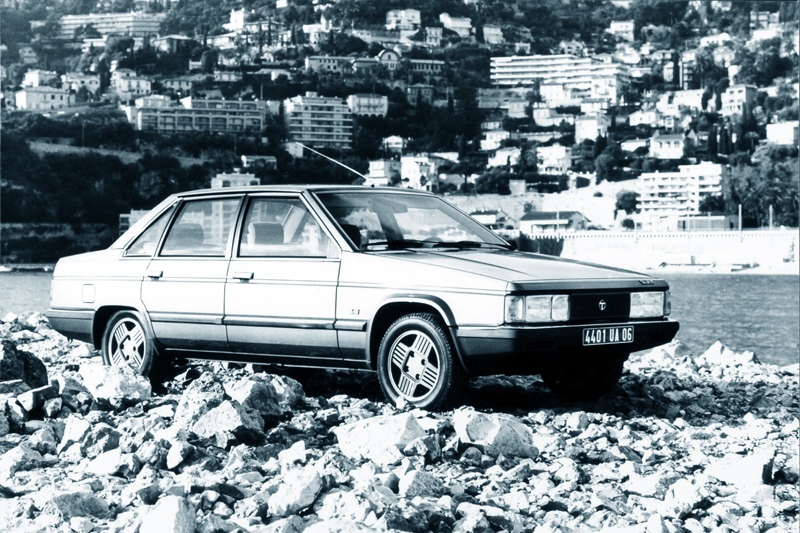
It was not until 1980 that the Talbot Tagora was launched. It was sold from 1981 and was not particularly successful. Production at the former Simca factory in Poissy was halted as early as 1983. At that time, not even 20,000 Tagora models had been produced, although the aim was to sell around 60,000 units per year.
Of the few Tagora produced, even fewer remain, and today one of these surviving limousines is likely to be a real rarity at any meeting. And yet everything had started so well ...
The entire development documentation , which is really worth reading, can be found in the Zwischengas archive.