Indigestion for acoustics – Why does a V8 rumble?

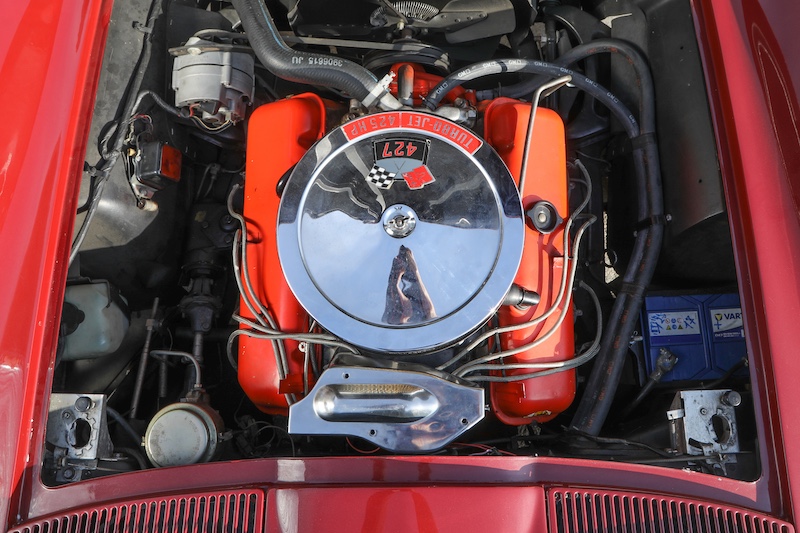
In automotive jargon, the "rumbling V8" is now just as much a fixed phrase as the "tough-as-nails roadster" or the "rustic off-roader". But why does it do this in the first place?
The secret lies in the combination of firing order and exhaust gas routing. In many V8 engines, from the Ford flathead to the Chevy small block, the cylinder banks do not always fire alternately – due to the 90-degree crankshaft, which enables better mass balancing than one with a 180-degree crankpin offset – but also once directly after each other per cycle.
This does not give the exhaust gases enough time to fully exit the manifold before the next cylinder in the bank fires, meaning that the engine cannot "exhale" properly and always "chokes" a little. However, because this only happens every third ignition (and then not always to exactly the same extent), the characteristic exhaust noise is produced.
In cars with two exhaust pipes, this performance-robbing problem can be solved with a connection ("H-pipe") or a crossing ("X-pipe") just behind the manifold, so that one side helps the other to exhale. However, this changes the sound from a slightly irregular "rumbling" to a fairly even "booming", as we know it today from AMG, for example.
In all other V-engines from six to 16 cylinders, the banks alternate at a nice regularity, so that only the V8 retains the characteristic of single-sided dual ignition – but not always. If performance takes precedence over smooth running and a 180-degree crankshaft is used, then a V8 will always alternate ignition. Which means that it basically consists of two four-cylinder engines running slightly asynchronously – and sounds like it too.

_RM.jpg)