When the pendulum swings back

Ingenious inventors and resourceful engineers, shrewd or not so shrewd businessmen and sometimes brazen fraudsters have accompanied the automobile since its beginnings. This has sometimes brought outstanding success, even an early pioneering role, but in some cases an equally rapid decline.
Rarely, on the other hand, has someone led a company to prosperity through their unconventional ways, only to bring it to ruin again in a short space of time through non-compliant behavior. Perhaps the world is now experiencing this for the first time. But let's look back first.
Many a pioneer has been overtaken by his imitators
Being the first certainly has its advantages. A good number of the early protagonists of automotive history have survived to this day. Brands such as Mercedes-Benz, Peugeot, Renault, Fiat, Opel and Ford have stood the test of time and overcome adversity. And even if independence has been lost here and there or the wind is blowing against some of them, it can be assumed that these brands will still exist in the future.
It is striking that most of the brands still active today - even if strong personalities left their mark on these companies in the early stages - have been able to establish their own identity without the founder having to be omnipresent. Anyone imagining a Ford Focus, for example, is unlikely to be constantly reminded of Henry Ford.
Other pioneers, on the other hand, have created foundations that are still valid today, but have nevertheless gone under. One important car brand that left the scene early on was De Dion-Bouton. First with steam cars - the "Marquise" built in 1884 is now the oldest working car ever - then with combustion engines, De Dion-Bouton was the largest car manufacturer in the world at the beginning of the 20th century and also one of the most influential. Numerous imitators copied the cars. By 1900, the company had already produced around 5,000 motorized tricycles and just as many engines near Paris, roughly where today's financial district "La Défense" is located. After a failed restart and the lack of a clear model strategy - popular cars in large series or luxury cars - after the First World War, the manufacturer earned its money with street cleaning vehicles and tippers, while the automobile business languished. In 1927, the balance sheet had to be deposited for the first time, and in 1932, car manufacturing came to an end and one of the most important car pioneers was eliminated.
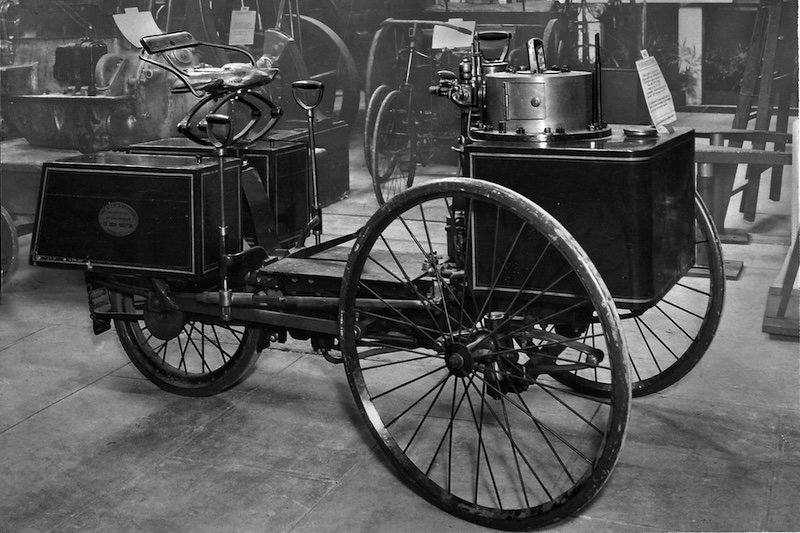
De Dion-Bouton from 1885, the former car pioneers were overtaken by developments
Controversial, but successful
The large-series pioneer Ford also almost disappeared from the scene. At the end of the 1920s, the former market leader - with 40% of the global car market around 1920 - only just managed to turn the corner after relying on the success of the Model T for too long. However, despite the success of the successor Model A from 1928 and the surprise with the first popular V8 from 1931, the giant from Dearborn only played second fiddle among America's "Big Three" from then on - behind GM and ahead of Chrysler. However, certain views of founder Henry Ford had little influence on the company's success. For example, he was an avowed anti-Semite. The publication of a series of 91 articles entitled "The international Jew" in the newspaper he bought in 1918, "The Dearborn Independent", which appeared from 1920 onwards, was full of accusations and clearly showed that Ford believed in a great Jewish world conspiracy. This attitude hardly stood in the way of his economic advancement, even when he published a two-volume, bound work of it and even had it actively distributed to friends and partners.
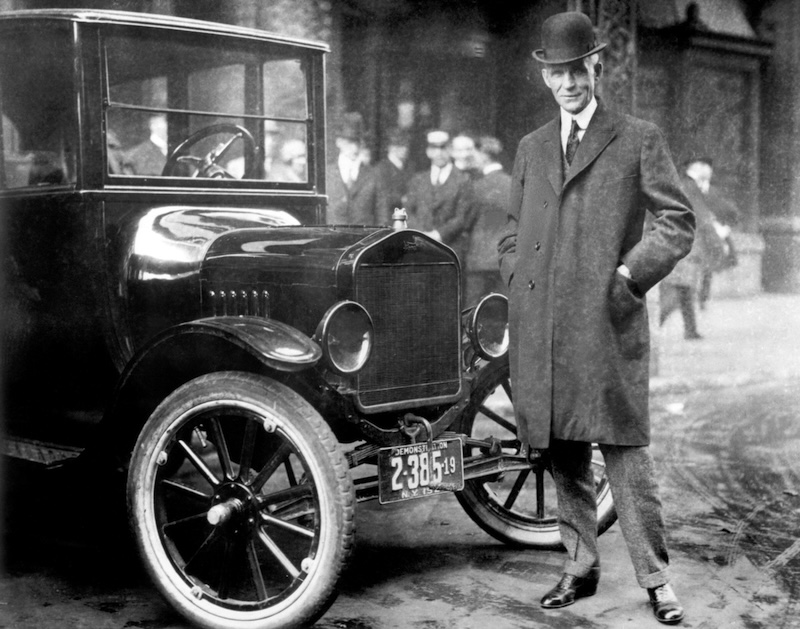
Henry Ford in 1921, a thoroughly controversial contemporary and anti-Semite - it hardly did him any harm
The circumstances in which the Porsche and Piëch families were involved, to put it mildly, do not appear to have harmed their careers or the business performance of their companies in any way. Apparently, it was of secondary importance which political stance they once held or, in the case of Professor Porsche, to which he had once allowed himself to be assigned without resistance and was able to profit from this to a large extent. It is not very often in history that a car manufacturer has been sidelined by its leaders outside of their core tasks - the management of the company.
There are such episodes, but they usually remain side notes. One example is that of Mr. and Mrs. Docker, whose brand was British Daimler. Daimler was the first car in the Royal Mews, the royal "garage". The oldest car brand in the United Kingdom was the official supplier to the court until after the Second World War. Rolls-Royce remained on the sidelines for a long time.
The official interpretation of the royals' reasons for switching brands was the repeated transmission problems with the royal Daimler in the 1940s and early 1950s. One of the Daimlers is even said to have suffered a broken axle during an official appearance. However, another reason could have been of a more delicate nature: BSA Chairman - Birmingham-Small-Arms was the owner of British Daimler - Sir Bernard Docker had married a former nightclub dancer and twice widow, Nora Turner, in February 1948. Now known as Lady Docker, she repeatedly made scandalous headlines. And Nora Docker became known for her extravagant, if not particularly good, taste. It was only when the Board of Directors put an end to the extravagance at the company's expense - Lady Docker had no fewer than five show cars built, now known as the "Docker-Daimler" - by dismissing Sir Docker in 1956 that the headlines in the tabloid and sensational press surrounding the manufacturer, once regarded as highly conservative and well-off, diminished. The tactless escapades of Dockers, as well as the underfunding of Daimler, certainly damaged the brand to such an extent that Jaguar founder William Lyons was able to buy Daimler in 1960. This was because he was mainly interested in the additional production capacity available here.
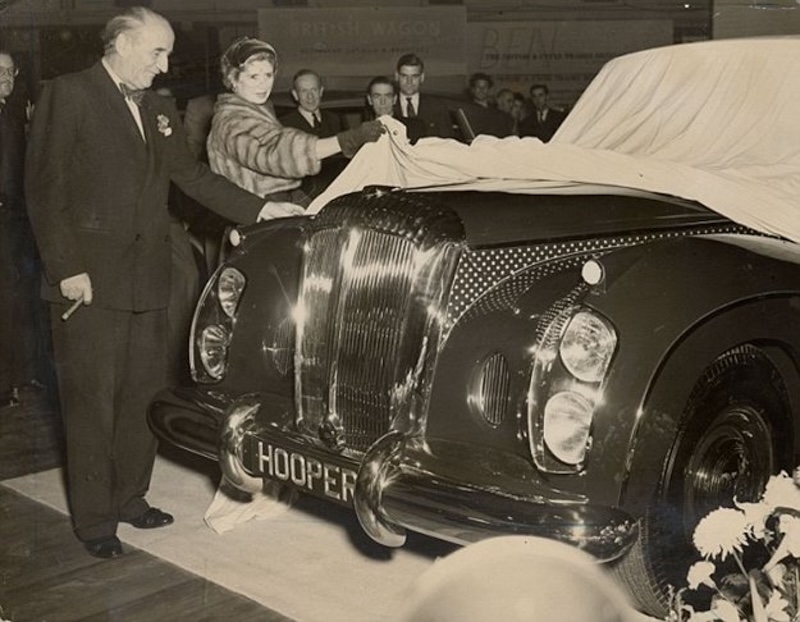
The Dockers caused many a scandal until it became too much for the Board of the Daimler Company in 1956.
Actuality
Pioneers who fail and company owners who damage their own company's success through their appearance and statements - or through their political stance - seem more than familiar to us today. Martin Eberhard and Marc Tarpenning once started out as pioneers when they dreamed of building a truly desirable, fully electric car in 2003. With the help of investors, including a certain Elon Musk, who had earned his money by launching and selling the Paypal payment service, for example, their company Tesla Motors made rapid progress from 2004 onwards. In 2008, Tesla presented the revolutionary Roadster based on the Elise from Lotus. At the same time, Eberhard and Tarpenning were replaced by Musk as CEO and today see themselves almost completely erased from Tesla's history. However, Elon Musk's charisma, his willingness to question everything that had gone before and his willingness to think big made a significant contribution to Tesla's ability to make the huge investments required to establish itself as a fully-fledged car manufacturer.
With self-confidence and an extremely skillful approach to investors, Musk has subsequently managed to put together an entire model portfolio: the Models S, 3, X and Y - if you turn the 3 around, you can see for yourself how Tesla's naming is to be understood. With the Cybertruck, which went on sale in 2023, a pick-up truck was added to the SUV and saloon fleet. Meanwhile, Tesla's market capitalization reached the astronomical sum of 1.35 trillion dollars on December 28, 2024. However, as of March 20, it was back at the level that the company had first exceeded in January 2021: 758 billion US dollars. This is a huge drop, but still a gigantic sum. This compares to an annual turnover for 2024 of "only" around 7.18 billion dollars. Tesla is therefore by no means a giant in the automotive sector, but rather lower middle class. Around 1.77 million cars were delivered in 2024.
For comparison: Toyota, whose market capitalization is currently valued at around 252 billion dollars, delivered over 10.8 million cars last year and achieved a turnover of 232 billion dollars and a profit of 24 billion dollars.
Tesla's stock market value is therefore primarily based on the expectations of investors in the (very) distant future. And this Tesla future looks anything but rosy. Sales are slumping, in some markets by up to 75 percent - in France, for example. Europe recorded an average drop of 45 percent for the beginning of the year compared to the same period in 2024. In Switzerland, for example, the Model Y also slipped from first place to 13th place by the end of February. There is no question that the escapades of the main protagonist Musk play an important role in this. On the other hand, the competition is catching up and now offers a more diverse range of vehicles than Tesla - including newer ones - with better quality and more service. The model upgrades of the bestselling 3 and Y were perceived as very superficial. And some electric cars from China are now technically quite clearly superior to both the Americans and the Europeans. This includes, for example, the use of lidar for the driving assistants, while Tesla continues to rely solely on its camera-based autopilot.
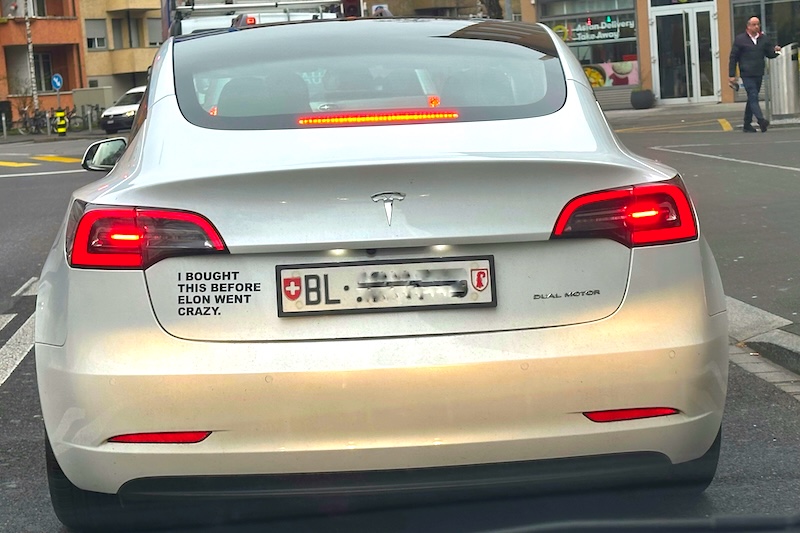
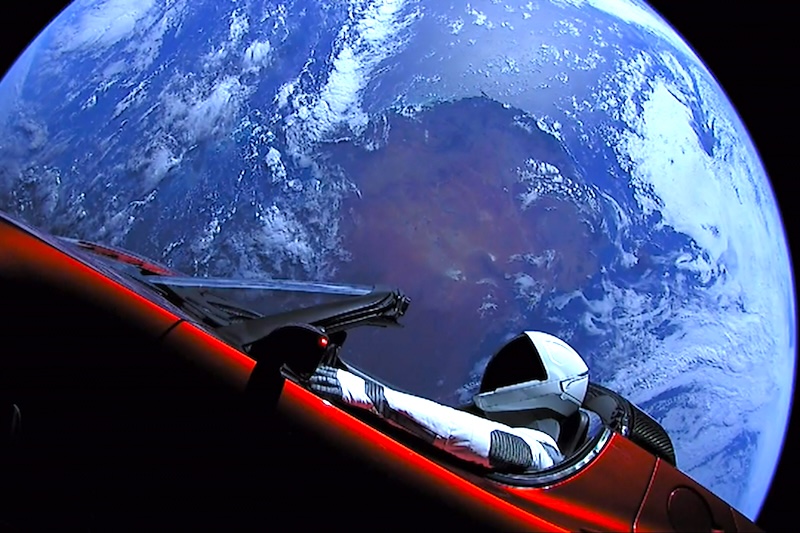
Uncool - Tesla owners try to distance themselves. A contrast to the lead image at the top: It was Tesla's PR highlight when Musk launched his personal Tesla Roadster with SpaceX into space with the puppet "Starman" on board.
Two possible scenarios
So the question remains: Is history repeating itself? Is the former pioneer increasingly being pushed to the wall by the competition? If so, we will either see a liberation or the slow, steady erosion of Tesla's significance. Or will Elon Musk's construct implode because he has turned from a popular figure into an object of attraction that infuriates even some loyal former followers of the almost religiously celebrated Tesla discipleship and causes them to turn away? We shall see. The only counter-argument to this assumption at present is the observation by analysts that nothing like this has ever happened before in the history of the automotive industry. History is therefore not repeating itself here - it is being rewritten!