Neither black nor white - restoration or conservation

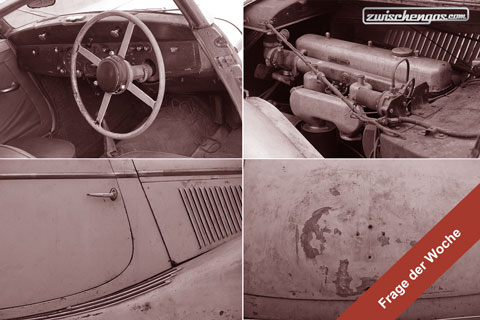
Preservation classes are en vogue at the big concours, barn finds fetch extremely high prices when they are sold, and original condition has never been valued as highly as it is today. But what do you do when you come across a largely untouched and also historically valuable vehicle that neither drives in the form in which it was found, nor does it recall its original splendor?
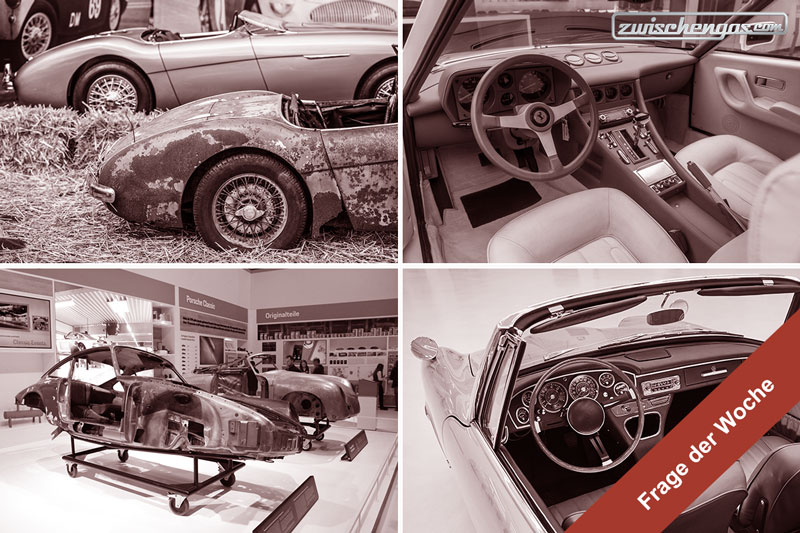
We presented our readers with a choice. The vehicle in question was a 65-year-old Jaguar with special bodywork, one of three cars wrapped in this way as a convertible. The condition does not allow it to be driven, and there is much to criticize visually. However, there is still a great deal of original substance that would be irretrievably destroyed or altered if the car were to be restored.
We gave the participants in the" Question of the Week" the choice of either restoring the car in its entirety or only preserving it, even if this meant that the car could not be driven.
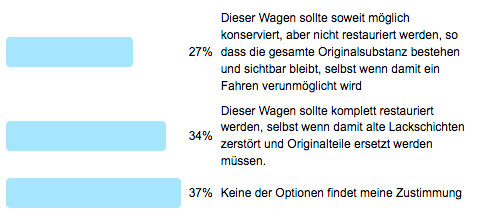
27 percent of the 407 respondents were in favor of pure conservation and complete preservation in its current condition.
34 percent preferred complete restoration, even if this meant destroying the original substance and replacing old parts.
However, the majority of participants, 37 percent, did not want to take one or the other path, and probably envisioned a middle way, in which, for example, the technology would be completely overhauled, but the bodywork and paintwork would be preserved as far as possible.
Here is the graphic analysis of the survey.
We have already posed a new question of the week . This time, the aim is to determine in which era the automobile made the most progress in series production.
And, of course, all previous results of the Question of the Week can still be found in the corresponding topic channel.