
The beginning of internal security

Hardly any car before had been given as much emphasis on interior safety as the Mercedes-Benz 220 S, which was launched in 1959.

In order to guarantee the survival of the occupants in the event of an accident, which could never be completely avoided despite the "foolproof" nature of the car, the interior of the car was designed to be as safe as possible.
Various tests were carried out to verify the result.
One was the "impact head test", in which a wooden ball weighing 5 kg was hit against the dashboard to simulate the impact of a head.
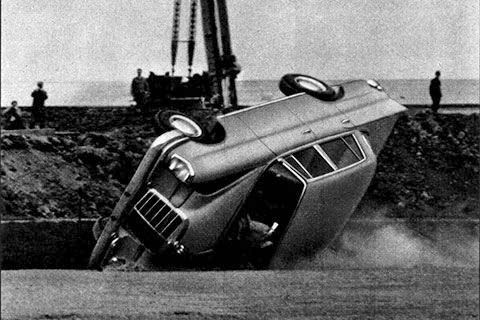
Then impact tests were carried out with a sledge that was driven against a wall. This was known as the "ejector seat". Finally, a rollover at 80 km/h was used to check whether the passenger cell would prove to be as stable as expected.
In 1960, it was considered a good result if the seats and belts - yes, they already existed at the test stage - were not torn from their anchorages.
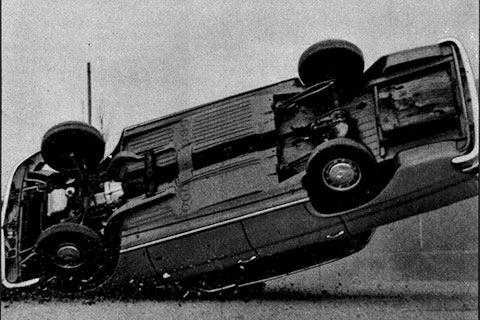
The three pictures show excerpts from the rollover test, which was described in the caption of the 11/1960 issue of ADAC Motorweltas follows:
"Our picture strip shows interesting rollover tests with the new Mercedes-Benz 220 models, which were carried out on the Daimier-Benz proving ground. Here are some phases of the rollover test. A test dummy sat in the driver's seat. The vehicle was driven onto the rollover ramp at a speed of 80 km. In the first picture, the car flies through the air and tilts sideways. In the middle picture, the car overturns on impact with the ground. The unlocked radiator grille lifts off on the right-hand side; the roof and all the windows are still undamaged at this stage. - In the picture below, the car has turned 180 degrees around its longitudinal axis and then falls onto the right-hand side of the car. The vehicle then turns onto its wheels again and comes to a standstill lying on its left side. The roof, rear and passenger compartment remained almost undamaged during this attempt."