The Passat compact car that wasn't from Volkswagen

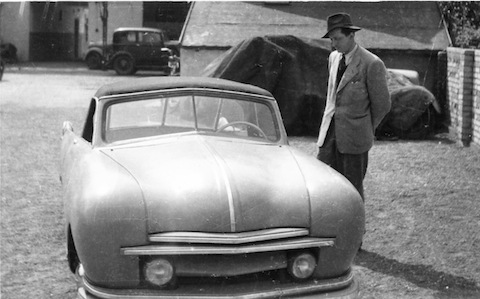
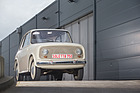
In the early fifties, many new cars were created, some of which had interesting design elements. One of these cars was the "Passat" small car, which caused a sensation in the press of the time in 1952.
One Wilhelm Fuhrmeister, the "Schriftleiter", described the new German small car as follows:
"The well-known Krefeld engineer Kurt Faust recently went public with a completely redesigned small car that caused a particular stir among experts. The core of the design is a mechanical gearbox without a gearshift, step and clutch with a differential effect, which automatically adapts to every gradient with the only correct reduction ratio.
This technically well-known, simple and reliable design, which has already been tried and tested for 20 years, was used by the designer for the first time three years ago and was modified and automated for operation in the micro-vehicle. This transmission is completely foolproof, as it is only influenced by the accelerator pedal and the road gradient and, above all, downshifts automatically and continuously on hills, making it completely impossible for the engine to stall due to the centrifugal clutch and thus ensuring a high level of road safety. The car is built in two versions, with a 600 cc four-stroke and a 250 cc two-stroke engine. The bodywork is the same for both types: sheet steel at the front and only light metal from the front door edge to the rear.
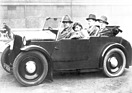
Three people sit side by side in the car with a seat width of 1400 mm; the middle seat is moved back 50 cm and there is space for the legs between the front seats. The ample luggage compartment behind can also be used for child seats. In order to avoid the uneven weight distribution caused by the rear position of the entire drive block, the rear wheel suspension was articulated at the outermost end of the chassis. It consists of steel torsion springs and torsion rubber blocks at the front, i.e. deliberately unequal suspension elements. All of the car's suspension joints are mounted in rubber blocks and are maintenance-free.
Amazingly smooth road holding was achieved by using the entire length of the car as a suspension base. The vehicles are also built in intermediate types of 360 cc, 400 cc and 500 cc and are to go into small series production of 50 units per month before the end of this year; the relevant negotiations are about to be concluded."

At the time, the technical data made people sit up and take notice, as the faster of the Passats was supposed to reach 90 km/h and consume only 4.5 to 5 liters of petrol per 100 km. The target price was DM 3,600, while the smallest version was to be sold for DM 2,750. As a result, the designer Kurt Faust was obviously inundated with inquiries and orders, so that a site and production facilities were already being sought.
However, as was often the case, this resourceful car manufacturer ran out of money too soon, and apart from the prototype, no car is said to have been completed. Nevertheless, the name was resurrected in the form of a Volkswagen in the 1970s and vehicles with three seats in a row were later built again.