When a Ferrari stops being a Ferrari

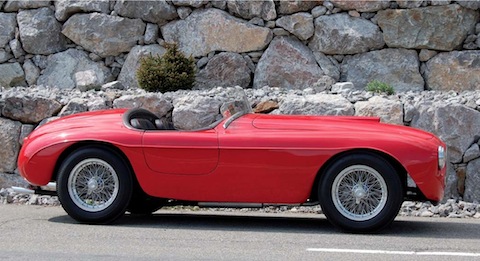
Once upon a time there was a Ferrari 330 GT 2+2, built in 1964 by the Ferrari company in Maranello with chassis number GT 6395, which gave its owners a lot of pleasure as a sports car coupé.

Sometime around 1990, Domenico Scaduto, a former employee of Carrozzeria Touring, converted the 330, which had grown old in the meantime, into a Barchetta. To do this, he used the chassis and mechanics of the '64 Ferrari and built an open sports car body on it using traditional craftsmanship, just as the employees of Carozzeria Touring had done in the 1940s and 1950s when, for example, the Ferrari 2000 Mille Miglia was created, a vehicle that was certainly the inspiration for Scaduto's new Barchetta in terms of design language. However, the newer Barchetta differs from the "original" due to its different dimensions and the increased space required by the more modern mechanics.

The owner John Weinberger from Illinois (USA) was very proud of the open Ferrari and even Sir Stirling Moss drove the beautiful car at a renowned classic car event. Autoweek magazine published a report on the vehicle.
Between 1995 and 2010, the car appeared at several auctions (Barret Jackson, RM Auctions, Gooding & Company) and changed hands several times. In 2010, Reinhard Schmidlin from the Oldtimer Galerie in Toffen acquired the sports car.
As Schmidlin wanted to resell the car, he advertised it on the classicdriver internet platform and, to his surprise, was "promptly" warned by German lawyers. Both the use of the Ferrari brand name and the attachment of the typical brand insignia (prancing horse) were illegal.
Schmidlin did not want to accept this and so the parties met in court in Frankfurt on June 21, 2012 (LG Frankfurt AZ 2-03 O324/11) after long and cost-intensive preparations by the lawyers involved.
The court tended to approve a trademark infringement on several points and thus found in favor of the manufacturer Ferrari. The majority of the arguments put forward by Schmidlin's defense were not accepted. As a result, the lawyers negotiated a settlement.
The whole story naturally raises a whole series of questions. What is the essence of an automobile (chassis, engine, body)? Can the current trademark laws, which incidentally differ significantly from country to country, be applied to the subject of conversion/special? Why is a process that was completely normal in 1949, namely the construction of a body by an external body company on a factory chassis, suddenly disreputable today? Would all the Specials that were built on Alvis, Riley or MG chassis at that time or later be worthy of a warning under German trademark law if there were a corresponding representative of interests?
Legally, the matter is certainly tricky and it is understandable that a manufacturer who invests a lot in its brand wants to protect it from free riders. But does it have to go so far that Ferrari sues a mortician for placing an unauthorized Ferrari logo on an urn (2007, Financial Times Deutschland) or warns a traditionally built Barchetta, which probably does more for the Ferrari brand than many a 456 or 599 on the road? And do all owners of King Ferrari or Felber Ferrari cars have to fear for the brand identity of their treasures? And will Ferrari have a say tomorrow if you want to replace the radio in your 308 or change the color from red to yellow?
Because this story began like a fairy tale, even though it corresponds to the facts, it should also end like one: And if they haven't died, the gentlemen lawyers will continue to argue, motivated by sending handsome fee notes ...