The art of braking and assisting technology

Brakes are hardly a point of discussion in current vehicle literature and even in driver training and anti-skid courses, the only weak point in modern vehicles is the driver who, for whatever reason, does not press hard enough on the pedal and thus loses braking power. Any modern driver can bring a contemporary car to a halt in less than 40 meters from a speed of 100 km/h if the road is dry and summer tires are fitted. The vehicle does most of the optimization.
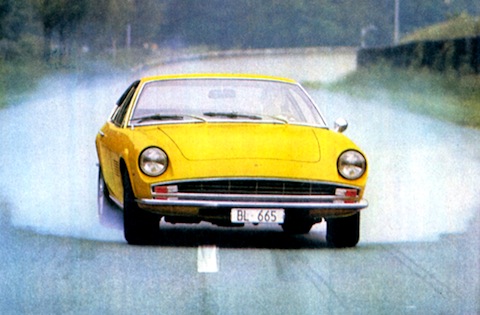
Things were different in the past. A whole series of innovations, inventions and technical refinements have brought us to the safe braking vehicle. Let's list a few of them:
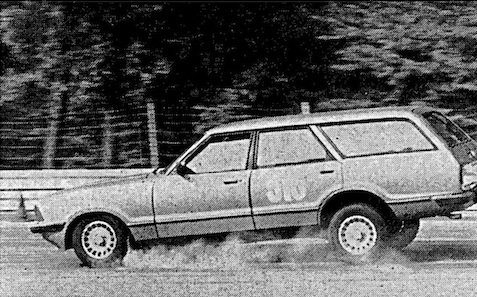
ABS, the anti-lock braking system, is probably one of the most important technical achievements, which was hesitantly installed in expensive vehicles in the 1980s, but is now standard. The ABS prevents the wheels from locking and, in particular, ensures steering ability during emergency braking maneuvers. While the braking distance can be short at lower speeds even with locked wheels, it increases considerably from starting speeds of 40 or 60 km/h if the wheels are stationary. The ABS therefore also helps with straight-line braking maneuvers. In particular, however, it also prevents the vehicle from skidding, which of course makes braking much safer.
However, the idea that it could be a good thing to brake all four wheels came about much earlier. In the early days, many vehicles were only braked on one axle, usually the rear axle. It goes without saying that this made it impossible to stop on the poor roads of the time. In addition, the rear axle can only make a small contribution to braking compared to the front axle, as anyone who rides a bicycle or motorcycle knows and can therefore decide for themselves how they want to brake. Before the war, it was definitely worth mentioning if a car had four-wheel brakes.
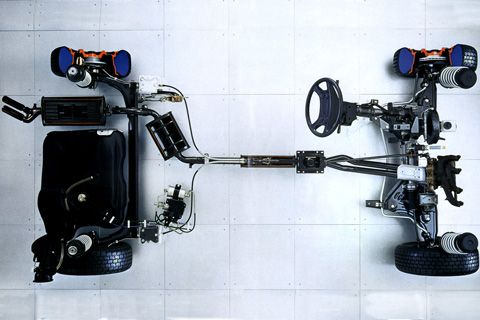
Jaguar introduced disc brakes at Le Mans in the 1950s and thus gained a major advantage, not only in terms of pure braking performance, but also in terms of operability and durability. Some car manufacturers began to install the new brakes first at the front and then later at the rear.
Power assistance makes braking easier, not necessarily better. However, many drivers today would hardly be able or willing to apply as much force to the brake pedal as would be necessary for emergency braking without power assistance. Modern cars go one step further: the vehicle electronics analyze the driver's activity and deduce whether emergency braking is necessary and then increase the braking pressure disproportionately. In addition, modern braking systems autonomously ensure that the brakes can be applied without delay even in wet conditions by repeatedly removing the water film by lightly applying the brake blocks to the disk.
Another important advance is the improvement of the chassis. When cars dive heavily at the front, they take the load off the rear wheels and give away braking power. Anti-dive devices and similar concepts help to make the car more stable and easier to brake.
However, tires play a major role in shortening braking distances. Thanks to better rubber compounds, larger contact surfaces and optimized treads, they probably contribute the most, alongside ABS and four-wheel brakes, to today's reduced braking distance of up to 30 m from 100 km/h to 0.
If you think about all these innovations and developments, you can imagine what an adventure it must have been in the 1920s to bring a car that was already traveling at over 100 km/h to a standstill! It took a lot of strength and skill to avoid leaving the road or hitting an obstacle. But even in the 1960s, there were many, many meters of braking distance between the expert and the beginner when a hard stop was required. Stutter braking, intermittent braking, a healthy sensorium in the butt and a lot of foresight helped to avoid accidents and drive fast laps on racetracks.
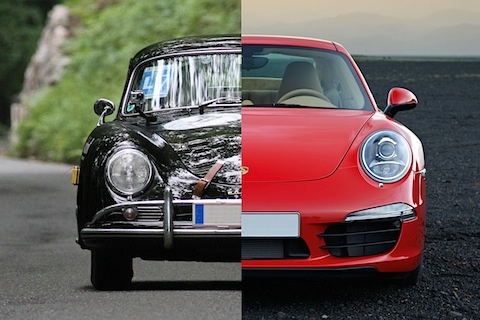
Incidentally, today's 30-40 meters for the braking maneuver from 100 km/h to 0 km/h can be compared with 45-60 meters for a car from the 1960s, which can be extended to 120 or 150 meters if you take cars from the 1920s and 1930s into account. If the modern car is stationary, an old car braking at full speed can still be traveling at 40 or 60 km/h and therefore has no chance of avoiding a crash if the distance to the car in front is short. This is why it is so important for classic car drivers to be very anticipatory and attentive behind the wheel.