Once upon a time... the five-valve engine


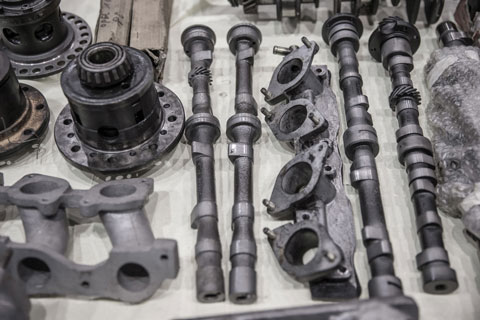
Five valves per cylinder—that sounds pretty exotic these days, as if it were from another era. And it is, because about fifteen years ago, the last new car with a five-valve engine disappeared from showrooms here.
It all started, of course, in motorsports. In the late 1980s, Ferrari won a whole series of Grand Prix races with twelve-cylinder engines, each featuring three intake and two exhaust valves per cylinder. Others followed the trend but were less successful—or even unsuccessful—such as Subaru's Motori Moderni. Five valves allowed for higher power output under the regulations in effect at the time.
But while Ferrari had already moved away from five-valve technology in racing by the early 1990s, the five-valve design was just coming into its own in production car manufacturing.

The first five-valve engine sold in large-scale production, however, was not the one in the Ferrari F355—as many people might think—but the three-cylinder engine in the Mitsubishi Minica. Thanks to three intake and two exhaust valves, the 548 cm³ three-cylinder engine produced an impressive 64 net PS in 1989, which corresponded to a specific output of 117 PS per liter.
It was the Volkswagen Group that then helped bring five-valve technology to truly large-scale production. The engines were given additional designations such as “5V” or “20V” and were available in a wide range of displacement classes from 1.8 liters to 4.2 liters—that is, with four, five, six, and eight cylinders. They were sold in models such as the Audi A4, Audi A6, Audi A8, VW Golf, VW Bora, VW Passat, Skoda Octavia, and Seat Ibiza. Around 2010, the era finally came to an end. Even the Ferrari F430, which succeeded the F355 and F360 in 2004, featured only four valves per cylinder.
The fact that five-valve engines are no longer used today is primarily due to technical and commercial reasons. The use of turbochargers allows for high power output even with fewer valves. The energy efficiency of five-valve engines suffers from suboptimal swirl. Five valves and the space they require are difficult to combine with direct injection. And finally, the installation and control of five valves are complex, cost more to produce, and add weight.

Incidentally, I myself once owned one of these five-valve engines. I wouldn't even have remembered the exotic valve train if I hadn't been writing this blog. Back then, the 1997 VW Passat (B5) 1.8 T was simply a snappy station wagon to me. I didn't keep it for long; it soon had to make way for a six-cylinder.