The older gasoline engines are not the big polluters at all


More and more cities are banning older diesel cars from entering their streets, entire stretches of road and neighborhoods are being closed. Stuttgart, Paris, etc., are all affected and the owners of older vehicles are of course also affected. When it comes to banning older diesel cars, the motto is that if you can ban older diesel cars, you can ban old petrol cars as well.
Yet petrol engines from Euro 2 are still better in terms of NOx emissions in real driving conditions than modern diesel engines with Euro 6, as new tests in real driving conditions (!) now show.
The Office for Waste, Water, Energy and Air (AWEL) of the Canton of Zurich has been measuring air quality in a suburb of Zurich (Gockhausen) for over 20 years using the RSD system (Remote Sensing Detector). This system measures the exhaust gases of passing vehicles at the roadside without contact. These are therefore measurements in real driving conditions around the clock throughout all seasons, not test bench trials. All the more interesting are the results, which, thanks to sophisticated data analysis, even allow conclusions to be drawn about individual vehicle and age groups, because not only are the exhaust gases analyzed, but the cars are also identified on the basis of their registration.
New results have just been published and they show that petrol cars perform significantly better than diesel cars in terms of NOx levels and that even Euro 1 petrol cars are only slightly higher than the NOx levels emitted by modern Euro 6 diesel cars. It is also apparent that petrol engines usually just meet or even fall short of the NOx levels stipulated by law across the individual emission standards.
Here is a brief digression on the Euro standards. Euro 1 was introduced on July 1, 1992 and applies to new vehicles from January 1, 1993. Euro 2 followed in 1996, Euro 3 in 2000, Euro 4 came in 2005, Euro 5a four years later, etc. All of these standards continuously tightened the emissions of CO, HC and NOx, but even before this, petrol cars with catalytic converters were already significantly better than required by law, as some classic cars with catalytic converters from the 1980s comply with Euro 1 or even Euro 2. The majority of youngtimers, however, must comply with Euro 1 to Euro 2.
The Awel measurements now show that these cars in particular perform quite well, with Euro 1 cars emitting as much as 10 percent less NOx than required by law. The Euro 2 vehicles produce slightly more (1.3 x), but significantly less in absolute terms (4.7 grams per kg of fuel) due to the stricter quantities and are therefore better than the Euro 6 diesels (8.0 grams per kg of fuel). Incidentally, at 18.6 grams (Euro 5) to 14.6 grams (Euro 1), the earlier diesels were actually significantly worse NOx producers than the petrol engines.
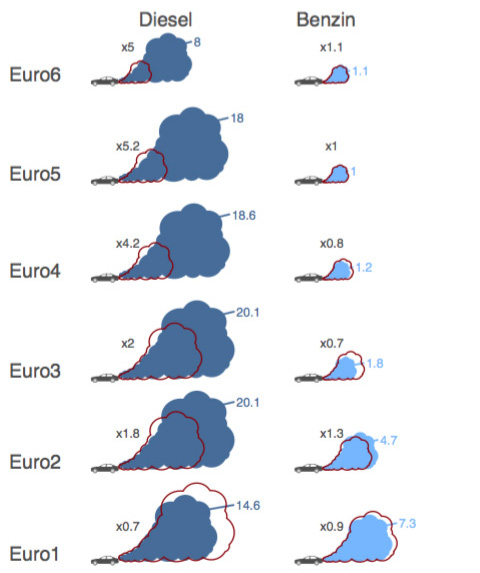
The above graphic from the latest AWEL report shows the real NOx emissions schematically for passenger cars: filled exhaust gas clouds symbolize the average NOx emissions on the road, open red symbols show the limit values from the type approval (converted into g/kg fuel); coloured figures = real NOx emissions (g/kg fuel), grey figures above vehicle = real emissions NOx factor (emission : limit value); representation freely adapted from ICCT.
Long story short. The older petrol engines are better than their reputation and it makes no sense, at least in terms of the NOx problem, to impose driving bans on youngtimers.