A Volkswagen as a packhorse
More than half a century ago, working from home was still commonplace. A large number of products were created in this way, even in the most remote mountain valley. One example of this was handmade wood chip products, which were carried and delivered many kilometers to the workshop due to a lack of alternatives,
In 1952, Ernst Bühler, the owner of one of these wood chip workshops, bought a Volkswagen Beetle to make life a little easier for himself and his home workers. The modern mobility solution was also appropriate, as there would have been no other way to handle an order from Chocolat Tobler to deliver several thousand boxes of praline per year.
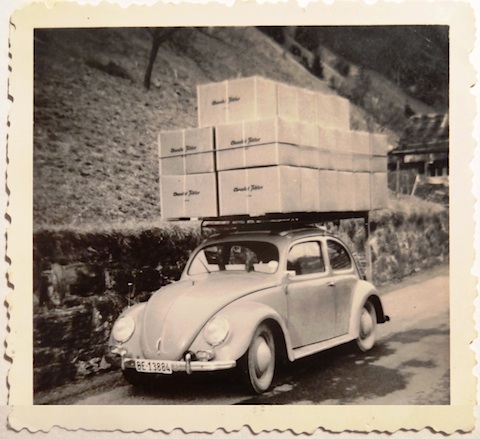
As is well known, however, a Beetle has little storage space under its front hood, so Ernst Bühler developed an extended luggage rack, which he supported on the front and rear bumpers. The Beetle became a pack mule.
The load often exceeded the volume of the car (see picture). Bühler could use the Beetle to get close to the home workers, who transported their finished products down to the valley by cable car or hand-drawn sledge.
Incidentally, the writer of these lines also learned the art of driving on this VW, which was still equipped with a non-synchronized gearbox. Gear changes with a well-tuned dose of intermediate throttle became as natural to him as steering or braking and later allowed him to travel halfway around the world with track-laying machines. And so, in his younger years, he taught machinists at numerous railroad companies around half the world how to handle straightening, levelling and tamping machines correctly.