Classic car adventure
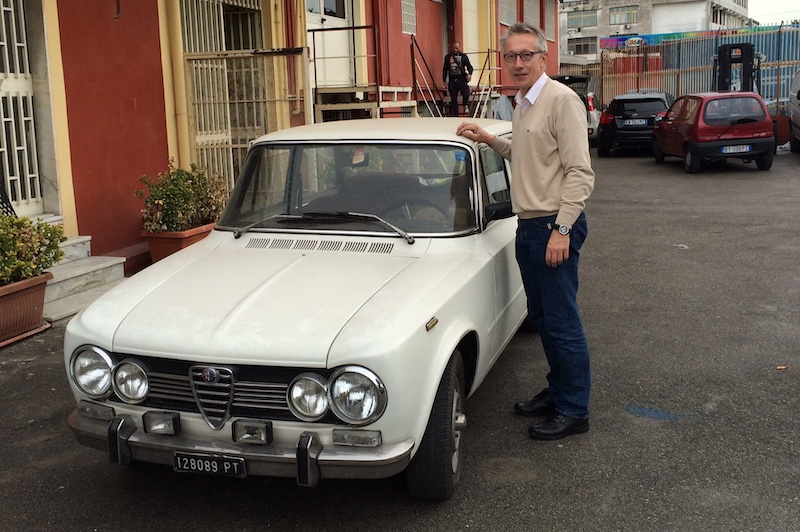
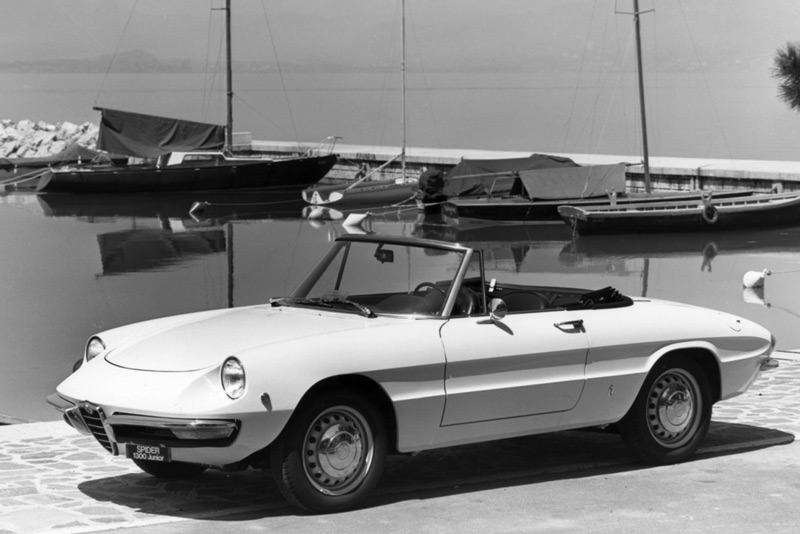
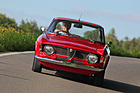
My first car was an Alfa Romeo Giulia Super in the 70s. Even though I experienced a Waterloo with its technology as an inexperienced 18-year-old, I loved the little Juliet. Even my girlfriend at the time, who is now my wife and has little affinity for cars, still gets bright-eyed when we see a Giulia. So it was clear early on that we wanted to own another Italian work of art one day.
After all, anyone can buy a car in Wanne-Eickel or Bad Wörishofen. No - an old Alfa has to be from Italy, I said to myself a few years ago. Autoscout24.it has numerous offers, including for Giulias built between 1970 and 1973, but it's difficult if you don't speak Italian.
I study the ads together with a friend who is Italian and makes the calls for me. It's not as easy as it sounds, because if you don't speak to the seller yourself, you can't get a feel for their seriousness or the condition of the car. But we are lucky and come across a white Giulia Super 1300 TI, built in 1973 with an alleged 126,000 km, parked in Naples. And the best thing is: the seller speaks English. So I can conduct the rest of the negotiations myself.
At the beginning of December, I fly to Naples to view the good piece. The salesman, with whom I am now on friendly terms, has a medium-sized company, but not in the car industry, and picks me up at the airport. We drive to his company, where the Alfa is kept in a garage. On the way, we stop off at a café, where Pietro invites me for a cappuccino. That's the way it is here!
The Giulia is in good condition from above, but looks worse from below, but nothing I wouldn't trust myself with. The biggest disadvantage is that the car was originally wine red and was only later painted white. That's not really an option for a classic car. However, this disadvantage is offset by the fact that Pietro speaks English and is also an incredibly nice guy.
The test drive is a little difficult. The Alfa is registered but not insured, which are two different things in Italy. Pietro sends an employee with another vehicle onto the road to see if the police are lying in wait. Then I drive the route in the Giulia. Of course, I can't do much testing this way, but the car drives and brakes reasonably well and the gears shift perfectly.
For me, a classic car is not just about the vehicle, the history also has to be right. The white Giulia has been in the family since the beginning. Pietro's father acquired a small collection of Italian cars, which he used to tinker with with his son in his spare time. Unfortunately, his father passed away two years ago and now Pietro no longer enjoys the cars because they remind him too much of his father. That's a wonderful story. We come to an agreement.
How do I get my acquisition to Moosburg in Upper Bavaria now? Hire a contractor to transport it, again, anyone can do that and it wouldn't fit the story. No, I have to drive the Giulia through Italy on my own and deliver it to its new home! Pietro assures me that he was still in Milan with the car last year, so it is suitable for long journeys. We make an appointment and I arrange everything with the traffic office to get German short-term license plates. These are valid, or at least tolerated, throughout the EU. Two days before the appointment, Pietro asks me if I can also come with customs license plates. That would be easier for him to deregister the car in Italy. I enter "customs license plates" into Google and find the following entry: "Warning! - German short-term license plates not valid in Italy..." In the entry, numerous Germans report how they were stopped by the Italian police because of the German short-term license plate, their vehicle was confiscated and they were only released after paying a fine of € 1000. A call to the ADAC confirmed this practice of the Italian authorities. I had to get Italian short-term license plates. I would have to find out for myself how to get the necessary Italian insurance and they wished me good luck. After consulting with Pietro, this option was no longer possible, as he had been told by ACI Naples, which is responsible for vehicle administration, that they do not issue short-term license plates at all.
Weeks pass, during which we explore all the options, such as a car train, collection with our own transport trailer, hiring external companies, etc. In the end, Pietro finds the opportunity to buy 5-day insurance for his Italian license plate. I can drive home with it, send the plates back to him and then he can finally deregister the car in Italy. He's not entirely comfortable with this, because any traffic violations I commit during the five days will be at his expense and he also has to rely on me actually sending the plates back to him, but he's a really nice guy.
During the inspection, I noticed that the Giulia's tires still had good tread, but were already 15 years old. When I tell my wife and her car expert sister that I want to cross the Alps with it in January, I can't expect any more support from them, except perhaps that they will order the men in the white coats for me. Oh well - I still have snow chains in the cellar. Although they are actually for a different tire size, they might also fit the Giulia. In any case, they fulfill the requirement of the northern Italians and Austrians that you have to carry chains in winter.
At the end of January, the time has come: I have two and a half days, although I actually have another important appointment on the second day. Unfortunately, the Naples flight doesn't leave until the afternoon, so I can only drive north for about three hours that day. But if everything works out, the following day should be enough for the rest of the 1200 km. Provided that nothing serious comes up.
On the plane to Naples, I sit next to an incredibly nice and talkative Italian woman. She works for the Italian government in Brussels. I learn a lot about the mentality of the Italians and the Neapolitans in particular. That's a great way to get in the mood. I get off the plane in Naples at 7° and in the rain. The first car I see is an Audi with a temporary license plate from Landshut. Pietro is not there, but has texted me that he has been delayed. I have the opportunity to watch the hustle and bustle outside an Italian airport for 45 minutes.
When Pietro arrives, we first have to drive to Naples station to pick someone up from there - in the evening traffic. Like all drivers, Pietro uses every square inch of the road and drives into every conceivable gap that I hadn't even anticipated. Nobody honks, nobody flashes, everyone is totally relaxed, while Pietro talks to God and the world on the phone.
He hands me the phone. He wants me to call a car dealer in Frankfurt. He wants to buy a car from him, but there are problems with the VAT and the German wouldn't understand English. I can arrange the deal for Pietro.
We make another detour to a garage. Pietro has to sort something out with the cartridge. He's had another inspection done on my Giulia so that I can get home safely! Almost two hours later than I had hoped, we arrive at Pietro's company, where the Giulia is waiting for me.
We first go to the office to deal with the contract and payment. There is a large washtub in the middle of the room that catches the drops coming from the ceiling. It doesn't rain that often in Naples. The secretary serves espresso. I'm not really a fan of it, but this is delicious. The five days of insurance have been running since yesterday, so I have the rest of today plus three days to reach Germany. But I don't have that much time anyway. I have to be home tomorrow evening, or maybe the day after tomorrow in an emergency. Pietro books me a hotel room in Orvieto, about 100 km north of Rome. The concierge wants to wait for me until midnight.
The Giulia is ready for me, freshly washed. The washing was a waste of time in view of the weather. I try to install the sat nav I brought with me, but the cigarette lighter has no power. We can forget about that. It's a good thing I've also brought a road atlas. However, it covers Italy on a single page.
The Giulia's engine starts at the first turn of the key and we drive to the filling station together. It's raining cats and dogs. My right hand searches in vain for the windshield wiper lever on the steering wheel. I remember: the toggle switch for the windshield wiper is in the Giulia on the center console next to my right calf. I won't have to look for the switch often. By the time the wipers stop working completely, it will be raining all the time.
On the way to the filling station, I notice that the red generator light is on. Pietro reassures me: it comes on from time to time, it doesn't mean anything. A windshield wiper flies off at the petrol station. Luckily it didn't happen on the road and we find it again straight away.
I fill up the tank and we drive back to Pietro to repair the windshield wiper. Adhesive tape and a cable tie do the trick. Then it's time to say goodbye. The secretary takes a photo of the two of us with the Giulia. Pietro has tears in his eyes. The Giulia has been with him all his life.
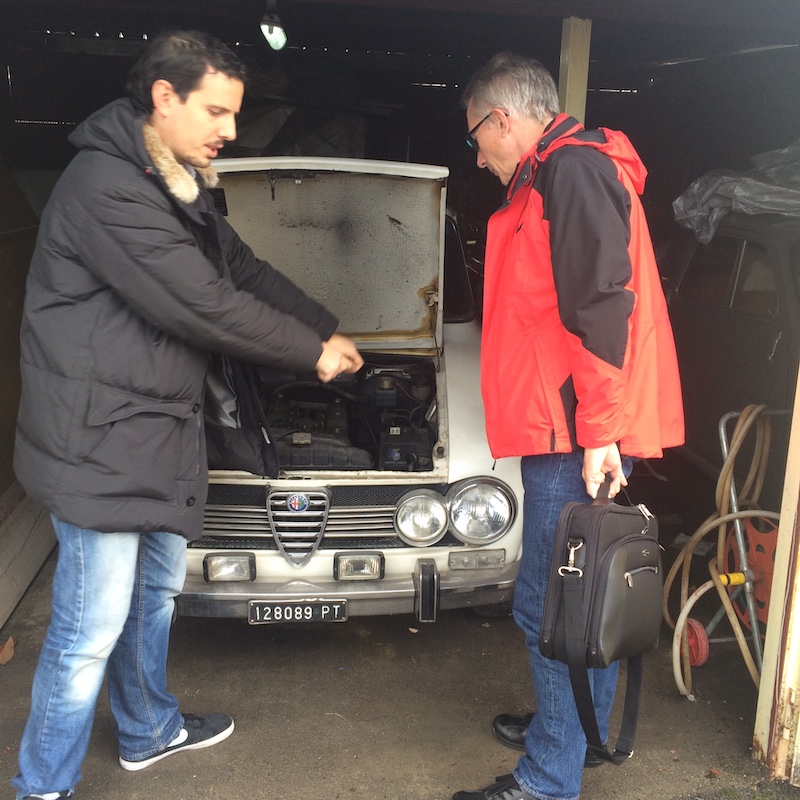
Since my navigation system isn't working, Pietro drives ahead of me as far as the highway. At the first traffic circle, an optimistic southern Italian squeezes between us and forces me to brake hard. In any case, the Giulia's brakes are fine and I'm wide awake. I've familiarized myself with the location on Googlemaps, but I don't recognize anything. The reality of Naples looks completely different. Without Pietro's guidance, I would still be wandering around Campania today. When we reach the autostrada, the hazard warning lights on his car go on and the horn sounds three times. Now I'm on my own.
The six-lane highway is excellently developed and could easily handle 220 km/h. In the land of Ferraristi, the speed limit here is just half that. But I don't want to put too much strain on the Giulia anyway, so I stick to the limit. The engine runs smoothly, the car drives straight, even if the steering wheel is a little askew. The blinker lever takes some getting used to, as it feels like a spoon stuck in pudding. At the same time, the lever needs to be moved properly, from stop to stop by what feels like 30 cm. Operating the blinker with your little finger is not an option here.
The red generator light goes out, so Pietro was right. After trying all the positions of the two heating and ventilation levers, I realize that the heating doesn't work. No one has probably noticed this in 40 years in southern Italy. I pull out at the next rest stop, put my jacket back on and get my hat and gloves ready. The cold in the car has another disadvantage: the windows are constantly fogging up. Maybe that's why Pietro has left two packets of paper tissues in the car. Will I have to get an ice scraper when the windows not only fog up later in the Alps, but freeze over?
It's still raining, the windshield wiper just spreads the water evenly over the windshield. Original parts are required for a classic car, but it is still advisable to use more recent wiper rubbers. However, I will appreciate this quality of visibility improvement later on.
The radio, where you have to search for stations by hand, stops working, at first intermittently, then completely. From then on, I let myself be entertained by the sonorous sound of the Alfa four-cylinder engine. The fuel gauge is also quite funny: on left-hand bends the tank is overfull, on right-hand bends the warning light comes on. The fuel level is still measured by a real float, which transmits the signals to the fuel gauge without electronic filtering. It's hard to imagine that today.
The red light comes back, but it doesn't seem to matter. In Rome, I seem to notice that the instrument lighting is getting weaker. That must be deceptive, because the city lights make the surroundings much brighter than before on the lonely highway. As the blinker slows down, I start to get a bad feeling. A little later, the windshield wiper also slows down and finally stops completely. Driving through the night in the pouring rain without windshield wipers is no fun. I pull over to a truck. That way I can keep in my lane and still make progress. At some point, the truck pulls away from me on an incline. I realize that I've pushed the gas pedal all the way down, but the Giulia can only manage 80 km/h. Once I've negotiated the incline, the car picks up speed again, but it's the same on the next incline: I shift down to fourth gear, but the Giulia is only doing 60 km/h. I also have to realize that after two hours of driving, my tank is almost empty. How much did that gas station attendant in Naples actually fill me up with? What am I supposed to do if the Alfa stops working completely in the middle of the night in the pouring rain without electricity or fuel? I imagine trying to get help over the phone in Italian.
It can't go on like this. When I reach a service area, I pull off the highway and into the gas station. Now I have to brake on the left so that I can keep the engine running with my right foot. I come to a halt at the petrol pump and recapitulate what I have left: The engine is running, but I shouldn't switch it off because the battery is probably flat. The lights are working reasonably well. I can buy gas here, but I can't spend the night. So I have to keep going. At that moment it gets dark. But it's not the Giulia that has gone out, it's all the lights at the filling station! The man in the ticket booth tells me: "Power cut. There's no gasoline. My options are getting fewer and fewer. There's no way I'll make it to Orvieto by midnight. I call the hotel and cancel my room.
I remove the key for the door lock from the key ring so that I can lock the Giulia with the engine running. Armed with my flashlight, I can at least make my way to the toilet. Once I'm back at the car, the lights at the filling station come back on and I can grab some gas. As I get behind the wheel and am still thinking about what to do, the generator light suddenly goes out, the instrument lights come on and the windshield wipers start working again. So I carry on. The engine power is also reasonable and I make good progress. I'm completely exhilarated, not a trace of tiredness. Where am I supposed to find an open hotel at this time of night? I decide to drive on until I come across a motel sign on the highway. But suddenly the red light comes on again. It's 00:30, I'm 10 km from Orvieto and decide to head for this town after all. And I'm in luck: there's an open hotel right at the entrance to the town, right next to a petrol station. After the porter has given me a room, I go outside and switch off the engine. Will I ever be able to bring it back to life? Anyway, it's time to get some sleep. But it's not until an hour later that tiredness overcomes me.
Driven by worries about my progress, I wake up after four hours. There's a hell of a noise - a downpour is drumming on the tin roof outside my window. There is also thunder and, yes, lightning can be seen through the curtains. It's January! I feel like I've been transported 3000 km south. Sleeping in is out of the question, so I head to the breakfast buffet at 6.30 am and combat my lack of sleep with cappuccino, which tastes simply divine. There are several burly truck drivers in the breakfast room. They would be just right to push my Alfa. But by the time I've finished breakfast, they've all gone.
I pack my things, pay for my room and sit in my car without any ideas. Without hope, I try turning the key. The engine starts on the first stroke! Signs and wonders are still happening! Even the red light is off. I drive over to the gas station and fill up the tank. The thunderstorm has also moved into the mountains, it's dry!
Back on the Autostrada, everything looks good. The Alfa is running, the weather is good and there is hope that I might be able to get the Giulia home on its own wheels after all. But after 60 km it starts again - loss of power. On inclines, the speed drops to 40 km/h. I drive in third gear on the hard shoulder. Now, in the light, I can see that I'm trailing a plume of smoke behind me. The Italians are understanding: nobody honks, nobody gets upset. But how is this supposed to continue? An unloaded car transporter overtakes me. It has an Aichach license plate and is therefore going the same way as me. But before I can react and draw his attention to my predicament by honking and flashing my lights, he has disappeared over the horizon. Catching up is also out of the question. This must be what a castaway on a desert island feels like when a ship passes by.
I notice that my tank is half empty after 70 kilometers. The Giulia is now running on empty and I take an exit. The cashier at the toll booth tells me the way to a garage. But my engine is only running at 1200 rpm, regardless of the accelerator pedal position. However, it maintains this speed even with first gear engaged. That still gives me 10 km/h. So I jerk and jerk my way to the garage described and stop 100 Italians in the morning rush hour traffic. But again, nobody gets upset. An Alfa driver with the old black Italian license plates can get away with anything here.
With one last rattle, my engine stops in front of the workshop's repair reception. Two mechanics, who could have come straight out of the latest cliché movie, rush out of the building: unshaven, hands and faces smeared, but with shining eyes and expressing their enthusiasm for my Giulia with a "bella Macchina". They even speak a little English and I can make them understand that my macchina is not running so bella at the moment. The taller of the two, whose name must be Luigi, taps the candele, the spark plugs. That could be it and I ask him to unscrew them. What comes to light is a picture of a spark plug that resembles a briquette. Either these plugs have been in use for 42 years or they have been damaged by the loss of voltage in the electrical system last night. Four new plugs are quickly found and screwed in. The engine starts at the first turn of the ignition key, runs beautifully and purrs like the much-cited kitten!
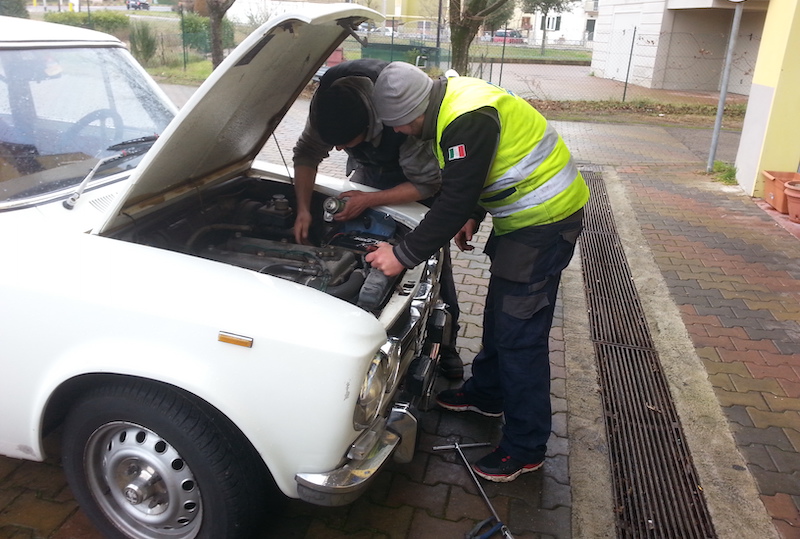
But the red light is back. Luigi and his partner check all the contacts, wipe and clean and spray with contact spray, but it doesn't help. They recommend that I install a new alternator. I doubt that they have an original part, and it has to be for a classic car. I don't want to get involved with delivery times; the time it would take to replace it would prevent me from reaching my destination today. I decide to drive on. The alternator light went out by itself yesterday evening. I'm charged €25 for the spark plugs - for each one, mind you! So the guys are business-minded too. Accompanied by best wishes, I set off again.
I have covered 80 km in two hours today. I won't reach my destination at this pace in the time available. Back on the Autostrada, the Giulia runs with an unprecedented ease. I have to pull myself together to keep to the prescribed speeds. I simply ignore the red light. But it starts to rain again, in tropical proportions. The highway gets twisty and mountainous, the rain gets a little weaker, but turns into sleet. And I'm not even at the Brenner Pass yet, but 100 km south of Florence! Will the snow chains work after all? Before I can think about what the lights, windshield wipers, fan and heated rear window are doing to my battery, the red light has a change of heart and goes out. It doesn't actually look too bad now, because the road is also well gritted and doesn't give the snow a chance to stick.
The rain even stops near Bologna and I recapitulate: the engine is running perfectly, the generator light is off, the road is soon dry and the sun comes out in Modena. What more could I want? In the northern Italian lowlands, the radio comes back on and plays Italian pop songs. Life can be so beautiful! The Alps come into view, the mountain peaks are lightly powdered with snow, a postcard panorama! The highway through the Adige Valley up to the Brenner Pass is dry and stays that way.
At the last Italian toll station, my engine cuts out - and won't start again, the starter won't budge. But I don't let little things like that upset me any more. A friendly Italian from the following car helps me push. Together we quickly get the engine running again. I have to switch off the engine again when I go to Austria to buy a pickerl and refuel. When it doesn't start again, a Pole who is also filling up there helps me.
The fuel, which was surprisingly expensive at the Austrian filling station, is only supposed to last as far as the German border. However, the fuel consumption is now so low that I have to fill up at home.
I reach Moosburg at 6.30 p.m. and head straight for the police station to get confirmation that my Alfa is in Germany. Pietro needs this for the deregistration in Italy. The policeman doesn't want to give it to me. He's not responsible for that and anyone could come. I ask him to give me a ticket because I'm parked in a disabled parking space. The €15 would be worth it to me. He refuses to do that either. He points out to me that I would be fined € 50 for deliberately parking in the disabled parking space. I must be happy to get away with it. The police, your friend and helper - that was the old days.
Nevertheless, I finally reach home overjoyed and park the Giulia in the garage, which it won't leave for the next few months. If the restoration is as exciting as the drive home, then the two of us still have some adventures ahead of us, I thought at the time. To be continued, i.e. the restoration story ...