200 years of speed rush


A horse at a gallop can reach around 60 km/h for a short time. For thousands of years, this was probably the highest speed that a human could experience more or less safely - camels don't run any faster, by the way. As the painter Jean Louis Theodore Gericault shows in his 1821 painting "Derby of Epsom" (above), the horse gallop was the epitome of speed. Well, perhaps somewhere in the past someone got into a cart and rumbled down a road. However, at 60 or 70 km/h, this is unlikely to have gone off lightly. Even a Roman road would probably have been too bumpy for that.
A smooth ride on wheels at the speed of a horse was only possible with the invention of the railroad. However, the first proponents of this idea did not travel on the slick tracks of today, but on wrought-iron tracks about one meter long. As you can imagine, this was an unparalleled rumble. And yes, the railroad also initially relied on horsepower. And it was not used to increase the speed of travel, but to increase the payload that an animal could transport. More speed was only achieved by replacing the quickly tiring animal with the fatigue-free machine.
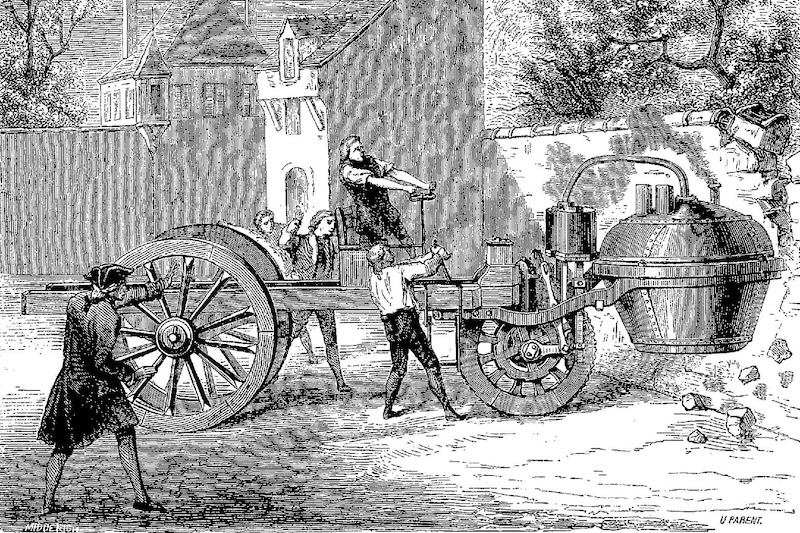
Two men were not enough, the Fardier rammed a wall in 1770
Cugnot, whose "Fardier" I have already mentioned here, tried to overcome the poor, maltreated nags' lack of stamina with a steam carriage as early as 1769 - unfortunately without rails, as the vehicle failed due to its virtually unmanageable design. The first "automobile" driving test in history ended in a brick wall. Richard Trevithick, on the other hand, drove a steam locomotive for the first time in 1804. This reached around 5 kilometers per hour and pulled several coal wagons and around 70 men with it. Of course, they could have walked at that speed. But at least a start had been made. Trevithick's "Locomotion" was heavy, however, and caused the forged rails to break again and again. And - like all these early railroads - it was primarily used to transport goods.
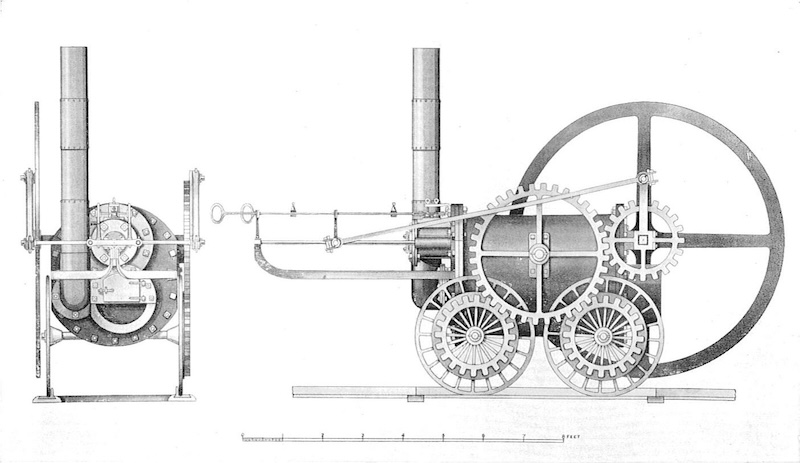
Richard Trevithick's Locomotion from 1804
Steam circus
In 1808, Trevithick designed his last locomotive and appropriately named it "Catch me who can". This was not without reason: the engine reached a measured 19 to 24 kilometers per hour during demonstration runs. Passenger rides were also offered for the first time on the line in Bloomsbury near London. This railroad served no transportation purpose, but was more of a fairground sensation. After all, it was the first time that it was possible to travel on a machine for money - and faster than a pedestrian.
However, the first public railroad went into operation in 1825 with the line from Stockton to Darlington, 200 years ago. Robert Stephenson had constructed "Locomotion No 1" and it was this locomotive that ran the first real passenger train in world history. On its opening day in September 1825, the train took exactly three hours and seven minutes to cover the 40-kilometre route from Darlington to Stockton with up to 550 passengers on board. In between, there were two stops totaling 55 minutes. Once, one of the carriages lost a wheel and a second time the locomotive needed a small repair. Nevertheless, hardly anyone would have made the journey on foot in this time.
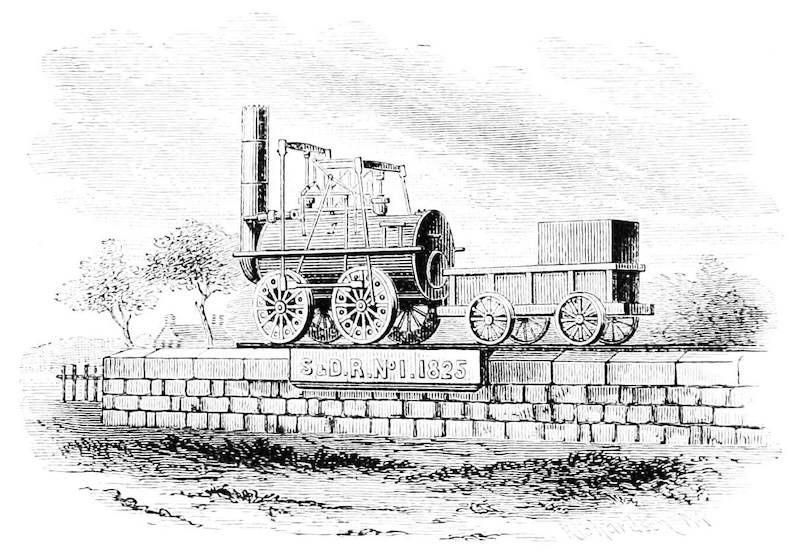
The Locomotion No. 1 as a memorial to the 50th anniversary of the Stockton - Darlington Railway in 1875
After that, the United Kingdom moved forward with seven-league boots. Stevenson's "Rocket" was already reaching 48 kilometers per hour in 1829, and in 1830 his "Northumbrian" for the Liverpool and Manchester Railway was already marching at 64 km/h - the horse had caught up, and not just for short moments, but as a cruising speed. And as early as the 1840s, an Iron Duke class engine of the "Great Western Railway - GWR" reached a guaranteed 129 km/h on a broad-gauge track with a gauge of 2140 mm. From 1852, the GWR express train ran with such engines from London Paddington station to Exeter (312 kilometers) at a scheduled average speed of 85 km/h.
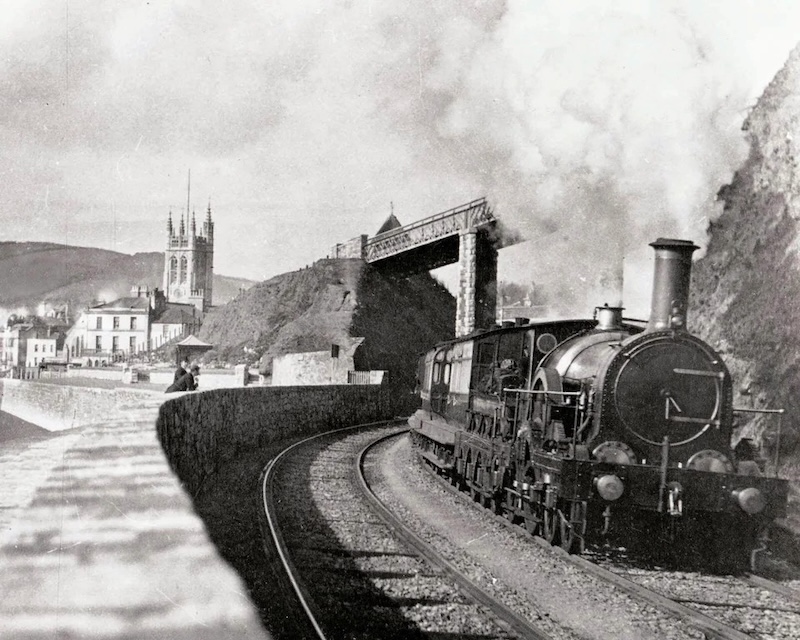
Great Western Railway broad-gauge locomotive of the Iron Duke class in Teignmouth - the first to exceed 100 km/h in regular service
Even 175 years ago, those who weren't afraid of smoke could stick their heads out of the carriage window and really let the wind blow in their faces. The car was still a while off, but 200 years ago, mankind got its first taste of what it felt like to race through the countryside faster than a gallop.