Ferdinand Piëch - the man behind the Porsche 917 (obituary)


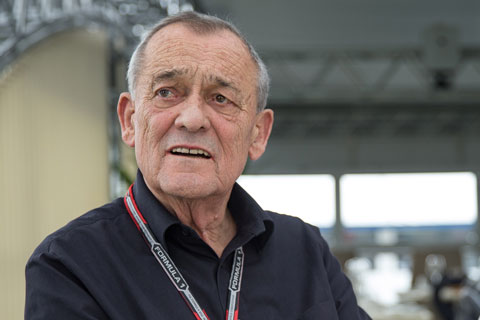
On Monday, August 26, 2019, Ferdinand Piëch passed away at the age of 82 in a restaurant in Rosenheim. He was the grandson of Ferdinand Porsche and worked for Porsche, Audi and finally Volkswagen. He was the man who turned the sleepy Wolfsburg-based company into a global corporation with around 600,000 employees and 12 brands, including VW, Audi, Porsche, Skoda and Seat.
Piëch was regarded as a brilliant engineer, but he was also feared and even hated by many throughout his life. He was considered a fantastic engineer and was probably the last top manager of a car company who built cars and engines himself.
His mother was the daughter of Porsche founder Ferdinand Porsche and his father managed the VW plant in Wolfsburg, which was founded by Hitler, during the war.

Born in Vienna on April 17, 1937, the Austrian went on to enjoy a fabulous career which, after a short time at the helm of Audi, led him to the Volkswagen Group, which he headed from 1993 to 2002. At Audi, he was largely responsible for the Quattro and its profitable participation in rallies.
Piëch said at the time in an interview with Auto Motor und Sport:
"I already had the idea before my time at Audi. So it's much older than many people think. I was still at Porsche at the time. Head of Development Helmuth Bott and I had bought two Jensen cars from England. One with all-wheel drive and one with two-wheel drive. However, the one with two-wheel drive was much faster on the skidpad than the four-wheeler because its suspension was much less well tuned. We didn't bother to improve the Jensen four-wheel drive. We thought the English would have done the best they could. After that, the subject was forgotten again. ...
The idea was certainly also inspired by the Cisitalia with its selectable all-wheel drive. Then there was the Porsche 917 development up to the turbos, where we had too much power for two wheels. We used up to 1200 hp. A differential would not have been able to cope with the power, so we drove with a rigid through-drive. It would have been logical to distribute half the power to two other wheels, especially in the wet. ...
It was a black job. That's why we later needed the approval of VW's head of development, Ernst Fiala. We delivered the four-wheel drive Audi 80 to him in Vienna. His wife took it to a parking garage. On the driveway, the four-wheel drive got tense and the Audi 80 bounced around the bend. Fiala no longer wanted the car. However, the Audi 80 had already shown its talents on the wintry roads. Fiala said: "If you can get it to stop bouncing, it's a great car."
Later, Piëch's career at VW was not only marked by success, but also by many scandals. For example, there was the affair surrounding the manager José Ignacio Lopez, who was poached by GM and allegedly took many company secrets to VW.

In the 1950s, Piëch attended a boarding school in Zuoz in the Engadine and later studied mechanical engineering at the ETH in Zurich. His uncle Ferry Porsche then brought him to Zuffenhausen in the 1960s, where he became Managing Director in 1973. Piëch was then elected to the Audi Board of Management in 1975 and finally became Deputy Chairman of the Board of Management in 1983. He took over the complete management of Audi in 1988 and from then on, the Ingolstadt-based company had a new look.

The car enthusiast and technology freak bought Rolls Royce and Bentley in 1998, brought Lamborghini and Bugatti into the Group in the same year and, under him, VW acquired a stake in Scania in 2000.
He became known to everyone at the latest during the takeover battle between Volkswagen and Porsche. As a small sports car manufacturer under manager Wendelin Wiedeking, Porsche wanted to take over the much larger VW Group. But thanks to Piëch, the deal ended up the other way around. VW integrated Porsche AG into its group in 2012.
Piëch left Volkswagen in anger after a power struggle with his former pupil Martin Winterkorn. He even lost the backing of his family, so that he finally sold his share package with a market value of over one billion euros to the family in 2017.
Racing was also always one of his favorite playgrounds for technology. One of the best examples of his unique way of thinking was certainly the Porsche 909 Bergspyder. Piëch demanded that the car be as light as possible, so it was fitted with featherweight beryllium disc brakes that produced carcinogenic dust. Piëch reportedly ran a magnet over the entire car to ensure that not a single bolt, nut, or even a single steel washer was used.

His greatest achievement during his time at Porsche was undoubtedly the 917, which finally brought the Stuttgart-based company the long-awaited Le Mans victory.
The top manager and father of thirteen also showed that he could save money in the 1-liter car in which he personally drove from Wolfsburg to Hamburg for the Annual General Meeting in 2002.