70 years of AMS - congratulations (too)!

The magazine "Auto Motor und Sport" is celebrating a truly impressive anniversary with its 14/2016 issue. It has been 70 years since "Das Auto", the predecessor of Auto Motor und Sport, first appeared. Well, at least approximately, because it was in December 1946 when founder Paul Pietsch dedicated his own magazine to German-speaking car enthusiasts. 30,000 copies were printed. In 1951 it merged with "Motor und Sport" and from 1963 the magazine was called "auto motor und sport" and has remained so to this day. We can still remember the fat issues of the seventies and eighties, the many test reports that sometimes made us raise our eyebrows. The race reports and special features that shortened many an evening, many a waiting time and many a winter's day.

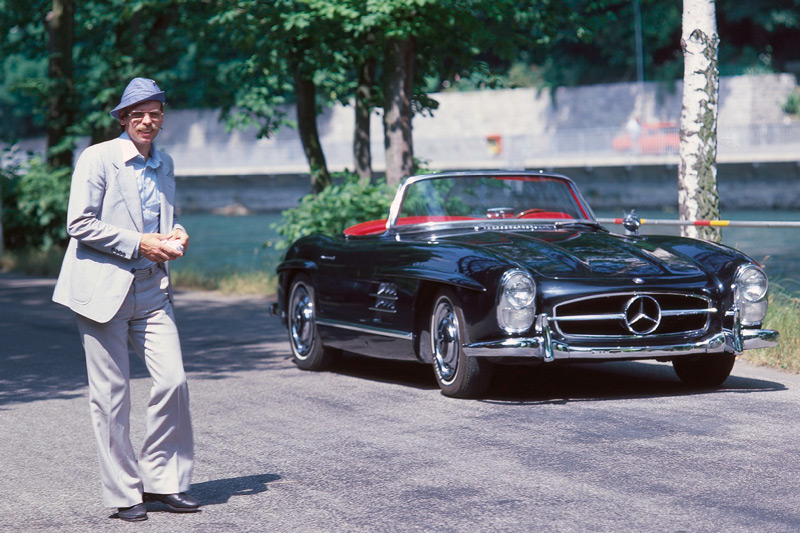
With 100 extra pages, the editorial team looks back on the last 70 years and takes us on a journey through time at the regular price of EUR 3.90 (if you buy the magazine in Germany). The review begins with seven car portraits of vehicles from seven decades - Mercedes-Benz 300 SL, Citroën DS 21 Cabriolet, Porsche 911 SC Targa, Audi Coupé Quattro, Opel Lotus Omega, Ferrari 430 Scuderia and Tesla Model S. But then it's time to get down to business.
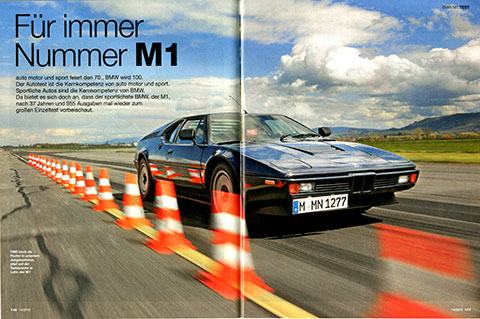
After 37 years, the BMW M1 once again takes part in the complete AMS test, is measured and chased around the test track. The mid-engine coupé takes 6.4 seconds to sprint from 0 to 100 km/h, but the 38.3-meter braking distance from 100 km/h is almost more impressive. The test consumption settles at 15.7 liters per 100 km, in "Eco" mode it is 275 km for a particularly economically driven lap over 275 km. The M1 is awarded five stars, with a wink of course, but a great deal of admiration.
Of course, the editors look back to yesterday's test methods, such as early measurements of braking distances or the emptying of luggage compartments.
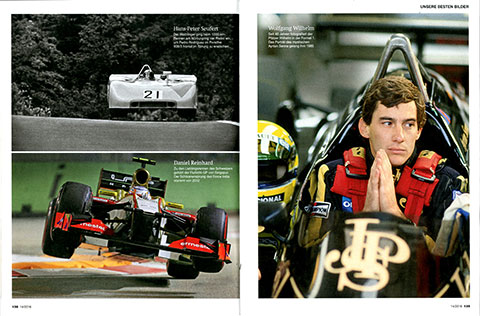
The photographers, who have of course had a significant influence on the magazines, are also honored, first and foremost Julius Weitmann, but also Hans-Peter Seufert, Wolfgang Wilhelm, Hans-Dieter Seufert and, among others, our very own Daniel Reinhard!
We also liked the infographic that looks back over the last 70 years. Here, for example, we learn that the number of petrol stations in Germany has fallen from 18,200 (1950) to 14,531 (2016). That's still okay. Or that 250,000 road accidents (1950) have now become 2,507,881 (2015), but that instead of 6314 (1950), only 3475 (2015) people died. And this with a passenger car density of 45 million (2016) instead of 700,000 (1950). Impressive!
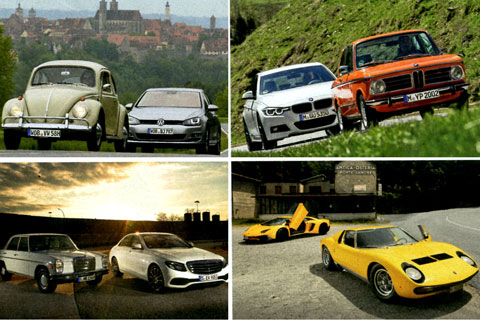
The development achievements are honored with four car comparisons within each brand: the VW 1200 Export Beetle is pitted against the VW Golf of the modern era, the BMW 2002 is compared with the modern three, the Mercedes /8 with the current E-Class. And as a highlight, the Lamborghini Miura and Aventator (both in yellow) are shown together (picture above).
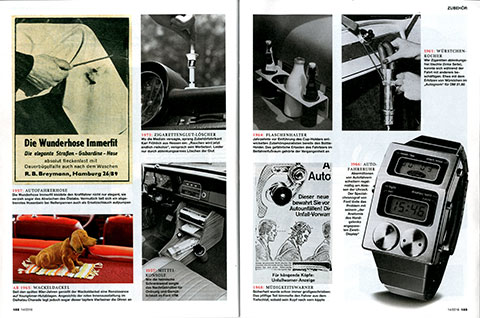
A very special treat are the various accessories that have been compiled on six pages, such as the sunroofs of the 1980s, the cigarette extinguisher (1973), the wobbly dachshund (1965) or the first bottle holders (1964). There was even a sausage stove back in 1961 and a fatigue warning device in 1968.
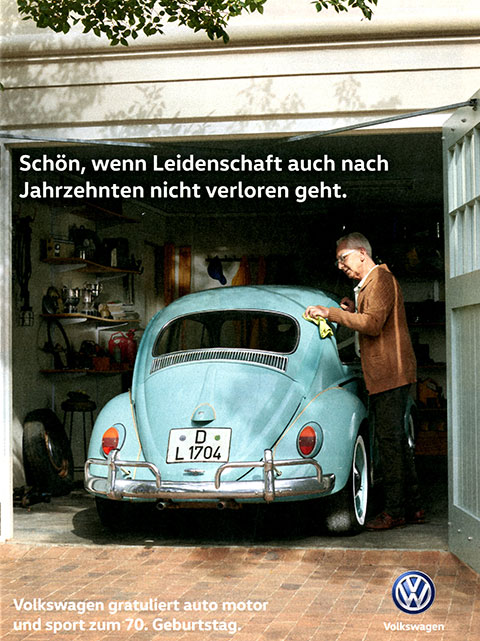
We then go back to the early days of his career with Walter Röhrl and accompany him on a drive in a Ford Capri Rallye. And of course there is also a Formula 1 review. A letter to Paul Pietsch, who died in 2012, unfortunately concludes the 100-page special section all too soon; we would have liked to read on. However, we also enjoyed the beautifully designed advertising pages throughout the magazine, which some manufacturers created specifically for the anniversary, such as Volkswagen, Alpina and Mazda.
We liked it, a lot. We therefore not only congratulate you on your birthday, but also on the magazine, which we have exceptionally included in our media library , which otherwise only shows magazines about old cars. And the remaining 190 pages are all about modern cars, for example the endurance test of the A-Class, which actually managed 100,000 km without breaking down, unscheduled workshop visits and the like. Yes, that was quite different 50 years ago. In those days, an endurance test ran for 15,000 or 25,000 km and there was a hail of problems.