The local racing drivers and the Barracuda

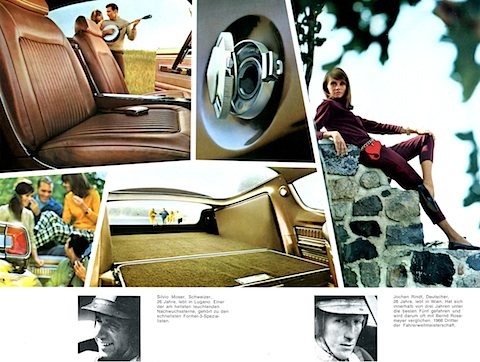
In 1966, the Swiss importer (AMAG) of the Plymouth brand came up with something special to prove the suitability of the Barracuda for everyday road use in Switzerland. The sales brochure read as follows:
"In the spring of 1966, world-famous motorists rushed the Barracuda from Chrysler along Swiss country roads."
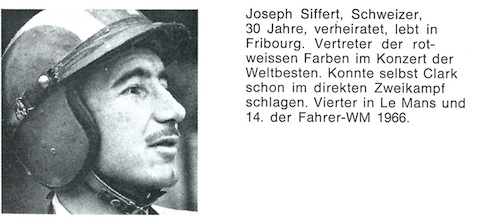
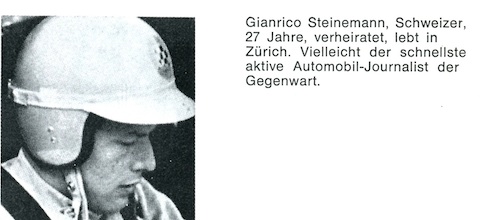
And of course these drivers were also shown in pictures and with a short biography. Alongside Silvio Moser and Jochen Rindt (above) were Joachim Bonnier...
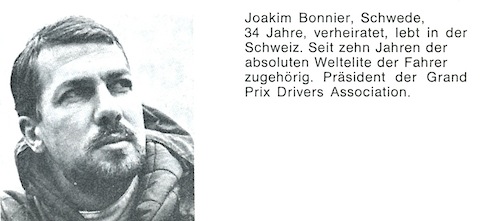
... Joseph Siffert and ...
... Gianrico Steinemann.
The text continued with:
"They had the task of chasing the Barracuda over bumpy roads, fast highways and through winding curves. They drove as sportily as the traffic situation allowed. Their superior driving skills allowed them to make full use of the Barracuda's capabilities.
It was a real experience to sit in the passenger seat.
The lightning-fast footwork, the full concentration, which was also transferred to the passenger and created a crackling tension in the car, was striking. The fairness towards other drivers was also interesting. The driving was extremely fast, but safe. Experts were at work, you could learn something.
A surprising conclusion was reached at the end of the whole event. The Barracuda withstands even the critical judgment of such spoiled experts."
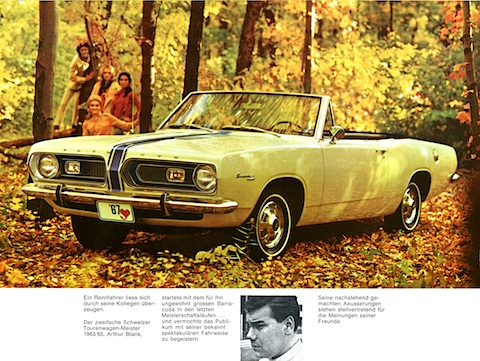
One of the racing drivers, Arthur Blank, was apparently persuaded to take part in car races with a standard Barracuda. Here is his résumé (probably sharpened up a bit by marketing specialists):
"Of course, I immediately realized that I would have to change my driving style if I wanted to win races with the Barracuda. The car had completely different external dimensions to my previous cars. What also made me skeptical was the purely standard material that I now only had at my disposal. Until then, I had been competing in touring cars that had been elaborately prepared for racing by the factory.
Of course, I was surprised when the Barracuda was still competitive. Various characteristics that I had noticed in American cars in racing
no longer applied. The thing didn't go to its knees under braking, the suspension felt pleasantly firm, even European. The Barracuda is not a rubber car.
American brakes have been criticized for years. They are said to be outdated and do not stand up to the demands of braking from high speeds. That was my opinion too, and I was almost afraid to brake the 1.4 tons from 200 km/h. However, my competitors soon made long faces, as I managed to outbrake the lightweight Europeans several times. The infamous fading effect of the disc brakes did not occur even after several laps of the Hockenheimring.
Power-assisted steering for racing?! I threw my hands up in disbelief. People wanted to kill me, what use was all my steering skill if I had to rely on the reaction of a hydraulic system? The Chrysler power steering then reacted just as quickly as I wanted it to. My scepticism towards the unfamiliar turned into enthusiasm for the technical perfection.
In my Barracuda S, I had a fully synchronized four-speed gearbox that was perfectly geared. In racing, fast times depend not least on how quickly the driver works and reacts. Tight, short shift travel and precise guidance of the stick allowed me to perform in my usual manner. I was faster than usual.
But I don't want to forget the most important point, the engine. Whereas in my previous competition cars I always had to be careful to keep the revs within a narrow margin, here I could allow myself to drop back by 2,000 revs and accelerate fully again without changing gear."
This was written in the 1967 sales brochure. Incidentally, the starts are documented! For example, in the report on the Mitholz-Kandersteg mountain race in 1966. Arthur Blank drove times of around 1:52 with the Barracuda, which was roughly on a par with a Lotus Elan or an Alfa Romeo GTA, not bad!
If you want to find out more about the Plymouth Barracuda , you should read the detailed report.