Luigi no more follow the Ferraris

Yeah, I know. With a two-and-a-half-year delay, you can leave a movie review alone. But I have to wait until the very latest films are shown on TV – and I happen to be sitting in front of it. Because films like Ferrari are the reason why I no longer go to the theater.
Films that are so convinced of their own glory that they think they can get away with anything – or rather, that they don't have to get away with nothing. Because Ferrari is exactly that: nothing. Not really a portrait, not really a company biography, not really a racing drama, not really a movie. We will ignore the fact that there was already an Italian television production with the same title in 2003, which is much more of all the aforementioned. That increases only the risk of confusion.
Admittedly: Gray-haired sourpuss with sunglasses has marital problems probably wouldn't have sold terribly well at the box office. But it would at least have raised the right expectations. Because that is the problem with the choice of title: Of all the associations that go with the "Ferrari" brand, the movie only contains the most banal: the first name of the company founder. Ferrari (the one from 2023) begins at an arbitrary point in Enzo's life with many loose ends – and ends 130 minutes later at an arbitrary point in Enzo's life with many loose ends.
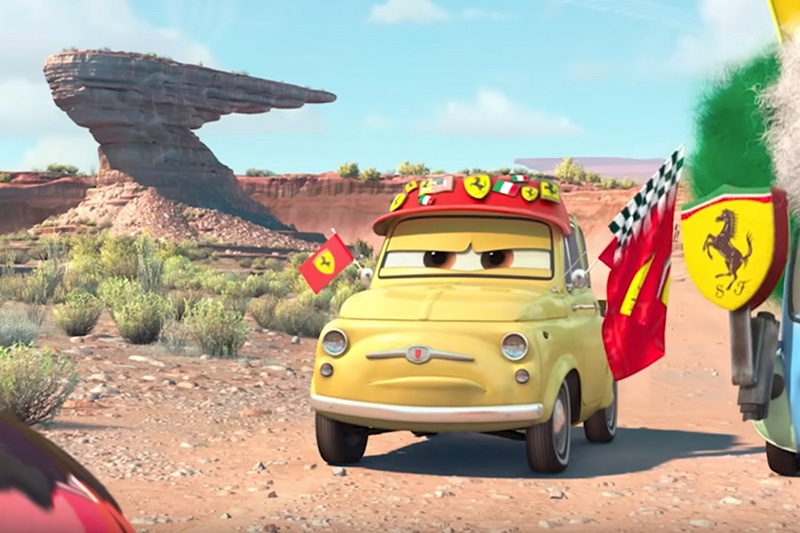
I have no problem with Enzo Ferrari being shown from his private side. But it should be a side that you don't know yet. Ferrari was always regarded as a cold-hearted asshole. And the movie shows him as a... cold-hearted asshole. And yet, according to Peter Schetty, he wasn't. As a result, by halfway through the movie any Ferrari fan expecting a deeply emotional reappraisal of a tragic figure looked like Luigi from Cars, when his buddy Guido is refused a pit stop.
All three storylines – the affair, the company, the race – are only touched on superficially and have surprisingly little to do with each other. No conflict lasts longer than one scene. In addition, the motivation of the characters often remains unclear. On the one hand, subtle acting is not exactly one of the cast's strengths; on the other, the dialogues try so hard to be profound that they often say nothing at all. On top of that, all the "Italians who-a talk-a like-a dis-a" make it sound like a bad parody.
If you want to see a love story, motor racing and a family business on the verge of bankruptcy with much more depth and a much better connection, you should watch Herbie: Fully Loaded . And I mean that in all seriousness. In terms of dramaturgy, Ferrari does not reach the level of a Disney comedy for children. There, too, the computer-animated scenes are so bad that you occasionally have to laugh out loud. However, this unintentional silliness seems far less out of place in a story about a VW Beetle with supernatural powers than in this melodrama, which takes itself so seriously.
Why not make Enzo Ferrari a supporting character if you can not, must not or want not tell anything new about him? Why not concentrate on Alfonso De Portago instead, and show scenes from the lives of the Italian boys from time to time until their fates intersect so tragically on that day in May 1957? Then we might have had a good movie and, what's more, something like an emotional bonding to the characters. But then, of course, you wouldn't have been able to make the box office ring with the illustrious name.
In Ferrari I just didn't care about De Portago. Because the character is never really introduced and you learn nothing about him except that he has a girlfriend – whose grief at his death you can't really share because of that. I cared even less about the moribound children because they appear out of nowhere just as suddenly as they disappear. And about Enzo Ferrari I cared by far the least because he makes even clichéd, overdrawn unsympathetic characters like Trip Murphy suddenly seem lovable.
It seems as if director Michael Mann really wanted to undercut Leo Beebe from Ford v Ferrari here. From the perspective of the automobile historian, I didn't really agree with his portrayal either. But in terms of dramaturgy, the creation of an antagonist was necessary. In my opinion, Ford v Ferrari is also far from being a masterpiece or even a movie for car enthusiasts. But at least James Mangold knew what story he wanted to tell and, above all, how to tell it so that the audience wouldn't fall asleep.
Let's pretend for a moment that Ferrari is not under the aura of the world's most glorious sports car brand. What's left then? A one-dimensional story about a guy in financial difficulties with an extramarital affair – something you get in every other early evening movie on public television: generic mediocrity, listlessly written, listlessly acted, listlessly filmed, without any sense for its setting in words or images.
But that's what you get when you believe that big names and big money automatically make a good movie. And in my opinion, this is the only explanation for all the rave reviews. Along the lines of: "If so many good things come together, the result must be good too." A misconception, of course. Or to put it another way: a Colombo V12 and a Pininfarina body alone do not make a Ferrari. It still needs a talented craftsman to put them together.