Like a Virgil


Virgil Exner had already put the idea on paper in December 1963, but it had not progressed beyond a 1:25 scale model kit. At the end of the 1970s, Budd Bayliff therefore made another attempt to revive the defunct Packard brand: In 1978, he acquired the rights to use the name and emblems and began applying both to brand-new Cadillacs and Buicks in his body store in Lima, Ohio.
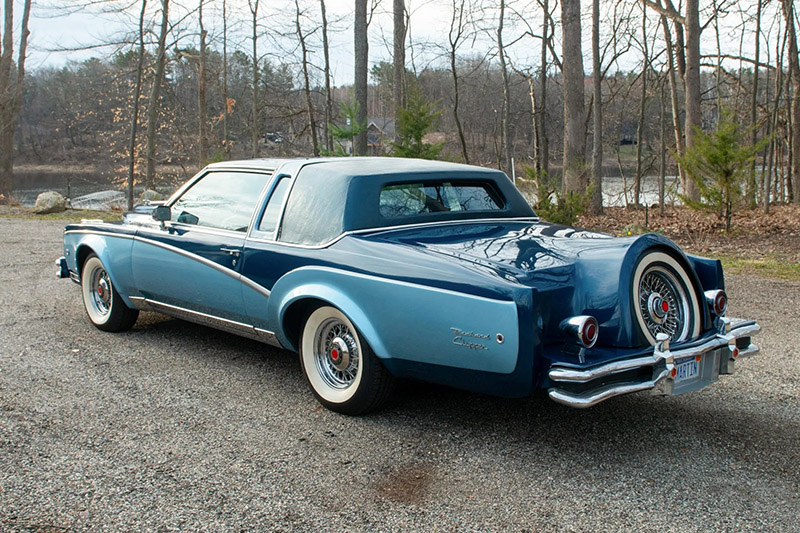
Of course, the luxury cars from the Detroit assembly line had previously undergone a whole series of visual modifications. And like Exner, Bayliff also had a slight tendency to overemphasize classic styling features. Although Packard had adapted its traditional radiator grille to the design language of pontoon styling in the 1950s, Bayliff opted for the narrow, tall pre-war format. Free-standing lights at the front and rear also returned.
Styling-wise, the new Packards were thus on a par with the Stutz reinterpretations on Pontiac chassis, with which they are often confused today. However, they were twice the price and more: the Bayliff Coach Corporation charged between 45,000 and 65,000 dollars for the artificial aging process. In contrast to the Stutz, the Packard was also available as a convertible in addition to a coupé and a four-door saloon – and as a hearse.

With its red roof light, it even played a dual role as an ambulance – handy if you realized halfway through the journey that the trip to the hospital was no longer worthwhile. However, only two examples of the pragmatic-nostalgic funeral coach are said to have been built, both of which still exist. Unfortunately, the number of models for living passengers is not known. So you can't hope to find a second one so quickly if you miss out on the first.
Consequently, you should make the most of the first chance you get. A 1981 Packard Custom Coupe is currently being auctioned on bringatrailer.com . Just in case you get too embarrassed at the wheel: In the Bayliff-Caddy on offer, the standard V8-6-4 with a measly 140 HP has been replaced by a 375 HP 7.7-liter V8 from 1968. This would at least provide a quick escape from ridicule. Sometimes bad taste can also make you lonely...