The fluttering has stopped

At best, valve flutter "only" causes ugly dents in the tappets. At least that's how a friend's engine turned out after it was dismantled. The phenomenon occurs when the valve train can no longer keep up with the engine speed due to its inertia. Something starts to jump, to "flutter". In the case of the friend's Volvo B20 engine, it was the tappets on the cams, the dents in them spoke a clear language, they were virtually beaten up by the cams. The reason for this is the over-revving of the engine.
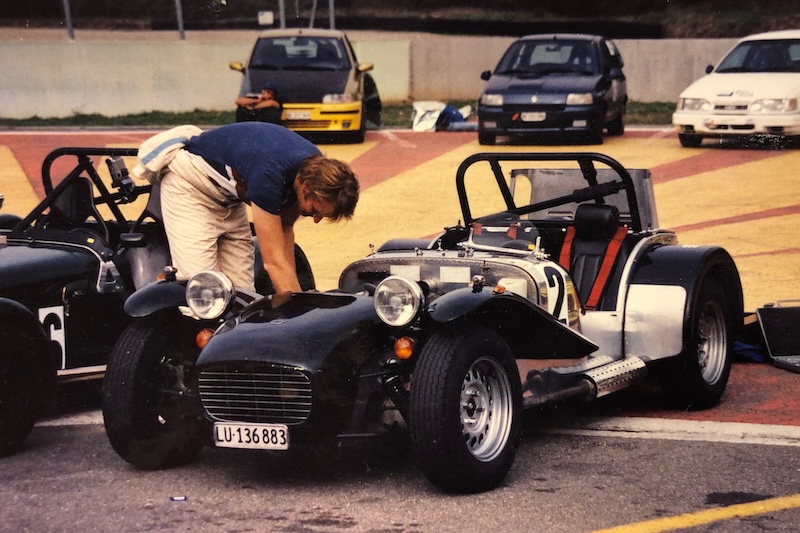
On my first Caterham Seven - pictured in 2002 on the Anneau du Rhin, Ford Sierra or Renault Clio Williams are hardly ever seen on a trackday these days - I converted the valves of the 1600 Ford Kent engine to double valve springs. As a result, the valve flutter should only start at around 6500 rpm instead of 5500 rpm. Lighter pushrods and rocker arms would also help.
Valve flutter manifests itself with a collapse in performance, but unfortunately this is not a real rev limiter, but the harbinger of a ruined engine and a sign of a careless driver. Modern engines, on the other hand, are protected against over-revving. Everything equipped with DSG, torque converter automatics and the like is anyway. Valves no longer flutter. I certainly don't have any nostalgic feelings about it.
On the same day at the racetrack where I "got in" with flapping ears and a good dose of luck and then decided to convert, another colleague's engine exploded. His rev limiter could not prevent it from doing so. Shifting down first and only then braking when the engine is revving is simply wrong. After all, what use is an ignition interruption if the engine is mechanically over-revved in coasting mode? Fortunately, my engine survived! It is still running smoothly for another owner - with the double valve springs.
Yes, valve flutter doesn't need a revival. Incidentally, this also includes steam bubbles, the shimmy or vacuum windshield wipers at full throttle. Even nostalgia has its limits!