A Different Take on Classic Cars


I still remember exactly how the VeloSolex met its end. In France, production was discontinued in 1988 following steadily declining sales; the helmet mandate had dealt the final blow to the classic bike, which was usually black. Our go-to dealer, Noser on Pilatusplatz, cleared away the long row of “Velotöffli” in front of his store—and with it, the entire building, complete with its address, vanished from the right-hand display window.

VeloSolex dealer Noser & Co in Lucerne in 1981. It had apparently closed down by then, which is why there's no line of Solex bikes in front of the building
Then prices for decent models skyrocketed. During high school and later as a college student, I financed my fleet of cars and motorcycles by repairing and selling old, worn-out Solexes. My purchase limit was 100 francs. But many Solexes were simply given to me as gifts. I kept the most expensive Solex I ever bought—a model that the Geneva Post Office is said to have used to deliver telegrams—along with the Lucerne-Paris-Lucerne Vélomoteur. I've written about that one before, too.

A Hungarian Impex VeloSolex—the quality was lousy, and deliveries were unreliable
The “Miracle” from Hungary
Then a miracle happened: a few years after production had supposedly ended, word was that production of the black moped had resumed in Hungary. The country had only just emerged from behind the Iron Curtain, and the path seemed viable to secure the future of the budget moped, supply us with parts, and keep the legacy alive.
Unfortunately, however, Swiss lawmakers wanted nothing more to do with a catalytic converter-less, smelly moped and refused to grant type approval. What remained was the revival of old Solex mopeds using “complete parts kits”: A rusty main tube with a Swiss frame and type approval number provided the “identity” of the moped; the rest came from Hungary. But these parts were poorly made, and the deliveries proved to be incredibly unreliable.
Ding-Ding Instead of Ding-Dong
It seemed easier to me to get original Solex mopeds in France. They were identical to the Swiss homologation model down to the last detail—with the exception of the bell—and could be “Swissified” without any trouble. Exactly: via the frame tube.
Incidentally, in Switzerland, the bell wasn't allowed to have two distinct sounds. I always picture the imaginary Mr. Bünzli from the Motor Vehicle Inspection Office, standing in front of the two-wheeler in his blue-gray work coat, pencil tucked behind his ear, assessing the ringing—a true expert! So: No “ding-dong” for Switzerland, just “ding-ding.”
I modified two or three Solex mopeds back then: I took the French ones apart, cleaned them, and mounted their parts onto Swiss frames. Those were good little mopeds—more a practical means of transportation than a collector's item. I avoided the replica parts from Hungary whenever possible, though—they couldn't be trusted. In 2002, the Hungarians were out of the picture anyway, which didn't bother me in the least.

Brochure page for the Hongdu-48 moped, a rather dreadful VeloSolex clone from China
The copycat gets the original
Things were quiet for a while. Then word got around again that new Solex mopeds were available for purchase—this time from China, and supposedly of better quality. I could hardly believe it.
The idea from the new distributor, called “Mopex,” was remarkable: They offered the Chinese a replacement for their own lousy copy, the Hongdu 48 from Jiangxi Hongdu Moped Co. Ltd.—with a product that could also be sold in Europe: the old-school VeloSolex. As a result, a few Mopex-Solex models were rebuilt using old Swiss frame tubes. Unfortunately, I've never seen one myself.
Nevertheless, the story itself impressed me: They essentially handed the copycat the original—or at least the original tools to manufacture according to the old model—so that something decent could come of it. And they probably spared themselves a lot of trouble, such as legal action against a state-owned enterprise that also builds airplanes and that once produced a replica of the BMW R71 under the name Chang Jiang sidecar motorcycle.

Mopex-Velosolex for the U.S. market—here, too, the project failed due to quality issues
A discovery on the Internet
Why am I telling you all this? Because I was “on the internet” again and found something: a Chinese company that builds golf carts, recreational vehicles, and transportation for vacation and tourist resorts. The vehicles are electric; some are even designed for a completely natural power source—a horse.
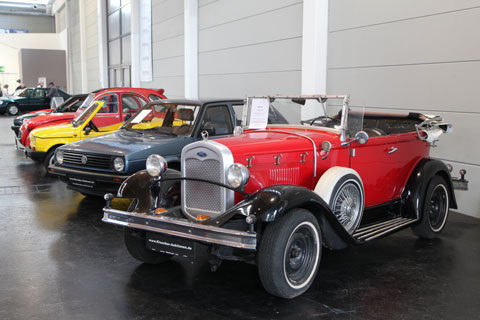
Some of the electric versions are astonishingly skillfully modeled after a Ford Model T or Ford Model A, though in a style reminiscent of Chinese toys. It immediately makes you wonder: Couldn't they have just built something proper instead of such an insult to all the senses?

An undefined car served as the model for this “golf cart” (?) with a classic look
With a little more care...
Why not a collaboration that benefits everyone? The Chinese manufactured new parts based on original blueprints and used them to build their electric classic cars. For fans of the originals, however, these would be valuable new parts modeled after the old designs, which they could use to keep their classics running.
The days of the 1990s are over in China, too. Today, there are plenty of companies in China capable of manufacturing high-quality products, and in many cases, Chinese firms have long been suppliers of reproductions based on old designs. This even has advantages: Instead of working with worn-out original molds pushed to the absolute limit of their tolerances, manufacturers take the measurements and dimensions from a good original part and use state-of-the-art technology to build a new mold—a process known as reverse engineering.

You can already see a bit more effort being made to stay true to the original; the drive remains electric
The Mini body as proof
A good example is Chinese raw body shells for the Mini. The British specialist firm Craig Webb Restorations compared one such shell with a body from British Motor Heritage, which is stamped using original dies. The result is astonishing: in some respects, the Chinese reproduction is more dimensionally accurate; the seams are more uniform, and the holes for attachment parts are positioned more precisely. Even NOS original parts could sometimes be mounted on the Chinese body with less adjustment effort than on the Heritage body.

A body-in-white from British Motor Heritage, partially manufactured using the original molds
An Opportunity Amid the Crisis
Is everything great, brilliant, and wonderful? The answer is: We don't really know! The fact is: The Chinese auto industry is in reverse, even if the situation in Europe looks quite different thanks to a massive export push. The domestic market is expected to shrink by about 22 percent this year. So it's quite possible that one or two Chinese suppliers will soon start looking for niches where there's still business to be done. Parts for classic cars could be one such niche.
Quality doesn't have to be an issue—even if some products from China tend to inspire more horror than admiration. This is true of some, but not all, vehicles produced by Xuchang Zhenda Machinery Co., Ltd.

European-style classic car fun, Chinese-style
Drive in peace
But why am I even poking around in these little-visited corners? Probably because it's exciting. And because I find old two-stroke bicycles far more interesting than their modern, electric counterparts. But I remain completely peaceful. After all, in the 1970s, the Solex—known in Switzerland, by the way, as “the” Solex—was advertised with the slogan “Ride in peace.” So: Peace! My love for the Solex grows with every e-bike I come across. And China? Well, I still don't quite know what to make of it when it comes to classic cars. Right now, the Chinese are still building their classic cars rather clumsily—brand-new, that is—but what happens when they get better at it and learn and make progress just as quickly as elsewhere? Will there then be lots of new parts for our classics, or lots of new classics for—well, for whom, actually? What happens if the Chinese market stagnates? We're seeing that happen right now with new cars...