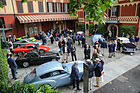
Goodwood is like traveling back in time to your childhood. The first impression is incredible. As soon as you get close to Goodwood, you see everything your heart desires on the road. An open-top Alvis (with Lucerne license plates), a Rolls Royce Silver Ghost or an Austin Seven, with passengers in matching outfits everywhere. The bus of the "Automobil Revue Reader's Tour" tour group is suddenly stuck in a traffic jam. No, not rush-hour traffic, all fans from the Goodwood Revival Meeting 2011.
They are lined up in a special classic car parking lot. The space is bigger than a football pitch, full of old cars of all makes and years. Now we are entering the grounds of the Earl of March's Goodwood Circuit!
It all began in 1948
After the closure of Brooklands due to World War II in 1939, the 9th Duke of Richmond, Freddie March, built the Goodwood Circuit where on September 18 , 1948, 85 drivers competed in front of 15,000 spectators at the first professionally organized motorsport event in England.
Fifty years back with the time machine
The entrance gate to the circuit area acts like a time machine, taking visitors back around 50 years in one fell swoop. All the people are dressed as they were back then, all the accessories, however small, are from times gone by. There are also hairdressing salons, film studios and clothes stores of all kinds. Cigars are rolled in the tobacco store. Everything is just right and, of course, all the vehicles are old and even older.
Open-mouthed in the paddock
You finally arrive in the paddock and stand open-mouthed in front of a paddock, a real paddock with a wooden roof and straw bales. All the overalls, whether worn by drivers or mechanics, match the racing cars. Of course, the crème de la crème of cars from past decades are present. But the absolutely fascinating thing is not the individual cars, but the overall impression of the whole scenery.
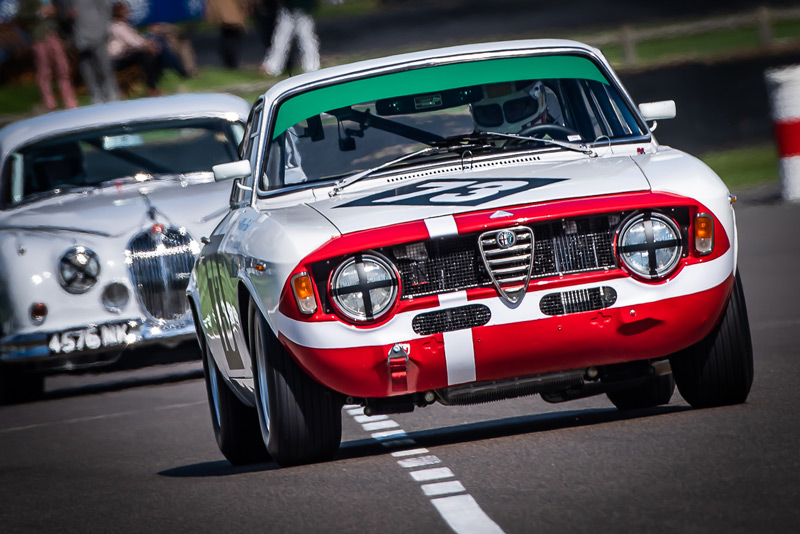
Top-class racing with constantly improved classics
The racing on offer on the track is absolutely top-class. However, it must be admitted that, apart from their shape and appearance, some of the cars have very little to do with their original predecessors. The technology is also improved here every year.
Adrian Newey, technical director at Red Bull, even put his Jaguar E-Type in the wind tunnel and made aerodynamic improvements. One of the resulting optimizations was the visibly slightly opened trunk lid, which is intended to provide more downforce. Newey drove the "Fordwater Trophy" together with Gerhard Berger, a race to celebrate the 50th anniversary of the E-Type. Berger showed no after-effects from the accident with the Cobra (see Saturday's blog) and drove a confident race from first place on the grid.
He handed the car over to Adrian Newey with a large lead. Unfortunately for the pair, this was a little too early, as a pace car phase shortly after the stop and a driving error by Newey on the first lap wiped out their lead. When the race was restarted, Martin Stretton was glued to Newey's rear. With unique drifts, the two delighted the 130,000 fans at the side of the track and did not give each other an inch. Stretton overtook Newey and won the race.
Unique field of small formula cars
The Earl of March Trophy featured a large field of 500 cc Formula 3 cars. The variety of these racing cars, of absolutely lightweight construction and mostly powered by a motorcycle engine, was probably unique. This race was won by Sam Wilson in a 1952 Kieft-Norton CK52.
100 million pounds at the start of the Royal Automobile Club TT Celebration
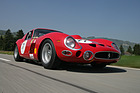
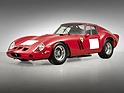
Another highlight was the race for the "Royal Automobile Club TT Celebration". The starting field was estimated to be worth over 100 million pounds. By the time the starting flag dropped, however, the value of the car had long been forgotten. The Cobra-Daytona Coupé with Kenny Brack and Tom Kristensen fought a fierce three-way battle with the Ferrari 250 GTO of Martin Brundle/Mark Hales and the beautiful white Maserati Tipo 151 of Joe Colasacco/Derek Hill. Even the deluge in the middle of the race could not stop the opponents from continuing and driving their wickedly expensive cars into the garage instead.
Skidding lessons from the professionals
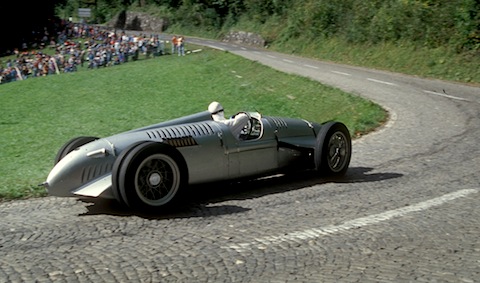
The race for the "Goodwood Trophy" took place entirely on wet roads with the pre-war Grand Prix cars. For the fans, it looked like a skid training session for full professionals. What the German Frank Stippler showed with the 1934 Maserati 8CM could easily be included in the main program of "Art on Ice".
A highlight compared to around 1,000 other motorsport events
You can read about the absolute crowd favorite, the Mini Cooper S in the "St. Mary's Trophy", in the separate story entitled "David versus Goliath".
In my career as a photographer, I have already seen and experienced around 1,000 events. There are exactly four emotional highlights among them: My first ever race, the 1979 British GP at Silverstone, which went down in history with Clay Regazzoni's victory in a Williams, the 1989 24 Hours of Le Mans with the victory of the Sauber-Mercedes C9, the double victory of the BMW-Sauber F1 team in Montreal in 2008, then Sebastian Vettel's first GP victory at Monza in 2008. Goodwood belongs on this list from now on. This revival has awakened a second motorsport spring in my step. It's been a long time since I've been as fascinated as I was last weekend. It was motorsport you could touch and marvel at.