For once, the good Lord had moved his weather from April to the first weekend in August. And just in time to celebrate the 100th anniversary of the Schauinsland hill climb. No fewer than 148 teams battled their way through the rain spray for two days from August 1 to 3, 2025 - a new record number of participants. The winner's trophy went to Helmut Nigst and Reinhard Moll with their Jaguar E-Type FHC (1965) ahead of Jörg and Fabiola Pöhlemann with their spectacular Lancia Beta Montecarlo 037 (1978) and third-placed Knut and Markus Henneke with a Porsche 964 Targa (1990).
The victims were the pre-war cars, which either had no roof or only a marginally protective cloth over the open bodywork. But here too, a true Indian knows no pain.

Varied route
ADAC and the Freiburg Motorsport Club came up with something special for the 18th edition of the Schauinsland Classic - after all, it was also the 100th anniversary of the Schauinsland hill climb. Instead of the usual 100 teams, this year 148 were included in the tableau - "something that pushed us to the limits of what we could organize", as Matthias Wolber from the organizing committee said.

His father Karl Wolber once again managed to choose a sensational route. The roadbook took the riders on a variety of side roads, minor roads, country lanes and occasionally through vineyards - all carefully selected and combined.

From A for Alfa to V for VW
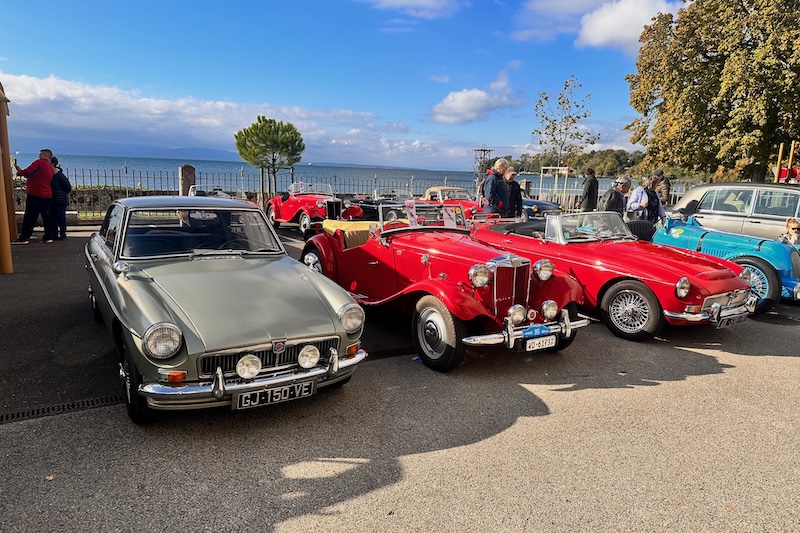
No fewer than 24 car brands from Alfa Romeo to VW were represented at the Schauinsland over the first weekend in August, offering spectators a cross-section of automobile construction from the 1930s to 1993.
The stars of the pre-war cars were a Mercedes-Benz 710 SSKL from 1930 owned by Thomas Kern and Katharina Maiwald, followed by an Alfa Romeo 6C 1750 Zagato, also from 1930, whose owner Beat Lüthi explained that the entire history of the model was known. Together with Stephan Lüthi, he was eagerly awaiting his first appearance in a classic car test.

Rainy Friday
On Friday's tour, the teams set off at one-minute intervals from Messe Freiburg in a southerly direction on the 270 km route that led to Bad-Säckingen (and the Swiss border). The route was peppered with special stages: Every hundredth of a second deviation from the target time was penalized with a penalty point.

The highlights were the Schauinsland race track and sections on the Eggberg mountain race track. The numerous spectators, who despite the bad weather on Friday evening at 7.30 p.m. did not want to miss the finish on Freiburg's Münsterplatz, ensured a good atmosphere: they greeted the arrivals with lots of applause despite the rain.

Saturday through the forest
The second day took us 260 kilometers into the eastern and northern parts of the vast Black Forest. Immediately after the start from the exhibition halls, the legendary Schauinsland route took us deep into the Black Forest. The highlight of this day's stage was the route itself, which led over roads and little streets away from the main traffic routes from Freiburg back to Freiburg.

Of course, the eponymous Schauinsland was once again on the program, which this time was ridden in both directions. And that's exactly what makes the Schauinsland Classic so charming! After 270 km, it was already over by early Saturday evening. The crowning finale was the award ceremony, which took place in Hall 4 of the exhibition center as part of a small banquet.

Freiburg and the church tradition
In the run-up to the anniversary Schauinsland Klassik, acquaintances of the chronicler from Freiburg told us that it was quite extraordinary that the convoy was allowed to drive through the old town to Münsterplatz. This could not be overestimated due to the left-dominated city government... On Friday evening, it was the same as always: due to the church tradition and the holy mass in Freiburg Minster, the first car of the classic car rally did not arrive at Münsterplatz until 19.31 p.m. - by then the evening mass was over and the engines could no longer compete with the spoken word in the church.
This year, the classic car rally was organized in a climate-neutral way for the first time. To offset the rally's CO₂ emissions, the entry fee for each classic car included a contribution towards planting a tree. "The first seedlings for the ADAC Schauinsland Classic Forest are already growing near Hofstetten in Kinzigtal," adds Heinrich Lauck. Further plantings are to follow in fall 2025.
100 years of the ADAC Schauinsland Mountain Prize
Due to the political composition of the city government, it was probably illusory to think of demo drives with racing cars on the original hill climb circuit or even a corso through the city center. On the classic hill climb circuit, only the double guard rails still bear witness to the racing past. The wooden racetrack mat, once lined with (tens of) thousands of enthusiastic spectators, has only served its actual purpose as a mat for decades...
However, the organizers went to great lengths and collected a considerable number of exhibits for the special exhibition in the exhibition halls. On a plaque of honor prominently displayed on the wall, half a Grand Prix field of pilots could be identified as participants in the Schauinsland Classic in the 1930s. Alfred Neubauer (yes, the later Mercedes race director also tried his hand at driving), Bernd Rosemeyer, Hans Stuck, Giuseppe Farina, Hermann Lang, Manfred von Brauchitsch, Rudolf Carcacciola, Achille Varzi, Tazio Nuvolari, Richard Seaman and many others competed on the Breisgau hill climb circuit. And many names from more recent times also line the board: Jo Siffert, Hubert Hahne, Lodovico Scarfiotti, Peter Schetty, Peter Monteverdi, Karl Foitek, Jochen Mass, Dieter Quester, Hans-Joachim Stuck, Fredy Amweg, Christian Danner - and then the eternal record holder Mario Ketterer. The list could go on and on. The Schauinsland is certainly one of the hillclimb circuits with one of the most illustrious fields of participants.
Special exhibition
In the truest sense of the word, Mario Ketterer from Freiburg is a fixture at the Schauinsland Classic. For once, however, he was not on the road as a participant, but actively supported the OC of the special exhibition "100 years of the ADAC Schauinsland hill climb record". Together with classic car expert Martin Waltz, he made a significant contribution to ensuring that this variety of historic rarities found their way into the exhibition. "Acquiring the vehicles and making contact with the people who own the cars was a great pleasure and a matter close to my heart," reports Ketterer.

He was in great demand on Sunday and had to sign autographs non-stop. He no longer has to worry that his course record on the Schauinsland could be broken.

The exhibition was rounded off by moderated discussions with former racing drivers, including Mario Ketterer, Dr. Helmut Mander and a descendant of British motorcycle racer Tom Bullus. They gave insights into their time on the hill climb circuit and shared personal memories with the audience. Many visitors were touched by the stories from an era that attracted tens of thousands of motorsport fans to Freiburg's local mountain year after year.

Prince Leopold of Bavaria
Decades after a start in the "regular" Schauinsland hill climb, His Royal Highness Prince Leopold of Bavaria was back at the start in a BMW 328 at the Schauinsland Classic 2025. His result proves that his racing genes are still working and that he didn't just roll up to the start like that: he took second place in the pre-war class together with his co-driver Sarah Büchner. Slightly soaked from the bad weather, he said at the finish line: "It was still fun!"

About the Schauinsland Classic
The Freiburg Schauinsland Klassik is one of the largest classic car rallies in the southwest and enjoys a high reputation among classic car enthusiasts. It emerged from the legendary ADAC hill climb on the Schauinsland. The next Schauinsland Klassik will take place from July 31 to August 1, 2026.