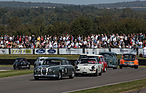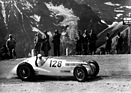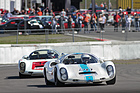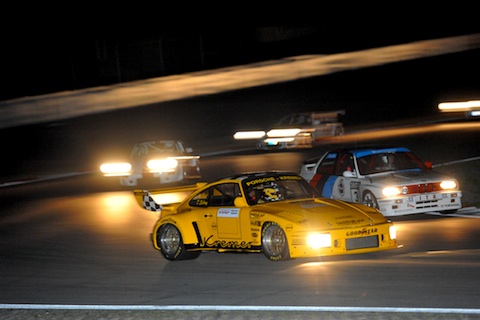
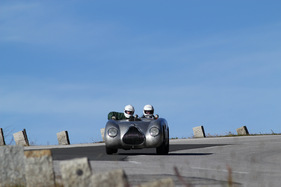
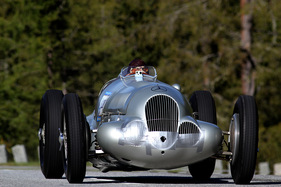
The last "Grosser Bergpreis" on the Grossglockner took place in 1939, and it would take until 2012 before a new attempt could be made. Around fifty pre-war racing cars and a good dozen post-war racers stormed the Fuscher Törl at 2,428 meters, but did not race for the best time, but according to a uniformity regulation. In the midst of a unique mountain panorama and in the best conditions, the sounds of hoarse eight-cylinder and supercharged racing engines rang out once again.
Weather at first like back then
The weather has always played an important role in the Grossglockner Race. In 1935, the first time the race was held, rain on the night from Saturday to Sunday created ideal conditions, as the heavy rainfall made the track dust-free. The strong wind then ensured a well-dried road surface.
In 1938, snow and fog made the drivers' work more difficult, while in 1939 thick clouds of fog and rain prevented them from setting the best times in the second race.
In 2012, however, the snow and rain receded shortly before the first orienteering run on Thursday; only the snow remained at the very top and the road had to be cleared of the traces of an early winter slump.
The W125 back on the mountain
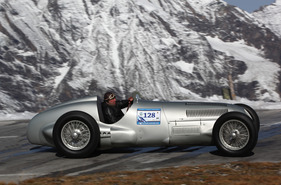
Hermann Lang had won the last edition of the Grand Mountain Prize in 1939. With an hourly average of 75.09 km/h, he had beaten his Mercedes-Benz W125 up the mountain in two runs, defying the roads covered in dust, gravel and cobblestones.
73 years later, Jochen Mass had a much easier time and was faster than Lang straight away. He also had it a little more comfortable, because the road is not only much wider today, but also optimally asphalted and in perfect condition. The hoarse-sounding eight-cylinder engine still went through the hearts and minds of the spectators along the route, however, and you could hear it roaring along for several kilometers. It must have sounded exactly the same back then.
Jochen Mass said that, given a little training, times under seven minutes were certainly possible. But of course he didn't take any unnecessary risks on the demonstration drives.
The indestructible Hans Herrmann drove another demonstration car, the Porsche 550 RS Spyder, which won the Carrera Panamericana in 1954. Herrmann wore the original helmet on his head, which also protected him during his wild accident on the Avis in 1959, when he flew 60 meters through the air.
Auto Union was missing
In 1938, Hans Stuck had won in the sixteen-cylinder Auto Union Type C. In 1939, Hermann Paul Müller had set the absolute track record on the 12.6 km circuit with 8 minutes 54.5 seconds, which corresponded to an average speed of 84.8 km/h.
Unfortunately, however, the Auto Union were absent in 2012 due to scheduling conflicts. What a pity!
The track
The modern Grossglockner mountain race track is 14.5 km long, with a difference in altitude of almost 1,300 meters. The first section of the route is serpentine, followed by the first tighter bends, then after about 2.5 kilometers the first hairpin bend, one of 14. But even the hairpin bends are optimally constructed, mostly flat, while the road is slightly inclined. Between the hairpin bends, there are further only slightly curved straights, and only at the very top does one hairpin bend replace the next. A total of 92 bends and gradients between 4 and 12% spice up the ascent.
If it were really about setting the fastest times, the route would allow hourly averages of well over 120 km/h. For speed tests, however, the track safety measures would also have to be extremely extensive, requiring additional crash barriers, barriers and an army of marshals.
The organization of the 2012 Grand Prix in the form of a regularity test on a closed mountain track was therefore a sensible compromise.
Dominance of the pre-war classics
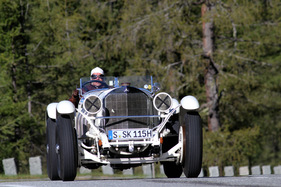
In keeping with the nature of the event, the main focus of the car fleet was on pre-war cars. Rare classics from Bugatti, Maserati, Alfa Romeo, Morgan, MG and Mercedes-Benz were at the start, just as they had been over 70 years earlier. Only vehicles from Alta, Frazer Nash, Fiat, Amilcar, Austro Daimler, Adler and Lancia were missing to do justice to the historic starter lists. The BMW dominance of 1938 and 1939 was also no longer evident in the current event.
The missing brands were replaced by vehicles from other manufacturers, including Bentley, Invicta, Riley, Alvis, HRG and Atalanta, which were not yet commonplace in Central Europe in the 1930s.
The fact that several Bugatti cars, including one of only five sixteen-cylinder Type 45 racing cars built, made it to Ferleiten is worth mentioning. Unfortunately, the eagerly awaited racing car equipped with two coupled eight-cylinder engines was not running properly, so there was no question of driving uphill.
The Alfa Romeo 1750
Christian Kautz started in the sports car class in 1935. He tackled the 19.5 km route in an Alfa Romeo 1750 Sport at the first event. He had to change gears 90 times on the way to the finish, his final time was 16 minutes and 47 seconds, which was enough to win his category.
A similar Alfa Romeo 6C 1750, a beautiful black model with touring bodywork, was at the start again in 2012. And covered the shortened route significantly faster.
The high altitude takes its toll on the vehicles
A hill climb with a finish at 2,428 meters makes very special demands. Carburetor engines lose up to 50% of their power, and even supercharged engines lose horsepower. Accordingly, some cars reached their performance limits and even stopped working. The field of participants had already shrunk noticeably after the first mountain run, and only around three-quarters of the vehicles crossed the finish line in the last run. The old material was taking its toll. But what did Pitt Jung say when he was once again using the wrench for a repair? "Rarely have I ever wrenched in such a breathtaking mountain panorama!"
It is thanks to the discipline of the participants that there were no accidents, apart from parking bumps in the paddock.
Ferdinand Porsche in the original Beetle
In 1938, car designer Ferdinand Porsche took part in the Grossglockner Race with the prototype of the new Volkswagen. He achieved an average speed of 34.5 km/h.
With starting number 38, the Porsche prototype VW 38 KDF car again tackled the 14 km from Ferleiten to Fuscher Törl in 2012 and was even faster, even though the early Beetle almost ran out of breath.
Sports car rarities from the German post-war years
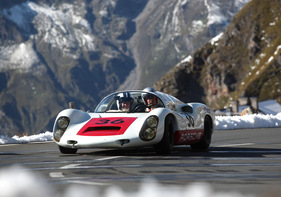
In addition to the 50 or so pre-war cars, three Veritas RS, a BMW Werkmeister and a Neumaier BMW sports car with a displacement of 1.5 liters, which had already competed with Herrmann Kathrein in 1939, also took part. They led a small field of post-war racing cars, which included a Ferrari 500 Mondial and a Porsche 910 as highlights.
Interested spectators in manageable numbers
Tens of thousands of spectators lined the slopes the last time the Grand Prix was held in 1939, but there were not to be as many in 2012.
Organizing a mountain stage on a Thursday/Friday is certainly not the recipe for a large crowd. This was probably not the intention. Nevertheless, some fans interested in classic cars found their way to Ferleiten and the route up the Grossglockner and enjoyed the classic cars and their drivers. Cell phones were used to take photos for all they were worth and drivers were bombarded with questions.
Results of the regularity test
The pre-war cars (1910-1940) were won by Berthold Dörrich and Veerle Ullrick in an Alvis 12/70 from 1939, followed by Günter Krenn and Leopold Gierl in an MG K3 Magnette from 1934. Peter Steng and co-driver Sabine Steng celebrated third place in the 1937 Delahaye 135 S.
In the Veritas class, Jürgen Bremer won together with Ulrich Detscher in a 1952 BMW Werkmeister, ahead of Günther Schindler in a 1938 Neumaier-BMW and Joachim Ohlinger with Astrid Hofmann in a 1948 Veritas RS.
Finally, in the post-war class (1950-1970), Marcus Schrammen and Irene Terhaag took home the winner's trophy in a 1955 Porsche 356 Pre-A, followed by Jürgen Rudolph and co-driver Frank Stricker in a 1967 Porsche 910, with Michael Kurzeja and Joachim Klutz in a 1961 Austin-Healey 3000 MK I in third place.
The precision of the overall winners is impressive! Berthold Dörrich and Veerle Ullrick in the Alvis 12/70 were only 67 hundredths of a second off the pace, and this over a distance of 14.5 km. Hats off!
Information on the historic Grossglockner races
- AR-Zeitung No. 63 / 1935 from Aug. 6, 1935 - Page 2: 1st International Grossglockner Road Race
- AR-Zeitung No. 70 / 1938 from Aug. 30, 1938 - Page 3: Stuck, best man at the Grossglockner race
- AR-Zeitung No. 64 / 1939 from Aug. 8, 1939 - Page 7: Hermann Lang wins the German mountain championship on the Grossglockner
Please note the separate extensive picture galleries with over 300 photosof all participating vehicles under "Recommended articles".