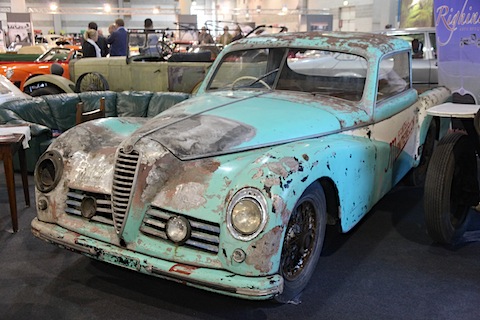
It is not easy to describe a trade fair like Auto e Moto d'Epoca, which took place for the 35th time in Padua from October 25 to 28, 2018. Too many impressions, too many cars (around 4,000), too many spectators (over 100,000) to be able to separate the essential from the trivial in a nutshell.

So let's try it along the alphabet, at least to some extent.
A for Abarth
Of course, many Abarth vehicles were also seen at the 35th edition. As is well known, Carlo Abarth sold his company to Fiat in the early 1970s, but the Abarth engineers continued to build racing cars for Fiat, Lancia and, in some cases, Alfa Romeo for many years.

So there were not only thoroughbred Abarth sports cars and optimized Fiat derivatives on display in Padua, but also rally versions of Lancia models, e.g. the 037, the Stratos and the Delta S4, the latter as part of an exciting special show, where two Opel Ascona and an Alpine A110 were also on display.

Mention should also be made of the 750 Allemano Coupé discovered next to a Ferrari F355, which was apparently a one-off, as only the Allemano Spider variants are actually known.
A for Autobianchi
"Autobianchi" has been a vanished brand for many decades, even though the Fiat subsidiary's cars were still being sold as Lancia until the 1980s. The vehicles used to be called Bianchina or Stellina, later the technocratic A111 or A112.

Almost the entire post-war product range was on display in Padua, partly on club stands, partly also as sales offers.

Something very special in this gallery of ancestors is certainly the Autobianchi A112 Runabout from 1969, which later became the Fiat X 1/9. Designed by Gandini, the prototype featured an extreme wedge shape, which was later also realized in the Lancia Stratos.
A for Alfa Romeo
Of course, the Alfa Romeo cars were not to be missed in Padua; there must have been several hundred of them. As usual, the most exotic and racy variants were mainly on display at the club stands, where the Alfasud Club particularly caught our eye with two early Alfasuds.

The IMSA racing car based on the Alfa Romeo 155 was parked on the official FCA stand, while an Arna was parked at a dealer's stand. Comparatively few Alfettas were on display, but the Giulietta/Giulia Spiders were available in a multipack.

Some visitors were probably unaware that the Milanese car manufacturer also built the Renault Dauphine under license in the 1960s.
B for Bonhams
Trade fairs are becoming increasingly popular as a venue for auctions. For the second time, Bonhams took the opportunity to make 58 classic cars attractive to the thousands of visitors in Hall 2.

On Saturday afternoon, it was time to get down to business when James Knight lifted the hammer. However, the results, which are documented in a separate report, were not entirely satisfactory for those responsible at Bonhams.
C for Caffé
Not only car lovers, but also coffee lovers get their money's worth in Padua. As every year, a large number of food stands offered the classic "caffé" (normally called espresso here), of course, but also many other coffee varieties. And if you also wanted a cornetto or Sicilian canolli, there was sure to be a vendor for that too.
D for confusion
It almost goes without saying that an Italian classic car fair always comes with a bit of chaos. And indeed, old and new cars were wildly jumbled together, but there was also a loose and entertaining jumble of useful and less useful spare parts and accessories at the numerous parts stands.

However, those who didn't have enough time with them soon had to capitulate, as they were sure to overlook many a valuable item.
E for Etceterini
Of course, in Padua you could not only discover vehicles from the big and well-known brands, but also from those manufacturers that have long since disappeared.

These are generally summarized under the collective term "Etcererini", which refers to suppliers such as Abarth, Siata or Ermini, some of whose cars were of course on display in Padua.

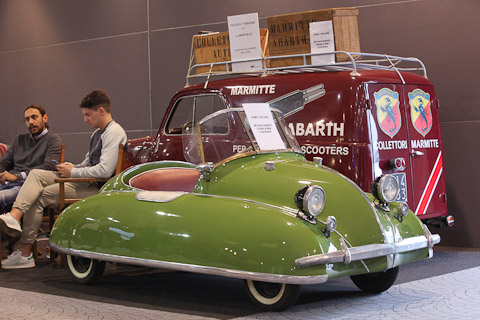
In broad terms, this could also include the Volugrafo Bimbo 46, a small car from the post-war period, built in a maximum of one hundred units by a racing driver and engineer.
E for exotic
What constitutes an exotic can vary greatly from country to country. A Honda Z 600 is rarer in Italy than many a Ferrari and even a Subaru Fuji is unlikely to have found its way to southern Europe.

Rare everywhere, however, are vehicles such as the two French pre-war rally sports cars that have been discovered in various places, or the Veritas Nürburgring as a coupé, of which not a handful were built.

F for Fiat
It should be logical that Fiat plays a leading role at an Italian classic car show. But what has always characterized Padua is that you can see models there that you hardly ever see anywhere else.

In particular, the many special bodies created by Vignale or Pinin Farina in the fifties and sixties were once again a small sensation in 2018.

However, the early Ritmo models with the asymmetrical radiator grille and characteristic wheels, which could be found as a pair on a club stand, were hardly ever seen, while more modern Abarth versions were offered for sale in various places.
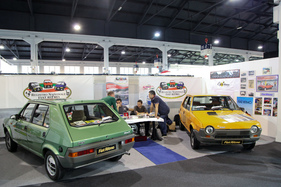
F for Ferrari
Despite a total of around 4000 cars, there were significantly fewer Ferrari sports cars in Padua than in Essen, for example.
Most of the cars on sale were newer sports cars from Maranello, such as the F355 (with multiple manual transmissions), the 512 BB and the Testarossa.

All the more striking was the historic Ferrari 250 MM from 1953 and of course the Grand Prix racing car 312 T from 1975, once driven by Niki Lauda.
G for crowds
When over 100,000 visitors are expected to spend four days in just 90,000 square meters of space, which is of course mainly used by the many cars and stand structures, then there is inevitably always a crowd. However, the large open spaces between the halls helped to keep the crowds to a minimum, so that queues formed especially at the food stands.
L for Lancia
Lancia, until recently an integral part of the FCA Group, is a brand that has disappeared in modern times. Despite its long and storied tradition, the brand was dropped by Fiat-Chrysler. However, little of this was noticeable in Padua, as visitors could hardly discover less Lancia than Alfa Romeo.

There were even plenty of examples of the Delta, which is currently somewhere between a classic car and a youngtimer, but there were also many different versions of other Lancia models dating back to the pre-war period.

And, of course, the Lancia cars were not to be missed in the special rally show.
M for Mercedes
The 2018 edition of the trade fair in Padua featured fewer factory presentations than previous editions. For example, official factory stands from Lamborghini and Volkswagen were conspicuous by their absence.

Mercedes-Benz, however, was not to be overlooked with its large presence. A historical model was juxtaposed with a modern interpretation, i.e. the A-Class of the past versus the A-Class of today, or the 300 SL Roadster versus a modern sports car.

However, the Mercedes people came up with something very special in a tent in front of the halls. There you could have your photo taken with a 300 SL in a historically decorated room.
M for Maserati
Maserati also attracted visitors in 2018 with a special mix of vehicles. While the "Eldorado", which has already been shown many times, stood in the middle, it was framed on the left by a Merak SS Turbo and on the right by a Khamsin.

Sports cars and limousines from Modena (e.g. the Frua Quattroporte) were also on display at various dealerships and club stands.
M for motorcycles
Not only cars, but also motorcycles were on offer in Padua, albeit in smaller numbers than their four-wheeled counterparts.

For two-stroke enthusiasts, however, the sight of a Suzuki RG 500 next to a Yamaha RD 500 must have seemed almost heavenly.
P for Porsche
Porsche also had a large stand on site. Among other things, showcase restorations were presented using a 911 S, a 356 and a 964. These vehicles were skillfully placed in the center with mirrors.

The sports cars from Stuttgart were also omnipresent elsewhere, whether it was old 356 models in need of restoration or almost new GT3 variants in all colors.

Compared to German classic car fairs in particular, however, the brand mix in Italy was much broader and more diverse.
P for Prosciutto
Nobody had to go hungry in Padua, a wide variety of food was on offer. There were even some who claimed that the food stands generated more sales than some of the retailers in the halls. However, this claim was refuted by the many "Sold" signs that were already displayed on some cars on Friday.
T for Expensive
30 euros was the price of admission for the day in Padua, but parking was comparatively cheap.
The cars were almost all marked with confident-sounding price tags. There were hardly any bargains to be found straight away.
V for Volvo
The Swedish car manufacturer Volvo, which is now in Chinese ownership, put on a really big show in Padua.

Historical as well as current hatchback versions were shown around the theme of "estate cars", including a Duett, a P220, a P1800 ES and a 245.

The cars were presented by charming young ladies, so that one was almost reminded of a car show.
Z for Zagato
Vehicles from Italian coachbuilder and designer Zagato were on display at various locations. Whether it was an Alfa Romeo Giulia TZ or one of the 356 Zagato Coupés built in modern times, the lightweight and streamlined creations were sure to attract admiring glances.

In general, the atmosphere on site was good and tidy, even if not all visitors were in a buying mood. But you can always take a look ... and our extensive picture gallery with almost 200 photos is an invitation to do so!