The 85th anniversary of the long-distance journey of four Skoda Popular cars from Prague to Calcutta is a reminder of Skoda's impressive tradition in India. The country quickly developed into the seventh-largest export market for the car manufacturer from Mladá Boleslav. In 2001, Skoda became the second European manufacturer to enter the Indian market locally and has been able to continuously strengthen its position in India ever since. Since 2018, the company has been in charge of the Volkswagen Group's model offensive on the Indian market as part of the India 2.0 project.
The beginnings
In 1925, the mechanical engineering and armaments group Skoda took over the car manufacturer Laurin & Klement from Mladá Boleslav in Bohemia. The Pilsen-based company was already active in India at that time and the high-quality commercial and passenger vehicles with the winged arrow quickly became established on the roads of the subcontinent. Long-distance journeys, which were undertaken in the 1930s in particular, were among the most successful forms of advertising at the time.
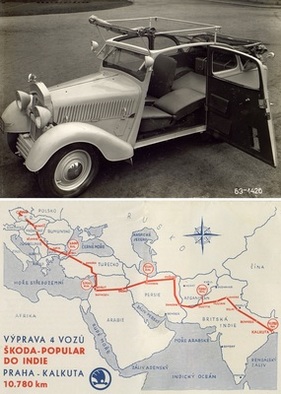
And so on Saturday, May 12, 1934, 85 years ago, a group of four Skoda Popular cars from the Prague Automobile Club set off on a trip to India. The semi-cabrios had one-liter four-cylinder engines with an output of 15 kW (20 hp). The unladen weight of Skoda's new entry-level model was 700 kilograms, plus a payload of 800 kilograms including the occupants.
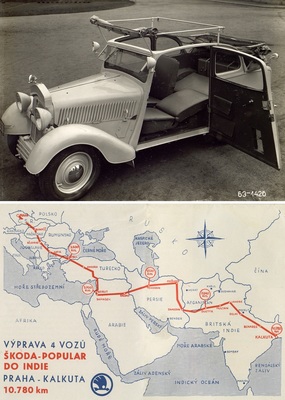
Led by Zbislav Peters, a lawyer and Czechoslovak national ice hockey player, the seven members of the expedition set off across the Balkans, Turkey, present-day Syria and Iraq to India. One vehicle even took a detour via Afghanistan. After arriving in Calcutta, the Skoda Popular drove to Mumbai, from where they traveled by ship to Trieste. From the northern Italian port city, the vehicles drove back to Prague and had covered almost 15,000 kilometers by the time they arrived on September 10, 1934, often in rough terrain and under harsh climatic conditions. On this long-distance journey, the new generation of Skoda vehicles proved their enormous quality and reliability just as impressively as their high technical level - the vehicles had central tube frames and independent suspension all round.
Around the world in 97 days
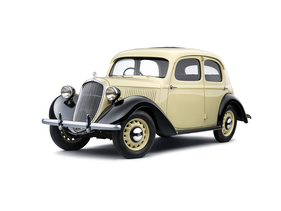
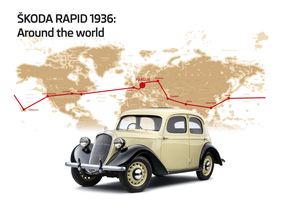
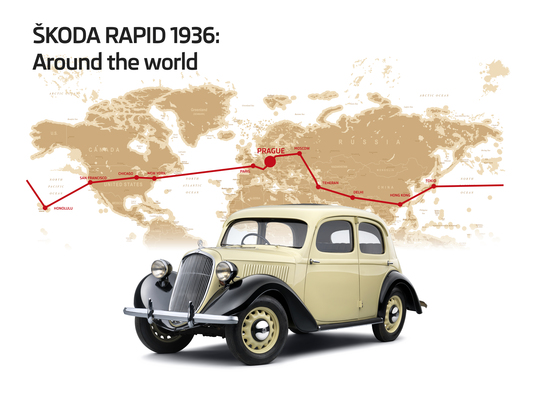
In the summer of 1936, Czechs Břetislav Jan Procházka and Jindřich Kubias drove around the world in 97 days. They relied on an only slightly modified open version of the Skoda Rapid with an output of 23 kW (31 hp) and powerful hydraulic brakes. The journey also took the vehicle through India. As the ship to Japan departed early, the Quetta-New Delhi-Mumbai section of the journey was like a chase: the fast and reliable Rapid covered this distance in just three days.
Not least thanks to the advertising effects of the expeditions described above, the number of Skoda vehicles exported to what was then British India amounted to 90 units per year in the second half of the 1930s. This put India in seventh place among the Czech car manufacturer's 39 export markets in 1938.
Economic change after the war
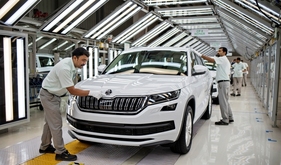
In view of the global social and economic changes after the Second World War, only 150 Skoda vehicles were exported to India between 1947 and 1955, followed by so-called ad hoc deliveries in the 1950s to 1970s, but there was no permanent representation. Another successful chapter in Skoda's history in India began in 2001, when the company from Mladá Boleslav became the second European car manufacturer to enter the Indian market locally with the Skoda Octavia. The launch of the flagship Skoda SUPERB in 2004 was followed by the LAURA (2006), FABIA (2008), YETI (2010) and Rapid (2011) models. Indian customers can currently choose from four model series: The Rapid is produced at the local plant in Pune, while the Octavia, SUPERB and KODIAQ are manufactured at the Aurangabad plant.
Over the past 18 years, Skoda has continuously consolidated its position in the Indian market, both in terms of the number of vehicles delivered and the perception of Indian customers. The potential of the Indian market is immense: with currently more than 1.3 billion inhabitants, the country has the second highest population in the world and the gross domestic product is growing by around seven percent annually.
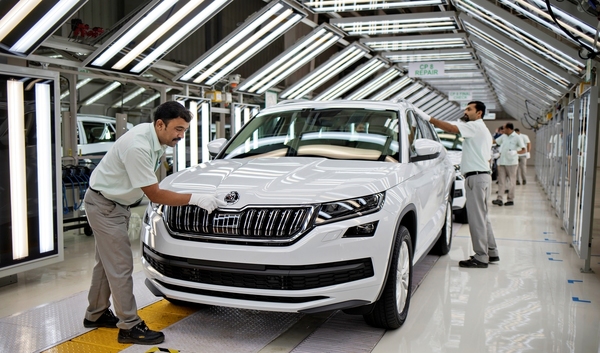
This makes the Indian market an important pillar of Skoda Auto's strategy. As part of the India2.0 project, the car manufacturer has been in charge of the Volkswagen Group's model offensive on the Indian market since 2018. The technology center in Pune was opened in January 2019. The vehicles developed at the new technology center are tailored to the requirements of customers on the subcontinent and 95 per cent of them are manufactured locally on the basis of the deeply localized MQB-A0-IN platform. This means that almost all vehicle components are 'made in India'. The car manufacturer will present the first design study at the Delhi Motor Show next year. In the next phase of the project, the Volkswagen Group will examine the possibilities of exporting the vehicles produced in India.