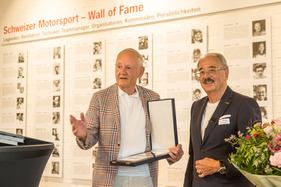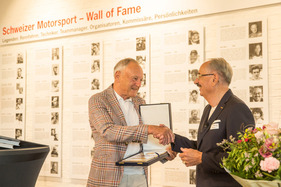
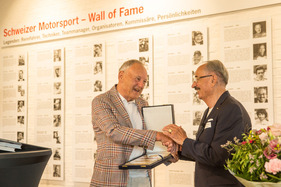
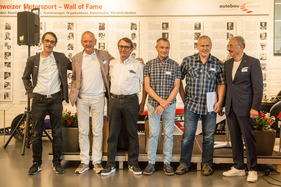
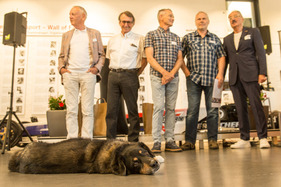
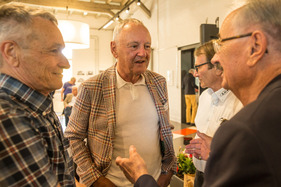
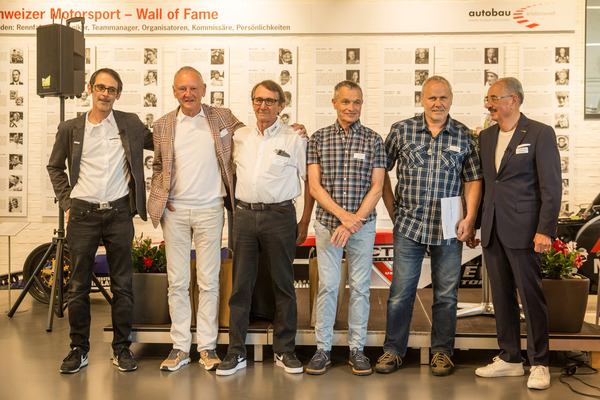
Last Saturday, June 3, 2023, three more motorsport stars were inducted into the "Wall of Fame" at the "autobau" museum in Romanshorn. In addition, as a result of the coronavirus pandemic, a man was honored who deserved to be immortalized there from the very beginning with the very big names such as Jo Siffert, Clay Regazzoni, Peter Sauber and Mario Illien: Fredy Lienhard. He was presented with three awards by Paul Gutjahr, President of the national sporting authority "Autosport Schweiz":
The first award was for Fredy's racing career. After all, he started small and simple, later built his own Formula Vee cars with friends and then founded the great "Lista Racing Team" again with friends, which has survived to this day. In 1976, he contested races in the Formula 2 European Championship, but always remained an amateur, as the Lista company needed its patron around the clock. The list of motorsport successes is long. However, his victory in the 2002 24 Hours of Daytona in a Dallara-Judd together with Mauro Baldi, Max Papis and Didier Theys stands out. Only one other Swiss driver has ever achieved this victory: Jo Siffert.
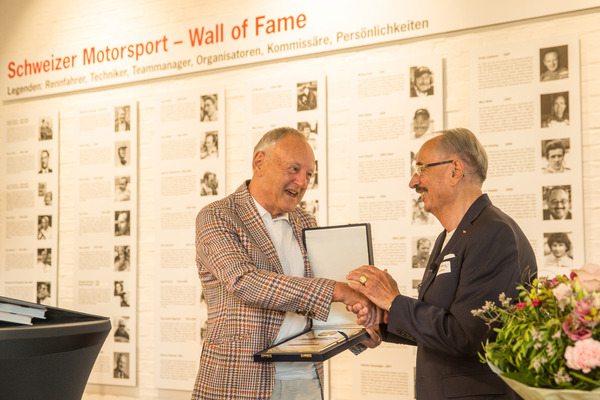
The second accolade: As Fredy himself experienced how much money motorsport costs, he was and still is considered a brave little helper for so many young talents. In 1985, a separate Swiss Formula 3 Championship was held. Eugen Strähl - himself a co-founder of the "Lista Racing Team" and NSK President at the time - established contacts with Fredy Lienhard to create a support platform. The championship was a success and enabled a number of drivers - most notably Gregor Foitek and Romain Grosjean - to continue their careers. Not only riders, but also organizations benefited time and again when the budget became tight and the organization of a race was at risk. A Lista grant often helped to prevent a race from being canceled. To this day, Lista's promotion of young talent and karting for young racing drivers is a major institution.
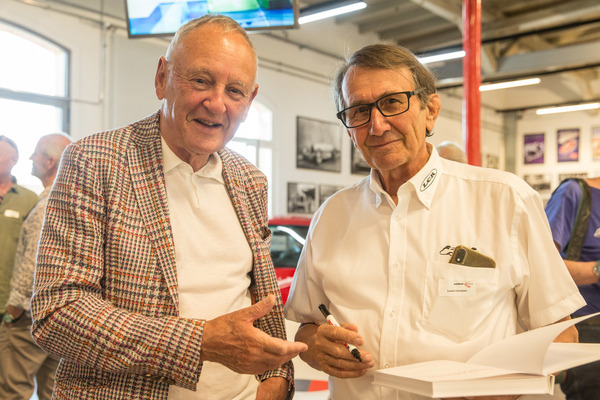
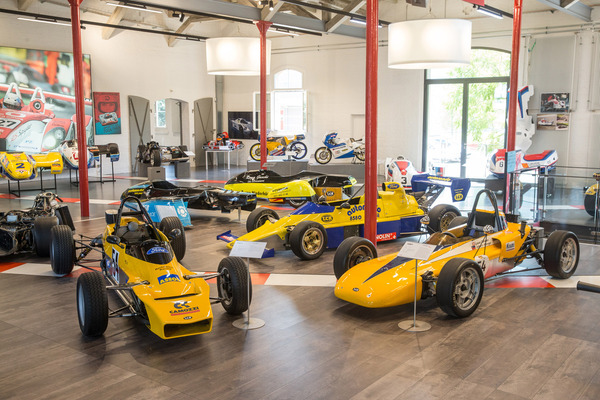
The third award: is the "autobau" museum. Or rather: a lively, constantly changing meeting place for friends of the automobile and motor racing. The meeting place in the renovated old buildings in Romanshorn is worth a visit for all automobile enthusiasts.
Now to the three new family members on the "Wall of Fame": Louis Christen, Rolf Biland and Markus Bösiger.
Louis Christen
He demonstrated his craftsmanship back in his school days by building model airplanes that actually flew. When he saw a Lotus Formula Junior at the age of 16, he knew what he wanted to do for a living. A car for Formula Vee was exactly the vehicle that could be built with relatively simple means. As a result, he devoted every spare minute - alongside his work as a mechanical draughtsman at Saurer's truck factory in Arbon - to building his own racing car. At the end of the project, all that was missing was a driver. So he got behind the wheel himself, and lo and behold, his design proved to be an instant success. Two new LCR Formula Vee racing cars were built for the coming 1973 season. The modern aluminum monocoque construction of these two cars was a first in Switzerland.
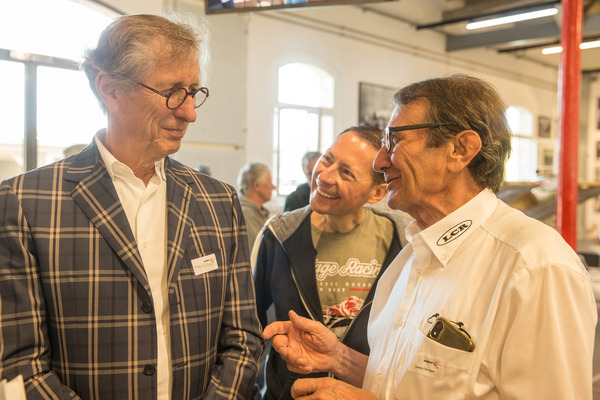
Together with his engine partner Franz Giger, he won all the races in the Swiss championship and also achieved many good results internationally. In the same year, the company LCR (Louis Christen Racing) Fahrzeugtechnik was founded. Just one year later, he made his international breakthrough with a Formula Vee victory in the European Championship race at the Norisring. In 1975, Louis hung up his racing helmet after a serious accident and from then on devoted himself to his own designs. In addition to four-wheeled vehicles, however, he now also began to build two-wheeled and, above all, three-wheeled vehicles. The sidecars, of which he has built around 500 to date, have brought him countless world championship titles. The first of these was won by Bruno Holzer and Charly Meierhans from Thurgau.
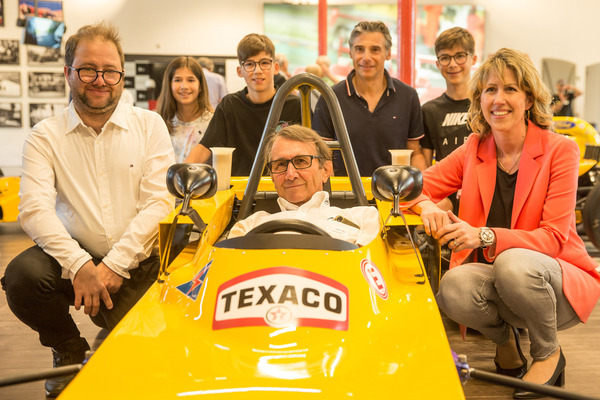
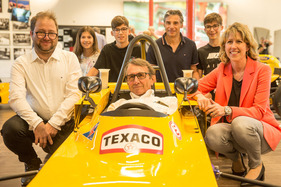
The innovative monocoque chassis design for two-wheelers also brought him the world championship title with Stefan Dörflinger in the then Krauser works team. With the production of motorcycles, he was able to produce larger quantities, and the worldwide sale of racing bikes guaranteed him a stable business, which was somewhat more difficult with racing cars. Christen, who was always somewhat overlooked in the Swiss media scene due to his great reticence, had already ventured into an electric car, the "Stromboli", years ago. However, the battery technology at the time prevented series production, and so it remained a prototype. 25 vehicles from Louis Christen's oeuvre are currently on display in a special exhibition at "autobau".
Rolf Biland
As a 20-year-old, he was allowed to take part in a hill climb for the first time as a co-driver ("Plampi") in Fritz Hänzi's team. This was later followed by the world championship race on the Salzburgring. Once he had tasted petrol, Rolf built his own team, but with 16-inch wheels, which actually worked and enabled him to win the Swiss championship title straight away. As early as 1974, Biland competed in the World Championship together with Fredy Freiburghaus: The pilot buys a machine, equips it with an engine, pays for everything himself, looks for sponsors for it and goes to the start. Absolutely unthinkable today. The first victory came as early as 1975 in Hockenheim. In 1977, he narrowly missed out on the world championship title and finished second. The first world championship title came in 1978 with the revolutionary BEO, in which the driver knelt and the co-driver sat and in which both rear wheels were driven.
From 1979, the world champion team Biland Waltiperg was one of Louis Christen's customers. Two people had come together who not only dared to experiment with technology, but also kept coming up with new, sometimes revolutionary ideas. Some of the designs were so outlandish that around four world championship titles were lost as a result of technical problems. Nevertheless, the team with Biland and Waltiperg won seven world championship titles, 81 GP races and finished in the top three a total of 18 times in the then highly competitive world championships. The technical understanding paired with driving quality and the absolute will to win was an almost unbeatable mixture.
Later, Rolf, who was never one to shy away from a joke, also drove racing cars and took part in the Formula 2 European Championship in Markus Hotz's team. He achieved his best result in Pau (France). More success would have been possible if his good team sponsors had also supported him more in Formula 2.
Markus Bösiger
After a visit to the "Dutch TT" in Assen, Markus decided to take part in sidecar racing as well. He took part in his first race in Misano in 1991. His first successes came very quickly. He finished third in the World Championship in 1995. Markus was not only a driver and team boss, but also a visionary and entrepreneur in sidecar racing. Like Biland, he was always looking for new ways to set himself apart from the competition. For example, he had a four-cylinder, four-stroke engine from Swissauto installed in his vehicle, which was only 250 cubic centimetres in size, but was equipped with an exhaust gas turbocharger. The success was moderate, but the costs were immense, which quickly led him back to the two-stroke engine.
In 1998, he launched another innovation with the "Höckler". In this vehicle, the driver sat just like in a racing car. In Bösiger's opinion, this type of vehicle was intended to encourage young kart drivers to enter the sidecar sport. However, the FIM banned this innovation at the end of the first season. Despite various setbacks, the Bösiger team was very successful and won the world championship title in 1997 and 98 with Steve Webster and David James.
At the end of the nineties, Markus Bösiger retired from sidecar racing and switched to truck racing. He was soon in the service of various manufacturers as a works driver. Here too, Markus was innovative and had his own truck with a MAN engine built by Tatra in the Czech Republic. In 2007, he was awarded the highest accolade, the FIA European Championship (there were no world championships). He also took the runner-up title three times. Markus was always the last to arrive at the racetrack, but also the first to leave, because for him the sport was just a vacation. And so he always returned to his company as quickly as possible.