Not all readers will probably be familiar with the name D'Ieteren, although some of the brands of this Belgian group, such as Carglass, will certainly be familiar to them. A brief introduction to the company's history, which stretches from the age of carriages to today's electromobility, therefore seems essential. In 1805, before the foundation of the Belgian state, Jean Joseph D'Ieteren successfully started building wheels and carriages.

At the end of the 19th century, or two generations later, the company began building car bodies on the site of its current headquarters in the Brussels district of Ixelles. The company was so successful that 65 percent of its production in 1928 was exported. After the Great Depression, D'Ieteren shifted its focus to importing American cars of the Pierce-Arrow, Auburn and Studebaker brands from 1931 onwards. Due to changed, restrictive tax regulations for imported vehicles, D'Ieteren launched a new line of business in 1935 and assembled Studebaker vehicles from supplied components in Belgium for the following 35 years.

In 1948, D'Ieteren concluded a contract with Volkswagen and thus introduced the Beetle exclusively to Belgium, followed shortly afterwards by Porsche. In addition, over a million Beetles were built in Belgium in the company's own factory. For a time, D'Ieteren even owned a car factory in the Congo, until it was expropriated by the dictator Mobutu. Later, the distribution of the NSU and Audi brands was added and today D'Ieteren is the Belgian general importer for all brands of the VW Group (including Lamborghini and Bugatti) as well as for Yamaha motorcycles. After a temporary involvement in the car rental sector, the company's portfolio currently includes, in addition to the automotive division, the global company Belron with the aforementioned subsidiary Carglass, a real estate division and the stationery company Moleskine.
Treasure at the headquarters
Over two centuries of company tradition are presented in the D'Ieteren Gallery at the traditional headquarters on Rue du Mail in the Belgian capital. Contemporary luxury cars from Porsche, Lamborghini and Bugatti as well as VW's "one-liter car" are on display in the windows.

The Gallery is not a pure car museum, because the business activities of the D'Ieteren Group are not limited exclusively to the automotive industry. Furthermore, the exhibits are not only on display, but are also used at motor sport and automobile history events. Almost one hundred automobiles and some two-wheelers are on display on 2,300 square meters. The exhibits are the smaller part of D'Ieteren's private vehicle collection. Curved strips on the ceiling of the building act as a timeline and show the company's activities over the course of time. Unfortunately, although the exhibits are atmospheric, they are ultimately illuminated a little too sparsely.
Of carriages and car bodies
Let us now begin our tour of this impressive collection. The replica of an elegant two-seater Tilbury carriage with a drawbar made of curved bentwood is representative of the carriage era. This is followed by impressive exhibits from the golden age of automobile body construction. In addition to a Hispano-Suiza Tipo 49 from 1929, the Bugatti Type 44 bodied by D'Ieteren a year earlier and a sporty, elegant Mercedes-Benz K, the mighty "Baehr Patent" torpedo from the Belgian company Excelsior from 1924 can also be admired.

As there were, of course, no air conditioning systems for cars at that time and crank windows were hardly common, a particularly tricky mechanism provided the longed-for cooling, which the friendly museum director van Boeckel clearly demonstrated to the author. First the side windows are folded up and then folded down to finally disappear behind a flap in the door.

Imported from overseas and from Germany
D'Ieteren's 35-year liaison with the American automobile manufacturer Studebaker, or Studebaker-Packard from 1954, is illustrated by a series of vehicles. These include a Studebaker EG Big Six from 1920 and a magnificent Packard 640 Custom from 1929.

Just before the Second World War, the two Commander variants Sedan (1938) and Business Coupé (1940) were created, followed a good decade later by the Packard Convertible from 1955. An example of the 50 Studebaker Champion Starlight, also known as the "bullet nose", is also missing, as is the design icon Studebaker Avanti from 1963.

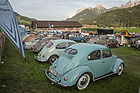
A large part of the exhibition is taken up by vehicles from today's Volkswagen Group and its predecessors. There are all kinds of rare items to discover in this section. Let's stay with the Volkswagen Type 1 "Beetle" and its predecessors and derivatives for a while. In addition to a pretzel Beetle and a Type 166 Schwimmwagen from 1942, a replica of the "Series 30" prototype from 1937 is on display.

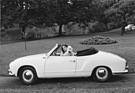
A buggy with knight's armor and, of course, a Karmann-Ghia Type 14 can also be seen. Next to them are the typical representatives of the seventies, VW Golf GTI and Scirocco.

Exotic prototypes and sporty gems
While you would almost expect to see an Apal Coupé at a Belgian motor show - and you are shown one - visitors are surprised by two Neretti sports cars. If you read the supposedly Italian-sounding brand name backwards, you will certainly see the light. Roland D'Ieteren (1942 to 2020) planned a sports car with a GRP body based on the Beetle for production in Mexico. The project was never realized and only a single example was built in 1964, the Neretti I.

Neretti II was not much more successful either. However, a pre-series of 15 units was built in Mexico City between 1970 and 1971.

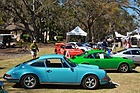
Several Porsches are parked in the vicinity of the exotic duo. And if you look closely, you can see the inscription "Anciens Etablissements D'Ieteren Frères Belgium" next to a stylized carriage on the flank of a 356 instead of the familiar name of coachbuilder Reutter. In 1960 and 1961, D'Ieteren built 724 examples of the 356 B Roadster. In addition to two 911s, a 550 and a Carrera 6, there is also a British Elva Mk 7, a racing car with a Porsche engine.

Many rarities from the Uni-VW-rsum
The pre-war era of Auto Union is also impressively represented. In addition to the DKW models F 1 and F 5 and the Wanderer cars W 23 and W 25 K, an Audi Type SS "Zwickau" with an in-line eight-cylinder engine is presented.

The two replicas of the Wanderer W 25 streamlined racing car and the Auto Union Type A from 1934 with 16 cylinders are certainly the highlights of the Auto Union presentation. The post-war cars include a DKW Schnellaster, an F 91 3=6 Sonderklasse Cabriolet from 1954, a 1000 SP Roadster and an Audi 60 L from 1972.

Fortunately, the NSU company is also documented. In addition to a Prinz III, there is a Wankel Spider and a Ro 80 from 1974. Seat is represented with the small sports coupé 1430 Sport from 1979. Czech automobiles also form part of the exhibition, with a Škoda 422 Tudor from 1930 and a Popular Cabrio from 1937 on display.

The Bugatti Type 57 Aravis with D'Ieteren bodywork from 1938 is in good company alongside a Lamborghini 350 GT and a Bentley S1 Continental Sports Saloon from 1956.

As mentioned above, the company was also involved with two-wheelers. Worth mentioning because of its rarity value is the Belgian Piatti scooter with 125 cc displacement, which D'Ieteren sold from 1952 to 1954, albeit largely unsuccessfully.

Due to the quality of the exhibits and the historical range, you should take enough time to visit the gallery. The further development of the company and its exhibition can also be observed with excitement. As diesel cars will no longer be allowed in Brussels from 2030 and petrol cars from 2035, D'Ieteren is increasingly focusing on electromobility and operates a large bicycle store at its traditional headquarters in Ixelles.
A visit to the D'Ieteren Gallery is possible by appointment.