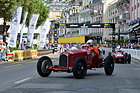
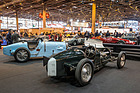
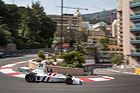
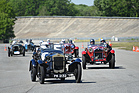
Montlhéry has a very special ring to it for fans of the taste of castor oil who are interested in history. The racecourse, to the south of Paris and just under 30 km from the center of the French metropolis, was built in just six months in 1924, after Alexandre Lamblin had previously visited the track at Brooklands.

In contrast to other high-speed circuits such as Brooklands, Sitges Terramar or Monza, whose banked curves were concreted on earth embankments, the curves of the Montlhéry oval are underpinned with a filigree support structure. The grandstands could hold up to 40,000 spectators at the time. In addition to the oval circuit with a length of just over 2,500 meters, a Grand Prix circuit with a total length of 12.5 km was built the following year. Only the east bend was integrated into the GP circuit and it was driven in a clockwise direction.
The high-speed oval, on the other hand, built for speeds of up to approx. 230 km/h, runs in an anti-clockwise direction. A cycle car race was held at the opening on October 11/12, 1924, and the first GP de L`ACF was held the following year on the outer GP circuit built in 1925.

In Montlhéry, motorcycle and initially even bicycle races were held in addition to automobile races and record-breaking races. The circuit was used for racing (up to Formula 2 races) until 2005, but was then closed to competition for safety reasons.
By enthusiasts for enthusiasts
The Vintage Revival, organized by a group of enthusiasts around Vinvent Chamon, continues the tradition of Jaques Potherat's events every two years after a break of several years. Participation is limited to pre-war vehicles with two, three or four wheels and is probably one of the largest and most varied events of its kind.

The variety of brands is incredible, not least thanks to the countless French manufacturers of the interwar years. Who remembers "Majola", "Grafton", "Tracta", "Alcyon", "Omega" or "Jongen"?
Among the 240 or so participants were around 40 Morgan, Darmont and Sandford three-wheelers as well as around 10 Amilcar C6s in the "Course", "CO" and even "MCO" versions.
Of course, a horde of Bugattis of various types from T13, T36, T43, T51, T35 to T59 was not to be missed. Other better-known brands such as "Salmson", BNC", "Rally", "Roland Pilain", "Lombard, "MG" etc. were also well represented.
The two-wheeled acrobats, around 100 in number, also brought the most unusual designs to the Montlhéry oval, such as a "Torpedo" with a "half" 4-cylinder radial engine, i.e. in a "W arrangement" so to speak.
An in-line four-cylinder "Slavia" from Skoda's predecessor company was also on show, as was the record-breaking Koehler Escoffier engine with supercharger, or a Mc Evoy with four-valve technology from 1924.
Hardly any spectators, no VIPs
Although the Motodrom is actually located in a large catchment area and would therefore have huge spectator potential, the "Vintage Revival" is a very intimate event. There are only a few spectators, VIP lounges and sponsor tents with intrusive advertising are conspicuous by their absence. It is precisely this simplicity and restraint, together with the special vehicles and participants, some of whom are dressed in historical costumes, that characterize the special charm of this event.
The ride on the historic steep-sided track
But what is it like to drive an 80-year-old GP racing car, a Maserati 8CM from 1934, on this historic track?

Gwenda Stewart, who set speed records in her front-wheel-drive Derby-Miller in 1934, and Antonio Ascari (father of the famous Alberto Ascari), who crashed fatally in his Alfa Romeo P2 in 1925, remain unforgotten. Swiss driver Benoit Musy, who overshot the top of the bend in a Maserati sports car during the "Coupe du Salon" on October 7, 1956, will also be remembered.
Although double crash barriers have since been installed at the top of the bend to prevent such incidents, there is still a certain amount of respect for the 16 to 18 meter high and progressively steeper concrete track. Of course, the ravages of time have also left their mark on this support structure, which today manifests itself in severe unevenness and displacement of the road surface.
From the experience of two years ago, I knew that everything on the vehicle had to be well tightened and secured in advance to avoid scattering all the bolts on the track in the event of vibrations and impacts.
So far prepared, and remembering the near-miss from last time, when I almost left the cockpit involuntarily due to a brief moment of inattention and a subsequent bump, I stand at the pre-start.
At the starter's command, we set off, first along the old GP track in a westerly direction. Then brake at 100 meters, second gear and cut the 180° hairpin bend at the water tower cleanly. When accelerating out, the still cold tires and the missing limited-slip differential make themselves felt negatively, but it is still enough to slow down the 51 Bugatti before the next left-hand bend. Now full acceleration, under the spectator bridge, third gear, and braking again, downshifting for the right-hand bend "Epingle du Faye", which hangs outwards.
There's a traffic jam in front of me - an MG, two Riley cars and a Salmson are struggling through the bend, so I ease off the throttle a little and overtake the group after the bend.
Now we are on the back straight to the finish area and can see the concrete pillar construction of the west bend on the right. Before entering the banked east bend, there is another tight chicane. Under braking, we manage to overtake the Talbot and the Aston Martin and drift through the narrowing of the track. Shift up to 4th gear and find the right trajectory in the bend according to your speed. If you are too low, the distance to be covered will be shorter, but the car will still push upwards, which requires extensive counter-steering. If you drive up but are too slow at the same time, the rear of the car starts to slide downwards. It is therefore important to find the right path where the centrifugal forces and gravity roughly cancel each other out. In order to drive at the very top at an angle of inclination of around 60°, you have to summon up the courage to drive at around 160 to 180 km/h.
The track is so uneven here that the car jumps from bump to bump at these speeds, the engine howls due to the lack of ground contact of the drive wheels and you have to concentrate on trying to stop the lateral displacement in order to drive a reasonably clean line.
It is now also understandable why the early racers often rode with a corset, because the unfiltered impacts are hell for damaged spinal discs. If you don't have a harness, you also have to hold on to the steering wheel or somewhere else to avoid being thrown off like a rodeo rider.
At the end of the east bend, there is another chicane, which is approached from the top of the steep bend and requires a downshift into second gear.
And suddenly the 51 Bugatti is there again, on the right, a little lower down, I hadn't seen it in the vibrating rear-view mirror. Did it perhaps choose the shorter route, i.e. a lower lane, to get back to me? Since he's on the inside, I have to give him the right of way before the chicane, but with the intention of catching him again as I accelerate out. Due to the deeper track and the slightly sharper turn-in angle, he has to brake hard, which results in the dreaded bouncing of the Bugatti's front axle and forces the driver to back off sharply.
So I can easily overtake him at the exit of the chicane and turn back onto the start-finish straight that leads down to the water tower, third gear, fourth gear, brake, downshift, turn in.
This goes on for another 10 laps until the race director waves us off the track and the next field starts.
Back in the paddock, we have to check everything on the Maserati, top up the fuel, check the screws, check the chassis and answer endless questions from spectators and photographers.
And so the time never gets long before the call for the next start is made.