One hundred years is a proud number, even in the classic car scene. The Linas-Montlhéry Autodrome, located a good twenty kilometers south of Paris, will celebrate its centenary in 2024.
The racetrack is a relic from another era. The two gigantic banked turns with a diameter of 500 meters (!), connected by two 180-meter-long straights, once formed the heart of the racetrack. The old pits, the timekeeper's tower and the grandstand on the start-finish straight still have a clear sense of the past.

When you hear the sound of old racing engines and the smell of burnt gasoline and castor oil in the air, you feel like you've been transported back decades.
Hardly any other event is as fitting for this unique race track as the Vintage Revival, as it offers the perfect setting to immerse yourself in the great era of Bugatti, Maserati, Amilcar, BNC, Norton, Terrot and many other outstanding brands.

Time has left its mark on and around the track. Accordingly, various adjustments have been made to the track layout over the course of 100 years. For some time now, only the east curve has been part of the current 3.4 km course.
Highly coveted starting places
The organizers knew that the demand for starting places would be enormous. Accordingly, the organizing team focused their attention primarily on racing cars with a historical connection to the race track. Vehicles from the period between 1924 and 1940 were permitted. 450 drivers were ultimately able to secure one of the coveted starting places. The starting list included 300 cars and 150 motorcycles.

There was a reunion with many brands that had long since disappeared. Many brands had not survived the II. World War II had not survived. They were brought back to life for two days on May 11 and 12, 2024. The vehicles were divided into 11 groups. On Saturday and Sunday, the vehicles were allowed on the track twice for 15 minutes each.
Cars with a Montlhéry past
Kurt Hasler's Maserati 8 CM can be found three times on start lists in Montlhéry. On September 9, 1934, Benoit Falchetto won the GP de L'U.M.F. Montlhéry with the car. The racing car with a 3000 cc 8-cylinder engine was later used for many years in Hungary. Accordingly, the vehicle is still painted in the Hungarian national colors today.
Hasler was able to bring the car to Switzerland in 2007. He subjected the racing car to a complete restoration and brought it back to its original 1937 condition.

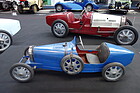
A special car at the 2024 Revival was the Bugatti Type 36/35A 1493 cc. Bugatti presented the Type 36 in 1925. The vehicle had a compressorless 8-cylinder in-line engine, as was also installed in the 1.5-liter Type 35. The 36 prototype took part in a race on the Montlhéry racetrack on May 17, 1925. As there was no rear suspension, the car was considered difficult to control.

Due to the poor experience in Montlhéry, the car was modified. The rear axle was fitted with leaf springs and the engine was fitted with a supercharger. All three Type 36s were later converted to a tried and tested Type 35C chassis.
Flying bananas?
A field of 34 Three Wheelers was sent out onto the track under the name Flying Banana. What the name "Flying Banana" stands for eludes the writer. Perhaps because some of these vehicles (Sandford) have a rear end that is vaguely reminiscent of a banana? The best-known manufacturer of sporty three-wheelers was and is the British company Morgan.

The Morgan Runabout prototype was first presented to the public at a trade fair in London in 1910. The vehicles were delivered with transverse V-engines from various manufacturers as well as with in-line four-cylinder engines (Ford).
Sandford was founded in Paris in 1922 by the former British motorcycle racer Malcolm Stuart Sandford. He put a number of redundant military motorcycles from the First World War on the road.

Darmont was also a French manufacturer that acquired a license to build Morgan vehicles and brought them onto the market with slight technical modifications under the name Darmont-Morgan.
Many Swiss in the motorcycles
The motorcycles were divided into three categories, with the Motocyclettes Pré 1919 & Exception group forming by far the largest field. Who remembers brands such as Blumfield, Lurquin & Coudert or Alcyon? They did their leisurely laps in Montlhéry in 2024. This field had the privilege of using both banked turns.

Things were much faster in the Motos GP class. It is always impressive to see the crazy speed at which the rigid-frame companions are chased around the bumpy track. It goes without saying that hardly a screw was left untouched on the inside of the engines. A sacrilege for some classic car enthusiasts, for others the logical development of what the machines were once built for - to go fast and win races.

In the Course & Sport class, too, there were not only a number of Swiss riders on the track, but also former well-known Swiss motorcycle brands such as Motosacouche and Condor. Among all the exclusive two-wheelers on the start list were two Brough-Superior. An MK1 SV and an SS 100, the latter of which was delivered with a certificate stating that the machine could reach at least 100 mph (161 km/h) - as early as 1924!
Brough's best-known customer was the British colonel, spy and writer T. E. Lawrence, known as Lawrence of Arabia. He had a serious accident in his Brough Superior SS 100 on May 13, 1935 and died of his injuries six days later.
A Bugatti with a Maserati engine
In June 1932, the Italian racing driver Count Luigi (Gigi) Premoli entered an extraordinary car in Monza with the BMP Bugatti-Maserati-Premoli Course. Premoli owned a Bugatti T35, but its performance could not keep up with the 8-cylinder Maserati cars of the time. Maserati, on the other hand, was in a financially difficult situation, so they also sold engines for other vehicles, even for racing boats. Luigi Premoli subsequently fitted the chassis of his Bugatti with a 2.5-liter Maserati engine. The gearbox, front and rear axles and the body were taken from the Bugatti. The radiator and mask, on the other hand, came from Maserati.
Luigi Premoli used the car in various circuit and hill climb races with moderate success. At the end of 1932, he was seriously injured in an accident at Coppa Ciano Montenero. While still in his hospital bed, he ordered the first of the newly developed 3.0 liter engines (no. 3003) from the Maserati brothers. The vehicle was completely rebuilt with this engine. The chassis, engine and gearbox suspension were massively reinforced. Premoli was able to achieve numerous victories and podium finishes with this rebuilt racer. According to the Premoli family, the car fell into the hands of the Nazis during World War II and has been considered lost ever since.
Rebirth in Switzerland
Inspired by this story, Edy Schorno, a classic car garage owner from central Switzerland, built a replica (recreation) of this racing car within six years. He first obtained the OK for his project from the Premoli family in Italy.

Schorno was able to acquire a Bugatti T30 35 chassis, probably from the 1960s. He was also able to obtain gearbox parts, steering gear parts and a hollow GP axle as well as body parts. What was missing was a suitable Maserati 3.0 liter engine. The days when you could knock on the door of the Maserati brothers were 90 years ago and such engines are impossible to find on the classic car market. So Edy Schorno decided to build a completely new engine based on an original template and some plans he had collected. He had the housing, cylinder, cylinder head and other parts cast accordingly. Some components were 3D printed. He machined all the parts himself in his workshop and produced countless missing parts.

At the Vintage Revival Montlhéry, the car was resurrected exactly 100 years after its birth and 92 years after its conversion. Edy Schorno cherishes the justified hope of one day being able to compete in the Goodwood Revival with this unique car.
Pic-Pic, the make from Geneva
Piccard-Pictet is an internationally little-known brand. The Geneva-based company's vehicles were known as Pic-Pic and were manufactured by Ateliers Piccard-Pictet & Cie until 1920. Various proprietary engines were installed, some of them from Hispano-Suiza. A 1918 Sturtevant Special was at the start of this year's revival. After the Pic-Pic company had to file for bankruptcy in 1920, the vehicles were built by Gnôme et Rhône until 1924.

The Pic-Pic was considered to be very robust and was procured by the Swiss army in large numbers and used until the late 1930s.
Some monster...
Today, downsizing is a keyword in automotive engineering. But around a hundred years ago, big, bigger, biggest was the order of the day. At least when it came to racing cars or record-breaking vehicles. Cars (or almost monsters?) were built with displacements of up to 28ˈ400 cc. Not for the road, but for record attempts where they wanted to prove the performance of the brand. Some of these "monsters" could also be admired in Montlhéry.

The Darracq 200 CV with 25ˈ400 cc always causes a stir. It is probably the first racing car with a V8 engine and the first car to officially exceed 200 km/h. The vehicle has a minimalist design and the hairs on the back of your neck stand on end when it is brought to life with a loud roar.
The Leyland Thomas N°1 broke 16 speed records in the 1920s. The vehicle was based on the Leyland 8, a luxury car that was a financial failure due to its price. John Godfrey Parry-Thomas later converted the car into a racing vehicle. However, the project ended tragically. The car overturned at Pendine Sands in 1927 while attempting to set a new speed record.

Thomas died at the wheel of his vehicle, named "BABS". The vehicle was buried in situ, unearthed in 1969, 42 years later, and underwent a 15-year restoration.
Another record-breaking vehicle is the Napier-Railton. The 1933 car is powered by a Napier Lion W12 aircraft engine with 24ˈ000 cc.

Between 1933 and 1937, the Napier-Railton broke several world speed records at Brooklands, Montlhéry and on the Bonneville Salt Flat in Utah.
...and a beast
The displacement king at this year's Revival was the FIAT S76 Racing. The car, of which only two were built, dispersed 28ˈ400 ccm over four cylinders. Elegant would certainly be the wrong word for this vehicle from 1911. It is tall and powerful, almost reminiscent of a locomotive. It was to go down in motorsport history as the Beast of Turin. The power output was given as around 290 hp at 1900 rpm.
The engine does not hum, it thunders, flames shoot out of the two mighty exhaust pipes, the ground vibrates.

Even if the beast never set a world record, it is one of the most impressive vehicles of the pre-war era. Remarkably, the car arrived in Montlhéry from England on wheels!
Abrupt end to the event
Unfortunately, the event had to be stopped prematurely. In the afternoon, dark clouds had gathered in the sky. A few flashes of lightning could be seen and heard. Unfortunately, lightning subsequently struck in the middle of the paddock. The revival was then stopped immediately.
What a pity, up to this point it had been an all-round successful event with fantastic vehicles and lots of visitors. A big thank you to the organizer under the direction of Vincent Chamon and his countless helpers!
Festival in October 2024
For all those who missed the Vintage Revival, there will be another opportunity to experience historic vehicles on this unique race track on October 12/13, 2024. The track operator UTAC is organizing the Centenary Festival, an event at which visitors can admire various classic and vintage cars. A visit should be worthwhile.