
The city of Bergisch Gladbach was created in 1975 from the small town of the same name by merging with the town of Bensberg and the village of Schildgen. It grew into a real city and is now the district town of the Bergisch Rheinischer Kreis with over 100,000 inhabitants. It is also the center of the Schloss Bensberg Classics, which have been held successfully and with increasing popularity year after year since 2009.

A typical feature of the Schloss Bensberg Classics is the division of the event into a Rallye Historique and a Concours d'Elégance with FIVA A status. On July 18-20, 2014, the time had come again: in contrast to previous years, the sixth Schloss Bensberg Classics took place in July instead of September.
Through woods and meadows
While a relaxed atmosphere prevailed on Friday afternoon during the vehicle registration and acceptance for the Rally Historique, inexperienced rally co-drivers were introduced to the secrets of navigation and special stages in a one-hour course. Some people were already buzzing before they had even enjoyed their first chilled glass of champagne.

Saturday morning was the day to start. In two loops, one in the morning and one in the afternoon, the riders drove on country roads and lanes in the east of Bergisch Gladbach, completing eleven special stages with hose/light barrier measurements and skill exercises.
While some participants got lost in the first few kilometers, others reached the finish line without any major difficulties and also mastered the parking exercise with flying colors.

The two circuits, which together covered around 200 km, were easy for all cars to master, not least thanks to the largely flat terrain, which was only made more entertaining by a few steep gradients. Even pre-war cars, and there were quite a few of them, were able to keep up well. They in particular made the spectators at the side of the road happy, because when else can you see two pre-war racing Bugattis with an Invicta 4.5 S Low chassis driving past in convoy?

Between the shorter drive in the morning and the longer route in the afternoon, the participants had a well-earned lunch at Lerbach Castle before returning to the starting point at Bensberg Castle in the evening, where the final timekeeping took place in front of an audience. The participants were given a glass of champagne as refreshment.
Interesting mix of vehicles
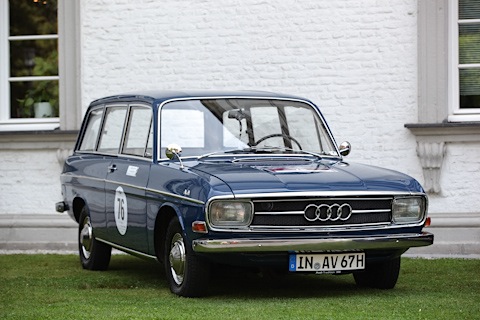
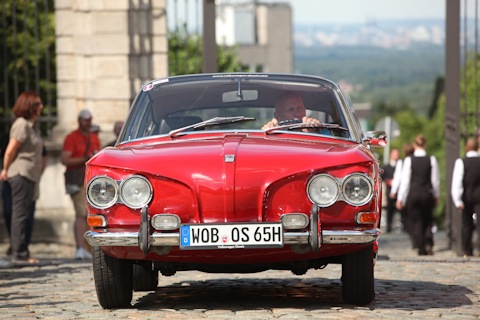
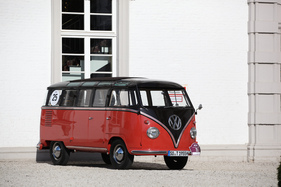
Around 100 vehicles took part in the rally, a not inconsiderable number of which came from the traditional divisions of the Volkswagen Group brands. These included rare rarities such as the Audi 80 Variant (built in 1967), the Karmann prototype for a VW Type 4 cabriolet (1968) and a whole parade of VW transporters from the T1 and T2 series.

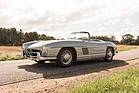
Also worth mentioning are some Concours vehicles that did not want to wait in the dark hotel garage for their appearance on Sunday, but were given a run-out at the rally on Saturday, such as the Mercedes Benz 300 S Cabriolet from 1952 and the Jensen 451 S from 1956, which, incidentally, once again finished at the top of the rally standings.

The crew of the Seat 124 Sport 1600 Coupé was particularly unlucky, because even before the rally began, an inattentive contemporary drove into the rear of the Seat, which is very rare here, and so the rally had to be tackled with a badly battered rear end.
Hourglass to electronics
The Rallye Historique was divided into four classes according to the age of the vehicles and the timing technology used.
Gilbert and Elisabeth Wurth won the "hourglass" class up to 1945 in a 1937 Riley TT Sprite Special, followed by Goy and Francoise Geltes in a 1924 Bugatti T 35.

In the post-war class with mechanical watches, Hans-Ulrich and Marie-Therese Hahn celebrated their victory in an Alpine A110 1600 S from 1969, while Gert Ittert and Gabriele Eickmann-Pohl took second place in a Jaguar XK 150 S from 1959.
In the pre-war electronics class, Stefan Brungs and Greg Kable took the winner's trophy in another 1926 Bugatti T 35, while Thomas Frank and Guido Reinking in an Audi 920 Cabriolet had to settle for second place.

The post-war vehicles with electronic support were dominated by Klaus and Karin Steffens in a Jensen 541 S from 1960, while Gotthard Schleicher and Maria Schmitt in an Alfa Romeo 1750 GTV from 1970 were only narrowly beaten.
Pictures of most of the participating vehicles can be found in the "Rallye Historique" picture gallery.
Early morning activities
Those participants who wanted to show a vehicle at the Concours d'Elégance had to get up early on Sunday. 42 vehicles drove from the hotel garage into the inner courtyard of the castle one by one from 06:30 in a light drizzle and were guided to their places by meticulously directing ushers.

Due to the rain, many cars were kept dry under plastic covers as far as possible, but the rain soon subsided and the cars were allowed to show themselves in their best light.
And there was plenty to see. The vehicles competed in eight categories in the beauty contest:
A. Impressive Elegance - Prestigious Saloons (Pre-War)
B. Open-Top Legends - Sporty Roadsters and Convertibles (Pre-War)
C. The Shape of Speed - Early Aerodynamic Designs
D. Heavenly Icons - Rare Convertibles (Post-War)
E. Italian Beauties - Forgotten Italian Classics
F. Passion and Power - 100 Years of Maserati
G. The Magic Material - Cars with Plastic Bodies
H. Roaring 50's - Racing Cars of the 1950s
Colorful Stories

Almost as important as the beautiful racing cars are the interesting stories behind them. The Jaguar XK120 that Wilhelm Eckerlin bought in 1951 did not satisfy the owner in terms of space. Without further ado, he had the new car converted by Autenrieth and thus widened by 20 cm. The interior grew by 40 cm. In the course of the conversion, which took six months and cost DM 55,000 (the basic price of the car was DM 18,500), the two-piece windshield was replaced by a panoramic windshield, electrically heated seats were installed and the dashboard was modified. Of course, the Autenrieth Jaguar XK 120 remained a one-off.

Or the Alfa Romeo 8C 2300/2600 with chassis number 221110 from 1932/33, which originally had a body by Castagna. Count Augusta had an accident with this car in 1951 and decided to scrap it. In a magical way, this chassis reappeared in the 1970s and, in the search for a suitable body, the dismantled body of another vehicle (2111018) was found, which had been given a body designed by Erdmann & Rossi and built by the Bandone company in Cannes in 1934. This body was now combined with chassis 221110 and the entire car was restored before 1990. Since then, the car has only been shown to the public twice. Today, the elegant body shape is impressive and, according to Egon Zweimüller, the 8C is wonderful to drive.
Two unorthodox Mercedes Benz

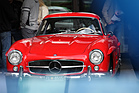
Hardly anyone knows that Mercedes Benz also built a GRP version of the 300 SL Gullwing in addition to the aluminum and sheet steel bodies. The 1955 model, which never made a public appearance, has survived and differs not only in the choice of materials but also in the special indicators on the front fenders and different rear-view mirrors. The car, which was being shown for the first time in a long time, arrived in the castle courtyard without engine power and without effective brakes, but it was still a minor sensation in the "Cars with Plastic Bodies" category.

Hardly less rare was the Kamm-Wagen K3, which was built in 1938 on the basis of a Mercedes Benz 170 V. The Cd value was an impressive 0.23, which is said to have helped the 38 hp vehicle reach a top speed of 130 km/h. The Mercedes was the only surviving Kamm car on display in Bensberg in unrestored condition.
Beautiful Eastern Europeans

Two Eastern Europeans made it into the Schlosshof in the category "The Shape of Speed". The Skoda Popular Monte Carlo from 1937, which had already impressed spectators at the rally with its elegance, and the Tatra Type 87 from 1941 with a three-liter V8 engine and a drag coefficient of 0.36, which enabled a top speed of 160 km/h even before the Second World War.
Unique plastic car from Germany
In 1967, Henner Werner, Michael Conrad and Detlef Unger built a self-supporting plastic sports car, which they called the Delta 1. Special features of the car were the sandwich construction and the light strip with six rectangular lamps that could be folded out.
The car was never built and was stored as a wreck for many years until Werner Brendel dared to start restoring it. It then became more of a reconstruction, in which design defects were also eliminated as far as possible.

Today, the car with its NSU-TT engine and around 650 kg is fully drivable again. With its blue paintwork, it was more than just a splash of color at the Schloss Bensberg Classics.
Special racing cars
Contrasts were the theme of the "Racing Cars of the 1950s" category. On the one hand, the top-restored Mille Migilia Ferrari with Vignale bodywork, on the other, an unrestored Borgward Hansa RS 1500, which unfortunately could only be started late due to too much oil in the engine after extensive pumping and therefore could no longer be considered as a class winner.

And while the Porsche 550-1500 RS Spyder from 1954 fought for race wins with a displacement of just 1.5 liters and 117 hp, the Maserati 450 S from 1958 drew on its full potential with well over 400 hp. The golden mean of the racing category was embodied by the OSCA 2000 S from 1954 with a 165 hp two-liter inline six-cylinder engine.
The most elegant of the elegant

With so much to choose from, the nine-member jury under Franz-Josef Paefgen did not have an easy job. But even with completely incomparable vehicles, they had to decide on a category winner and so the Duesenberg SJ from 1933 won in the prestige cars of the pre-war era, the Bugatti Type 50 from 1930/31 in the sporty roadsters of the pre-war era, the Tatra Type 87 from 1941 in the early aerodynamic cars, the Porsche 356 Pre-A Speedster from 1955 among the rare post-war convertibles, the Siata 140S Daina Sport from 1952 among the forgotten Italian beauties, the Maserati A6G/2000 Frua as a coupé from 1955 in the Maserati category, the Studebaker Avanti R2 from 1963 in the plastic-bodied car class and the OSCA 2000 S from 1954 among the racing sports cars of the 1950s. The fact that two Volkswagen Group brands are represented among the winners should certainly correspond to the statistical proportion of these car brands.

The Fantuzzi Spider Maserati 150 GT from 1957 won the jury's "Best of Show" award, while the public opted for the Porsche 356 Pre-A Speedster from 1955. Unfortunately, the Delta 1 and the Borgward were left empty-handed.

The various special prizes can be seen in the table below. Pictures of all Concours participants can be found in the Concours d'Elégance picture gallery.
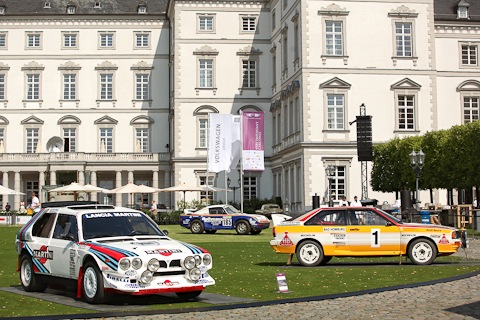
The fact that the Volkswagen Group is the main sponsor of the Bensberg Classics was also evident from the two special exhibitions in front of and behind the castle, which provided interesting insights into the Le Mans history of the Group brands and the racing history of the VW Golf.
Prizes and participants in the Concours d'Elégance
The following table shows all the vehicles entered for the Concours d'Elégance and the prizes won.
| Cat/No | Make | Type | Year | Country | Prices/Comments |
|---|---|---|---|---|---|
| A1 | Mercedes Benz | 450 K Nürburg | 1928 | D | |
| A2 | Bentley | 8 Litre | 1930 | D | |
| A3 | Duesenberg | SJ | 1938 | Category winner, special prize Prewar Closed | |
| A4 | Rolls-Royce | Wraith | 1939 | CH | Special award Most Attractive Prewar Design |
| A5 | Rolls-Royce | Wraith | 1939 | D | Works car |
| B1 | Bugatti | Type 27 Brescia Modifié | 1923 | MC | Special price Best Unrestored Condition |
| B2 | Riley | Brooklands Speed Model | 1930 | D | |
| B3 | Bugatti | Type 50 | 1931 | D | Category winner |
| B4 | Alfa Romeo | 8C 2300/2600 Brandone | 1932 | D | Special prize Prewar Open |
| B5 | Mercedes Benz | 380 K Special Roadster Erdmann & Rossi | 1933 | D | |
| C1 | Porsche | Type 64 Berlin-Rome car | 1938 | D | |
| C2 | Skoda | Popular Monte Carlo | 1937 | CZ | |
| C3 | Tatra | Type 87 | 1941 | D | Category winner |
| C4 | Eagle | 2.5 highway convertible | 1938 | D | |
| C5 | Mercedes Benz | 170 V Kamm-Wagen K3 | 1938 | D | |
| D1 | Jaguar | XK 120 Autenrieth | 1951 | D | |
| D2 | VW | Dannenhauser & Strauss | 1951 | D | factory car |
| D3 | Mercedes Benz | 300 S Cabriolet | 1952 | D | Special prize Longest Journey to Bensberg |
| D4 | Bentley | R-Type Mullinger DHC | 1953 | D | |
| D5 | Porsche | 356 Pre-A Speedster | 1955 | D | Category winner, Best of Show by Public |
| D6 | BMW | 503 | 1956 | D | |
| D7 | Maserati | 150 GT Spyder | 1957 | A | Best of Show Jury, Special Prize Postwar Open |
| E1 | Siata | 140 S Daina Sport | 1952 | NL | Category winner, special prize Postwar Closed |
| E2 | Cisitalia | 505 F | 1953 | D | Special prize Best Restored Condition |
| E3 | Abarth | 750 Allemano Spider | 1958 | D | not on site |
| E4 | Abarth | Allemano 2200 | 1959 | D | |
| E5 | OSCA | 1600 GT | 1960 | I | |
| F1 | Maserati | A6G/2000 Frua Coupé | 1955 | Category winner | |
| F2 | Maserati | A6G/2000 Frua Spyder | 1957 | D | |
| F3 | Maserati | 3500 GT Spyder | 1960 | D | |
| F4 | Maserati | 3700 GTI Sebring | 1967 | CH | |
| F5 | Maserati | Ghibli SS | 1971 | D | |
| G1 | Mercedes Benz | 300 SL GRP Coupé | 1955 | D | Works car |
| G2 | DKW | 3=6 Monza | 1956 | D | works car |
| G3 | Jensen | 541 S | 1960 | D | |
| G4 | Studebaker | Avanti R2 | 1963 | D | Category winner |
| G5 | Gordon-Keeble | GT | 1964 | D | |
| G6 | Delta | 1 | 1967 | D | |
| H1 | Ferrari | 250 MM Vignale Spider | 1953 | D | |
| H2 | Porsche | 550-1500 RS Spyder | 1954 | D | |
| H3 | OSCA | 2000 S | 1954 | D | Category winner |
| H4 | Borgward | Hansa RS 1500 | 1956 | D | |
| H5 | Maserati | 450 S | 1956 | CH |