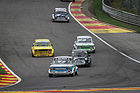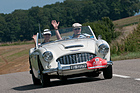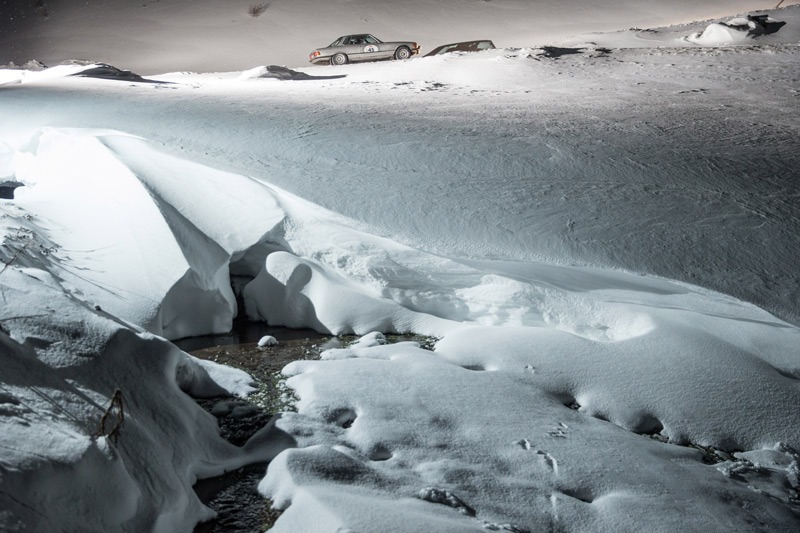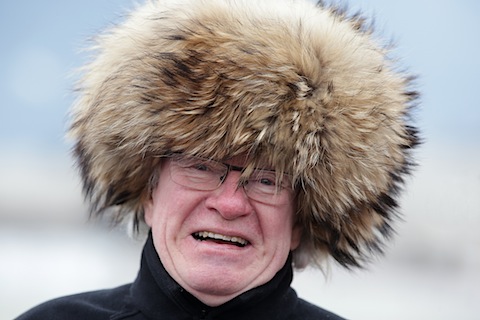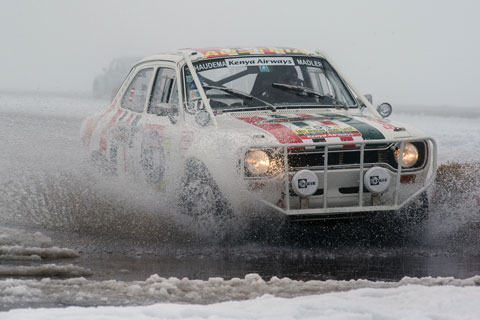
The classic car year 2014 has finally begun with the Planai Classic. Shortly after the turn of the year, the 18th event took place in the Enns Valley on January 4. Despite the depths of winter, at least according to the calendar, temperatures were relatively mild at the start. There was no sign of snow. The trotting track was neither frozen nor covered in snow. You could easily have ridden the first day on summer tires.

But all the cars were equipped for winter conditions and that was a good thing, because hardly anyone could have imagined how extreme the road conditions would change within a few hours.

Quester with problems
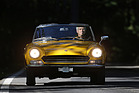
Dieter Quester, who had arrived from Vienna at the last moment, took a seat in a Volvo P 1800S. For some, this was a completely unfamiliar sight, as Dieter is primarily known as a BMW driver.

Well, the Austro-Swedish marriage didn't last long, as the Volvo couldn't even get the Quastl to Schladming. Serious technical problems forced the Querster-Glöckner pairing to switch to the extremely spacious Porsche 912 of a helpful competitor.
At the finish of the first day at Schloss Pichlarn, the pair had to be freed from the back seat of the "Stuttgart minibus" with a shoehorn.
Aaltonen in a winning mood
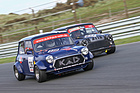
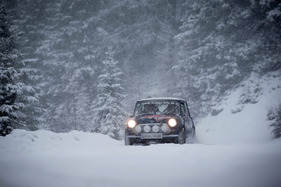
Rauno Aaltonen, who had traveled all the way from Finland, took over the dark blue Mini Cooper, as tradition almost dictates.
Things went better for the Finn than for Quester, much better in fact, as he mastered all the difficulties with absolute aplomb and ultimately won the rally with the "big" Mini. When asked how he actually came across the Mini back then, Aaltonen replied: "I saw a Mini parked at the time, six months before the first ones started competing in rallies, and immediately thought to myself that this was the ideal rally car." And he continued: "You can see from the outside whether a car is sporty and fast to drive. The prerequisite for this is a short overhang at the front and a moderate to no overhang at the rear; the wheels have to be far out. The car must also be as light and small as possible. At the time, the Mini was also the only car with a transverse engine that made it possible to design a car with a short front overhang."
When asked about the secret of the Mini's rally successes at the time, Rauno said: "I was a works driver at the time, together with Pat Moss. Our first rally was the Monte Carlo in 1962, and I stayed until 1968, when it closed. It was a great team, we had the best mechanics and the management was also excellent. Steward Turner was an excellent manager, everything was just right."

After two third places in previous years, he was able to win the Planai Classic for the first time exactly 57 years after his first rally success.
Where other participants followed strange tracks and drove into nirvana, Rauno and co-driver Helmut Artacker strictly adhered to the road book and did not allow themselves to be confused. When asked if he knew where the serpentine section of the 13th special stage was, he said with a laugh: "Yes, that was a 60 to 40 situation".
Confusing route
The route was indeed not easy to recognize, as the serpentines led around the hairpin bend further into the mountains, while on the special stage, however, you had to continue straight ahead at the start of the hairpin. As planned by the organizer, there were a few metres of snowy road with confusing tracks.
Many drivers picked up endless penalty points here and were therefore out of the running for overall victory.
Snow on day 2
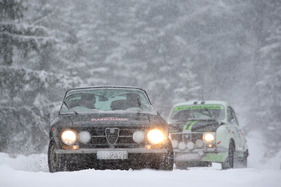
While the special stage at the Niederöblarn airfield was still rainy on Sunday morning, the long-awaited white splendor arrived just in time for the three Planai mountain stages.

The snowfall began at midday and never stopped. In just over four hours, a good 25 cm of fresh snow fell at an altitude of 1750 m. The road conditions changed from stage to stage. Lots of fresh snow and increasingly slippery conditions forced many co-drivers into the trunk. Weight on the rear axle was the be-all and end-all for rear-wheel drive vehicles.
The secret winners in the pre-war race car
One participant, who had so often amazed many competitors, probably outdid himself. With warming bags in their gloves and equipped with rain suits and helmets suitable for the high mountains, Christian and Margit Baier drove the oldest vehicle in the field, the 1927 Lea Francis, to an astonishing sixth place overall.

A winter rally in a pre-war car is and remains not for the faint-hearted, as it requires not only toughness, but also a great deal of meticulous preparation and subsequent care of the car.
You can only raise your hat to so much dedication and perseverance.
Results of the 18th Planai-Classic (overall classification)
1. Rauno Aaltonen/Helmut Artacker in a Mini Cooper (1972) (Fin/A)
2. Werner Fessl/Peter Schöggl in a Fiat 124 Coupé Abarth (1972) (A)
3. Günter Schwarzbauer/Erich Hemmelmayer in a Datsun 240Z (1972) (A)
4. Erich Laderl/Gilbert Raowsky in a Volvo 123 GT (1968) (CH)
5. Ingrid Corsmann/Thomas Voglar in a VW 1302 S (1972) (A)
6. Christian Baier/Margot Baier on Lea Francis P-Type (1927) (A) - winner class 1
7. Thomas Matzelberger/Martin Rettenbacher on MG A Coupé (1957) (A) - winner class 2
8. Franz Brachinger/Peter Rech in a BMW 2002 Tii (1972) (A)
9. Michael Haberl/Therea Moser in a Porsche 911 (1965) (A)
10. Wilfried Peters/Christian Mitterdorfer in a VW 1302S (1972) (A)
It is striking that all the usual drive concepts and all three rally classes can be found among the top ten overall finishers. Front and rear-wheel drive are just as well represented as front and rear engines. Only the mid-engine fraction, represented in the field by two Porsche 914s, did not make it into the top ten, but two high-traction Beetles did.
Combination car-ski competition
As every year, the "Grand Finale" of the Planai-Classic took place on the finish slope of the Planai downhill run. Ski legends and the best teams in the automobile classification held a combined competition.
Where the World Ski Championships took place almost a year ago, legendary ski racers such as Johann Kirchgasser, Reinhard Tritscher Ernst Riedelsperger and Thomas Schroll showed off their skills at the Planai Classic 2014.
Two runs were held, which had to be completed in as identical a time as possible. The top three managed to complete the course with a difference of just 0.04 seconds.
The lucky winners of the combined classification were the Volkswagen team of Ingrid Corsmann and Thomas Vogler with skiing legend Johann Kirchgasser. Second place went to Günter Schwarzbauer and Erich Hemmelmayer, supported by skiing legend Didi Queissner. Third place went to Rauno Aaltonen and Helmut Artacker with skiing legend Ernst Riedlsperger.