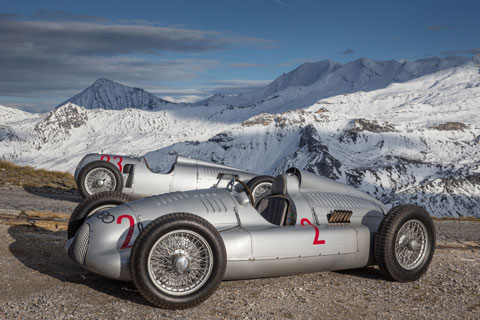
After a four-year break, the Rossfeld mountain race finally took place again last weekend. However, the last two postponements were not the only cancellations in its eventful history: The 1962 Alpen Bergpreis was canceled due to planning errors and scheduling conflicts, and the 1972 race was postponed due to the Olympic Rally in the same year. In the slipstream of the Olympic Games in Munich, it took place as a European Championship rally, which included a special stage over the Rossfeld.

Röhrl misses anniversary
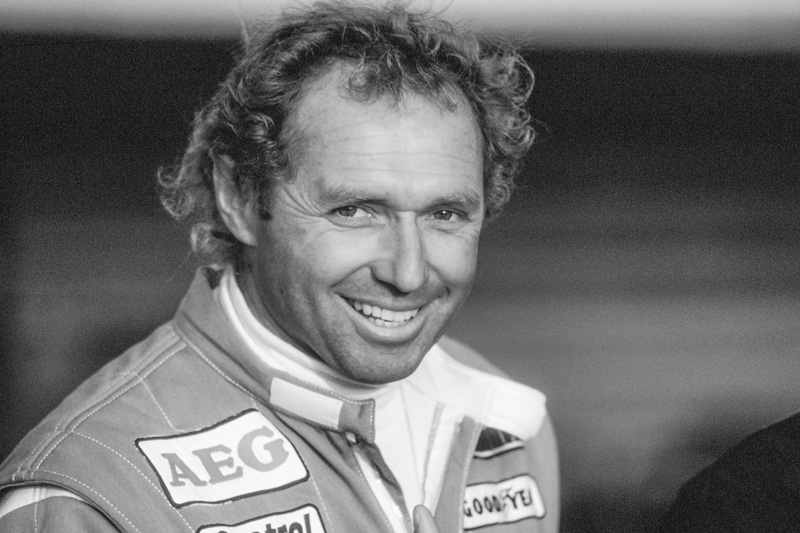
Rossfeld ambassador Walter Röhrl: "I would have celebrated a special anniversary at the - unfortunately postponed - 2020 edition: In 1970, I drove a Porsche in a rally for the first time at the international ADAC Bavaria Rally and exactly 50 years later to the day, I would have driven an exact replica of this car at the Rossfeld. It wasn't meant to be and now I'm starting two years later with this car. But this year I can celebrate another anniversary, which unfortunately came to an unfortunate end before the special stage at Rossfeld: in 1972 I drove a private Ford Capri in the Olympic Rally. I was in second place overall and only one minute behind the eventual winner, Bernard Darreiche in his Renault Alpine. An engine failure, with Munich almost in sight, put a spanner in the works. Despite the involuntary stop, this was the final start to my career, because I then signed my first works contract with Opel."

Large starting field
154 racing and rally cars and around 20 motorcycles lined up at the start and drove a total of six runs up the hill on the six-kilometer route in front of another large crowd. The first hill climb took place on this 548-metre course back in 1958. The course record of 2:39.35 is held by Christian Debias in a Ralt R1 F2 from 1977.

Audi Tradition sent an Audi 80 and an Urquattro with the two well-known drivers Harald Demuth and Stig Blomqvist to Berchtesgaden.

Lancia was most strongly represented with the Fulvia, the Delta, two Stratos and the 037.

Volkswagen also sent a small fleet to the Rossfeld.
Special single-seater
After 61 years, Tobias Aichele brought the Formula Junior Melkus-Wartburg back to the Rossfeld race. Nine of these loudly rattling and extremely fragrant vehicles lined up at the start of the largest meeting of Formula Junior racing cars with two-stroke engines.

Kurt Ahrens, who finished second in the 1961 Formula Junior race behind Gerhard Mitter (Lotus Mitter-DKW) in his Cooper Stanguellini, was also a guest in Berchtesgaden as a contemporary witness. In the Melkus with starting number 51, Heinz Melkus himself finished a respectable 4th place in this top-class field of starters at the time.
The indomitable Hartmann
With four Hartmann-DKW racing cars in the field, it is worth keeping an eye on this Alfred Hartmann (12.8.1910 - 5.5.2001) from Lusatia. Like so many others, Alfred Hartmann came to motorsport via motorcycles. In 1937, he achieved an outstanding 4th place in the European Championship of the time, which is equivalent to today's World Championship, with a loading pump DKW. In 1938, he competed in reliability and Alpine races - now known as rallies - with a DKW. Then came the Second World War, during which he lost his left arm due to a shell splinter. But even this could not stop him from continuing with his beloved sport.
He started rallies and long-distance competitions with one arm again. In the turmoil of the post-war period, Hartmann moved to Berchtesgaden, where he worked as a car salesman for VW dealer Hans Buchwinkler. It was here that he built up his new livelihood, benefiting from his close ties to DKW.

An excerpt from a special edition of "Automobil - Technik - Sport" from 1959 reads: "Alfred Hartmann is a well-known figure among motor sports enthusiasts. He enjoys the reputation of being a particularly fair sportsman, an excellent driver despite the loss of his left arm, and his skills in the field of tuning two-stroke engines and in the construction of sports and Formula Junior racing cars are of a high order. Word of Hartmann's skills spread throughout the world, with orders for engines and junior racing cars coming in from 18 countries, from Australia to Canada... He delivered around 70 racing engines worldwide."
In 1958, he began building his own Formula Junior racing cars. He founded the "Spezialbetrieb für Zweitakt-Hochleistungsmotoren", as well as the "Scuderia Hartmann Berchtesgaden". His first racing cars were based on the DKW 3=6. His best-known drivers were Eberhard Mahle, Kurt Ahrens and Walter Schatz. Three of the 15 or so racing cars produced between 1959 and 1961 were delivered to the former Yugoslavia, where they were allegedly used by the then President Tito in his own racing team.
In 1960, Alfred Hartmann retired from automobile racing after around 200 races and looked for a new field of activity. He handed over his business to Georg Köppl in 1963 and moved to Innsbruck, where he began working for OMV.
Pure enthusiasm
Joachim Althammer is the great initiator of the Mountain Prize and always manages to put on a unique event.
Not just for the fun of it, but also to support the region.

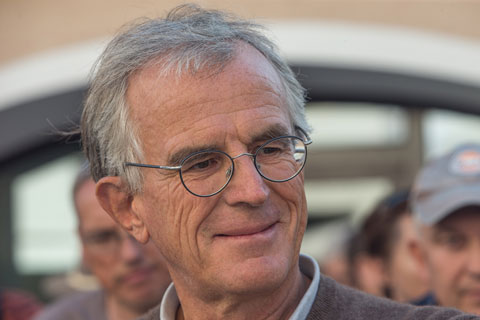
District Administrator Bernhard Kern says: "The best and most meaningful thing about the International Edelweiss Mountain Prize Rossfeld Berchtesgaden is the charity idea - all the net proceeds go to people with disabilities in Berchtesgadener Land and help to make their lives a little easier and more beautiful."

.jpg)